

Listen to the audio version of this article (generated by AI).
Elon Musk has never been accused of thinking small.
If you need proof, look no further than the SEC filings of Space Exploration Technologies Corp. (SPCX).
According to those documents, part of Musk’s restricted stock award is tied to what the company officially calls the “Mars Colony Milestone.”
We’re not talking about planting a flag on Mars or sending a handful of astronauts there one day.
SpaceX defines the milestone as establishing a permanent human colony on Mars with at least one million people. Musk’s award is also tied to a series of market-value targets that eventually climb as high as $6 trillion.
Folks, when a company is literally putting a million-person colony on Mars into its executive compensation plan, you can understand why investors get excited.
SpaceX has one of the greatest stories on Wall Street. This is Elon Musk’s rocket company – the business behind Starlink, reusable rockets and some of the most ambitious plans in the history of private spaceflight.
But a great story and a great stock are two very different things.
Back on June 12, I warned Market 360 readers about the hype surrounding SpaceX.
There had been a lot of fuss around the company’s initial public offering (IPO) back in mid-June. And it wasn’t hard to understand why.
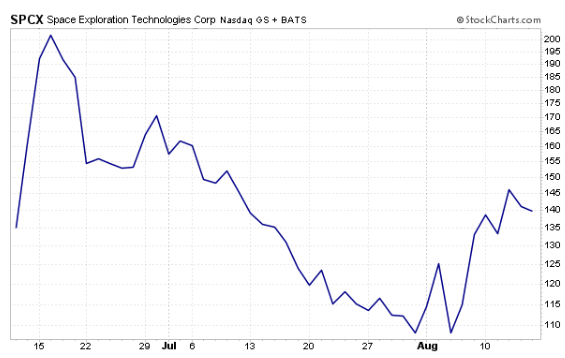
Investors rushed in, and SPCX surged about 40% in its first two days of trading.
But as I warned my followers, all that excitement didn’t automatically make SpaceX a sound investment.
I also warned that SpaceX’s unusually small public float could eventually put pressure on shares as restrictions on insider stock began to expire. That process started last week.
Since then, shareholders have gotten a crash course in the difference between a great story and a great stock. SPCX fell sharply from its post-IPO highs, dropping about 45% at one point, before rebounding again.
The stock is now roughly flat since it went public.
And this week, the company finally gave us something much more useful to evaluate than hype: its first earnings report.
So, in today’s Market 360, let’s take a closer look at what SpaceX actually reported and why its enormous AI spending has Wall Street nervous. Then I’ll share what this tells us about the increasingly difficult decisions investors face in today’s AI boom.
SpaceX Is Growing – But at an Enormous Cost
SpaceX reported second-quarter revenue of $7.8 billion, up about 92% year-over-year and ahead of analysts’ estimates of $6.8 billion.
That is serious growth, folks.
Starlink is generating recurring revenue. Falcon rockets continue launching satellites. And customers across aviation, maritime, telecommunications and defense are spending heavily on SpaceX’s services.
So, let me be clear: SpaceX is becoming a real commercial business. And a 92% increase in sales is exactly the kind of growth that gets my attention.
But sales growth is only one part of the equation. The company still posted a net loss of $541 million, or $0.09 per share, due largely to its enormous spending on AI and infrastructure.
SpaceX spent nearly $16 billion on AI infrastructure during the quarter, pushing its total capex to roughly $18.4 billion.
Think about that for a moment. SpaceX generated $7.8 billion in quarterly revenue. Yet it spent more than twice that amount during the same three months.
That doesn’t automatically make SpaceX a bad company or even a bad investment. Plenty of great businesses have gone through periods of enormous spending before generating huge profits.
But it does put the burden of proof on the company.
The question is not whether SpaceX can attract customers or grow sales. It clearly can.
The question is whether all that spending will eventually generate enough earnings and cash flow to justify the price investors are being asked to pay for the stock.
That matters especially because all of this is happening during one of the best earnings environments of my lifetime.
Our friends at FactSet report that the S&P 500 is currently on track to achieve 47.4% year-over-year earnings growth in the second quarter.
By the time NVIDIA Corporation (NVDA) and Micron Technology Inc. (MU) announce their earnings, it will likely be over 50%.
Folks, that is extraordinary. And this is why it’s vital we focus on fundamentally superior stocks.
Wall Street is willing to reward growth. But investors increasingly want to see that growth translate into stronger earnings and a clear path toward future profits.
That distinction is especially important in artificial intelligence.
AI Is Becoming a Capital-Allocation Story
Companies are spending staggering sums on chips, data centers, power, networking and other AI infrastructure. Goldman Sachs estimates that $1 trillion will be spent globally in 2026 alone.
But spending billions of dollars on AI doesn’t guarantee billions of dollars in profits.
Ultimately, the biggest winners will be the companies that can take those enormous investments and turn them into durable sales, earnings and cash flow.
And we’re already seeing evidence of that this earnings season.
Microsoft Corporation (MSFT) just reported 43% growth in Azure revenue, while its operating income climbed 18%. Alphabet Inc.’s (GOOG) Google Cloud revenue surged 82%, while Cloud operating income more than tripled to $8.8 billion. And Amazon.com Inc.’s (AMZN) Amazon Web Services grew 37%, with operating income jumping 64%.
These companies are spending enormous sums on AI, too. The difference is that they’re already showing investors where the payoff is coming from.
In other words, AI is becoming a capital-allocation story. And that principle applies to investors, too.
For decades, I’ve used quantitative analysis to help separate strong stocks from weak ones. That’s why I built the systems that eventually became Stock Grader (subscription required).
I wanted a disciplined way to cut through Wall Street’s noise and focus on companies with superior sales growth, earnings growth, earnings momentum and institutional buying pressure.
I’ll continue doing exactly that. But the AI boom has created another challenge.
Ever since OpenAI released ChatGPT to the public on November 30, 2022, my InvestorPlace colleagues and I have spent years digging into opportunities for investors to profit.
We’re talking about semiconductors, software, data centers, power generation, networking, cooling systems and plenty of other businesses that most investors never would have considered “AI stocks” a few years ago.
We’ve found some tremendous winners along the way.
But that success has also created a problem.
Over the past year alone, my colleagues and I have collectively issued more than 200 recommendations across our research.
Obviously, no individual investor should own more than 200 stocks simply because we happened to recommend them.
At some point, finding more ideas stops making your financial life easier. It starts making it harder.
Finding a Great Stock Is Only the First Decision
And that’s where stock selection gives way to portfolio construction.
Suppose Stock Grader helps you identify 10 fundamentally superior stocks. Or 20. Which ones deserve the most money? Which should play smaller roles? And how do you make sure those individually strong stocks actually fit together?
Those are different questions from simply asking whether a stock is a “buy.”
Think back to SpaceX for a moment. The company just reported 92% sales growth. That’s impressive.
Does that make SPCX a buy? Not for me – at least not yet. As I’ve said before, I want a full year of trading data before Stock Grader weighs in.
But identifying whether SpaceX eventually deserves a “buy” is only the first decision. If it does, how much should you own compared with every other fundamentally superior opportunity available to you?
The point is that the AI boom has given us a pretty nice problem, folks.
We no longer have to worry about good ideas. We have to worry about capital allocation.
So after 47 years in this business, I’ve decided I need to make a change…
A Major Change Is Coming on August 19
Back in 2023, I sat down with my InvestorPlace colleagues Luke Lango and Eric Fry to begin working on a project that grew directly out of the problem I just described.
Simply put, we’ve gone through InvestorPlace’s large universe of AI recommendations and selected what we consider our absolute best ideas.
The result was a portfolio of stocks that we considered the crème de la crème.
I’m proud to say that the portfolio has delivered a return of roughly 106%.
And since we last rebalanced it in December 2024, through July 23 this year, our picks have gained 58%. Meanwhile, the S&P 500 gained 24.4%, and the NASDAQ rose 25%.
After speaking to Luke and Eric, we all agreed it was high time for another rebalance.
The result? A newly rebuilt portfolio of roughly 20 stocks. And it all goes live on Wednesday, August 19.
But that’s not all. Next Wednesday, I will announce the biggest change to my role at InvestorPlace in decades.
And before anyone gets the wrong idea, I’m not going anywhere, and I’m certainly not giving up Stock Grader.
What is changing is the way I intend to approach the problem I’ve just described.
For most of my career, I’ve focused on helping readers find fundamentally superior stocks. But what’s become clear to me in the midst of this AI boom is that finding great picks is only part of the job.
While I can’t give you individual advice, my goal is to help investors better allocate all of these amazing picks into a portfolio that makes sense and delivers stellar risk-adjusted returns.
I’ll explain exactly what I mean on August 19. I hope you’ll join us.
You can go here to sign up for free now.
Sincerely,

Louis Navellier
Editor, Market 360
The Editor hereby discloses that as of the date of this email, the Editor, directly or indirectly, owns the following securities that are the subject of the commentary, analysis, opinions, advice, or recommendations in, or which are otherwise mentioned in, the essay set forth below:
Alphabet Inc. (GOOG), Micron Technology Inc. (MU) and NVIDIA Corporation (NVDA)
