

Listen to the audio version of this article (generated by AI).
Falling AI prices aren’t bearish… the gauge that signals the top… nearing last call for our experts revamped AI Revolution Portfolio… tomorrow’s inflation test
Below is a chart that bears have been circulating recently. It shows AI token prices collapsing – roundtripping from a spring peak all the way back to where they sat last December.
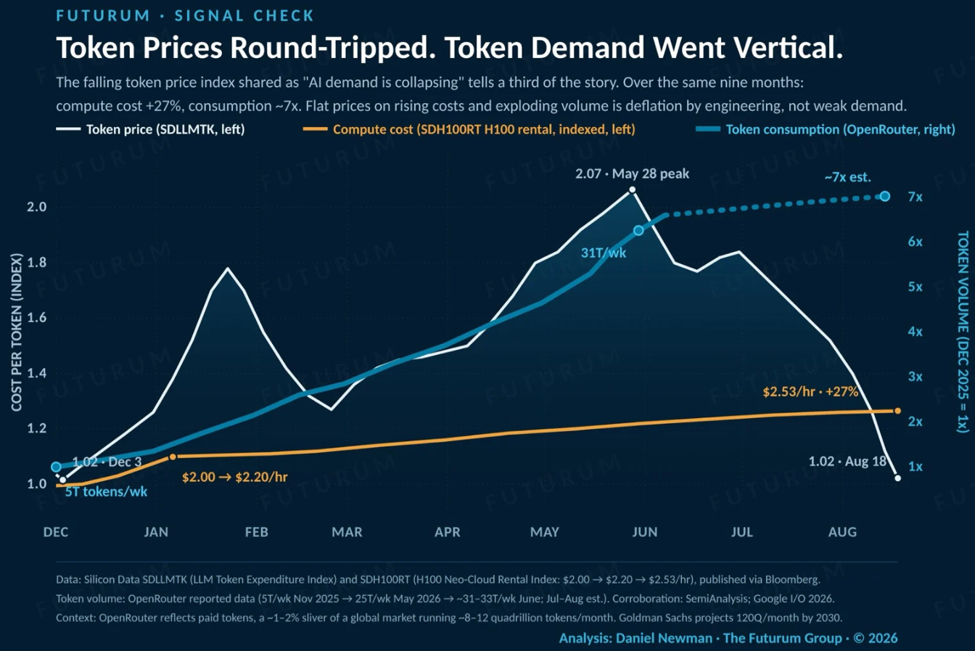
It looks bearish for AI – prices are falling, demand is dying, sell your AI names.
But our technology expert, Luke Lango of Innovation Investor, dismantled that fear in a recent piece:
In 1865, efficiency didn’t kill coal. In 2026, cheap tokens aren’t killing AI. They’re feeding it.
Luke is describing Jevons Paradox – an economic principle that explains what happens when a resource becomes cheaper to use. In 1865, William Stanley Jevons noticed that more efficient steam engines didn’t shrink Britain’s appetite for coal; they exploded it. Cheaper per unit coal made the commodity more accessible, and total consumption tripled by 1900.
Swap coal for tokens, and you have 2026.
Back to Luke for what the bearish argument misses:
Over those same nine months [that token prices have been falling], the underlying cost to rent H100 compute rose 27%, from $2.00 to $2.53 per hour – capacity didn’t get cheaper but scarcer…
Flat retail prices on rising wholesale costs and exploding volume isn’t weak demand. It’s deflation by engineering – labs passing efficiency gains through to customers, who respond by using vastly more.
That’s Jevons, playing out in real time.
Luke’s mention of “exploding volumes” isn’t hyperbole. For example, at the Google I/O 2026 conference in May, Alphabet CEO Sundar Pichai said that AI is using 3.2 quadrillion tokens per month, up sevenfold in a year.
Pichai joked:
I never imagined I’d say the word “Quadrillion” in an I/O keynote. But here we are.
So, I agree with Luke when he says that falling token costs don’t spell doom for the AI trade today.
What falling compute costs will mean when we look further out
Luke’s discussion of falling AI costs and Jevons Paradox is the front half of the dynamic I laid out for you in our July 15 Digest.
I used the analogy of a descending escalator. Usage growth is you trying to climb up it. Falling token prices are the escalator descending beneath your feet. Right now, Luke’s point is that you’re climbing far faster than the escalator declines, so total AI spending keeps rising (upward progress on the escalator), and the infrastructure names keep winning.
We are unambiguously in that phase today – and it’s bullish for the AI infrastructure trade. But here’s what I flagged back in that July Digest:
At some point in the future, token prices will fall far enough, or usage growth will mature enough, that the balance will flip – and when it does, the AI trade will reach a key inflection point.
This “flip” will serve as a massive sifting mechanism for the broader AI trade. When cumulative progress on the escalator changes from “up” to “down,” it will usher in new winners and losers in the broader AI complex.
The companies most exposed will be the ones whose whole business is renting out compute by the unit. Their pricing power depends on scarcity. When compute stops being scarce, that pricing power goes with it.
On the other hand, AI users will benefit tremendously from this flip. Companies that adopt AI as a tool inside their existing business will see expanding margins every time their AI bill shrinks.
The gauge to watch – and what it’s telling us today
For an indicator about when this flip will happen, watch the companies whose entire business is renting out computing power or selling the chips inside it. I’m talking about the specialized data-center operators the industry calls “neoclouds,” like CoreWeave Inc. (CRWV) and Nebius Group (NBIS). They make money on the same bet: that computing power stays scarce.
Right now, that bet is paying off spectacularly. CoreWeave reported earnings earlier this month, and the numbers were spectacular. But for our purposes today, the real story was about pricing.
Here’s CoreWeave’s CEO, Michael Intrator, on the new contracts the company is signing:
…the customer contracts we signed came with contribution margins we expect to be 5 to 10 percentage points above those added in recent quarters.
In plain English: customers are paying CoreWeave more, not less, for access to compute.
That’s pricing power – you on the escalator, racing higher with ease. If you’re waiting for a sign that the boom is cracking, this report was the opposite.
So, what would the crack look like?
The very same dynamic in reverse.
Watch for the quarter when a CoreWeave or Nebius stops bragging about fatter margins and quietly starts reporting thinner ones. That’s the moment rising costs stop getting passed along – the tell that computing power is finally going from scarce to abundant. The day that happens is the day you’re going to need to look long and hard at your portfolio.
We’re not there today – and we may not be for a good while. But now you know what to look for.
But massive compute demand today doesn’t mean your AI portfolio isn’t in need of a refresh
Some of yesterday’s winners could now carry outsized weights in your portfolio after monster run-ups. Other positions might have panned out as expected. And companies that weren’t on your radar 12 months ago might now be the best place for your money over the next 12 months.
That’s why Luke, alongside Louis Navellier and Eric Fry, spent weeks rebuilding their AI Revolution Portfolio from scratch – and why Louis has stepped into a new role to manage it.
The rebuilt portfolio is live now – along with the new AI Revolution Position-Size Calculator, which tells you exactly how much to buy of each stock. There’s also Eric’s report on the AI stocks to sell before the next shakeout, Luke’s report on the one stock he believes has true 100X potential this cycle, and a recorded board meeting where all three walk through every position and why it earned its slot.
We’re taking down the free replay later this week, so if you’ve been meaning to watch, I’d recommend you take a look ASAP. You can check it out right here.
One more risk to the AI trade we’re tracking
The token-cost escalator is a slow-burn risk to your AI positions. But there’s another we’ve been tracking for months, which got the lead story in yesterday’s Digest – political risk.
We highlighted legendary investor Louis Navellier, who said we should not be worried about data center moratoriums. He noted that the buildout is still set to nearly double the number of U.S. data centers, and the way to profit is to stay invested.
In last week’s Innovation Investor Daily Notes, Luke chimed in. Like Louis, he isn’t worried about data center backlash today, but he is concerned about tomorrow – and has a specific timeframe in view for when it could hit investor portfolios:
The scenario that would actually threaten the AI infrastructure supercycle requires two things to happen simultaneously:
State-level restrictions hardening from temporary pauses into permanent structural barriers across enough major markets that geographic rerouting becomes difficult, and a federal policy shift — most plausibly tied to the 2028 election cycle — that removes the current administration’s active support for the buildout.
To Luke’s point, sentiment against data centers is souring – and doing so rapidly.
In March, Gallup ran a survey finding that 71% of Americans would oppose the construction of a data center in their area. By comparison, only 53% would push back against a nuclear power plant.
But while this is a growing risk, it’s not fully here right now. Back to Luke:
Neither of those conditions exists today. Both are plausible over a multi-year horizon.
That is precisely why we characterize this as the risk most likely to eventually end the AI bull market, while being clear that ‘eventually’ means 2028 or later, not this earnings season or even this year.
More immediately, Luke is looking for strong numbers from Nvidia (NVDA) tomorrow to reignite the AI trade. The AI leader reports earnings just after the closing bell.
Back to Luke:
A strong print would meaningfully de-risk the technical picture heading into the seasonally choppier October window.
We’ll keep you updated with Luke’s thinking/analysis on the data center risk over the coming quarters – as well as Nvidia’s results.
Before we go – tomorrow’s inflation test
Tomorrow brings the latest Personal Consumption Expenditures (PCE) report, and it lands with the committee more divided than it’s been in years.
As we’ve covered here in the Digest, new Fed Chair Kevin Warsh prefers the “trimmed” PCE data that strips out the wildest price swings – and by that yardstick, near 2.3%, inflation is nearly back to target.
But three regional Fed presidents – Logan, Kashkari, and Hammack – look at core inflation still stuck in the low 3s after five years above target. They were alarmed enough to vote to hike rates outright in July.
What accounts for their different take on inflation?
Fear.
Warsh fears choking off the economy over a temporary oil-driven price spike that will fade on its own. The hawks fear the opposite: keep calling every shock “temporary,” and high inflation quietly becomes the new normal – the kind you need a recession to break.
Since Warsh is all about data, watch tomorrow’s PCE and trimmed mean PCE for how broad the price pressure is.
Compare headline PCE to core PCE (core strips out food and energy). If headline PCE is hot but core is tame, the heat is concentrated in energy – the pressure is narrow. If the core is also hot, it’s spread beyond energy – the pressure is broad.
As for the Dallas Fed’s trimmed-mean PCE, if it stays near 2.3%, that’s a win for “no hikes.” But if it jumps substantially, a September hike is increasingly in play.
Then, all eyes shift to Friday and Warsh’s first Jackson Hole speech – but don’t expect him to tip his hand.
He’s pre-billed this speech as big-picture rather than policy, and this year’s theme conveniently lets him talk financial plumbing instead of interest rates. So, we should expect him to say a whole lot of nothing.
But even a chair who hates giving signals might leak a few. So, watch his tone on inflation – and perhaps little clues like whether he calls the trend “favorable.” On the other hand, he might use terms like “vigilant” and/or “unfinished,” which echo the hawks.
We’ll monitor and report back.
Wrapping up, none of today’s risks – cheap tokens, the data-center backlash, a divided Fed – is a reason to step away from AI right now. But each one is worth watching as they have portfolio-shaking potential when they shift.
We’ll keep tracking it with you here in the Digest.
Have a good evening,
Jeff Remsburg
