

Revenue, capacity expansion, and infrastructure orders are showing that real demand is starting to justify the spending
Listen to the audio version of this article (generated by AI).
Editor’s note: “Microsoft, TSM, and Cisco Are Breaking the AI Bubble Narrative” was previously published in July 2026 with the title “The AI Capex Bear Case Just Lost Its Best Argument.” It has since been updated to include the most relevant information available.
When the first American railroads began reporting revenue in the 1840s, the critics who had called the whole enterprise an overbuilt fantasy found themselves with less and less to say.
Something similar is happening in AI right now.
Exponential View just published the most comprehensive accounting of the AI economy we’ve yet seen – its State of the AI Economy 2026 report – with real revenue, utilization, and capex payback math.
Then Microsoft (MSFT), Taiwan Semiconductor (TSM), and Cisco (CSCO) delivered earnings that pointed in the same direction. Customers are paying for AI. Suppliers are expanding to meet the demand. And infrastructure orders keep piling up.
The tracks are still being laid. But paying freight is already moving across them.
The bear narrative now has a lot less room to breathe.
AI Revenue Has Reached a $175 Billion Annualized Run Rate
Exponential View’s report estimates the global ex-China Generative AI (GenAI) economy is producing $175 billion in annualized revenue. And before anyone accuses Exponential View of creative accounting – this figure excludes chips, AI ad uplift, legacy software “AI features,” and financing.
In other words, it is only reflecting real customer demand.
Now, $175 billion in run-rate revenue sounds massive – and it is. But let’s contextualize that number.
At $175 billion, the GenAI economy is already big enough to prove that real customers are paying for this technology. Revenue is scaling. Demand is showing up. The buildout is no longer running on demos and promises alone.
At the same time, AI has barely started working its way into all the industries, businesses, and daily tasks it could eventually reshape.
That is the sweet spot for investors – enough revenue to validate the thesis, with a huge amount of growth still ahead.
Because here’s the thing those relative numbers don’t capture: speed. AI revenue relative to GDP is already up 10x from Q1 2024. GenAI is scaling 3x faster than prior IT waves – faster than the internet and mobile booms. In 2023, the AI economy needed 180 days to add $1 billion of cumulative revenue. Today it needs less than two days. That is a 90x acceleration in the speed of revenue generation. Recent quarter-over-quarter growth is running ~35%, which annualizes to more than 3x.
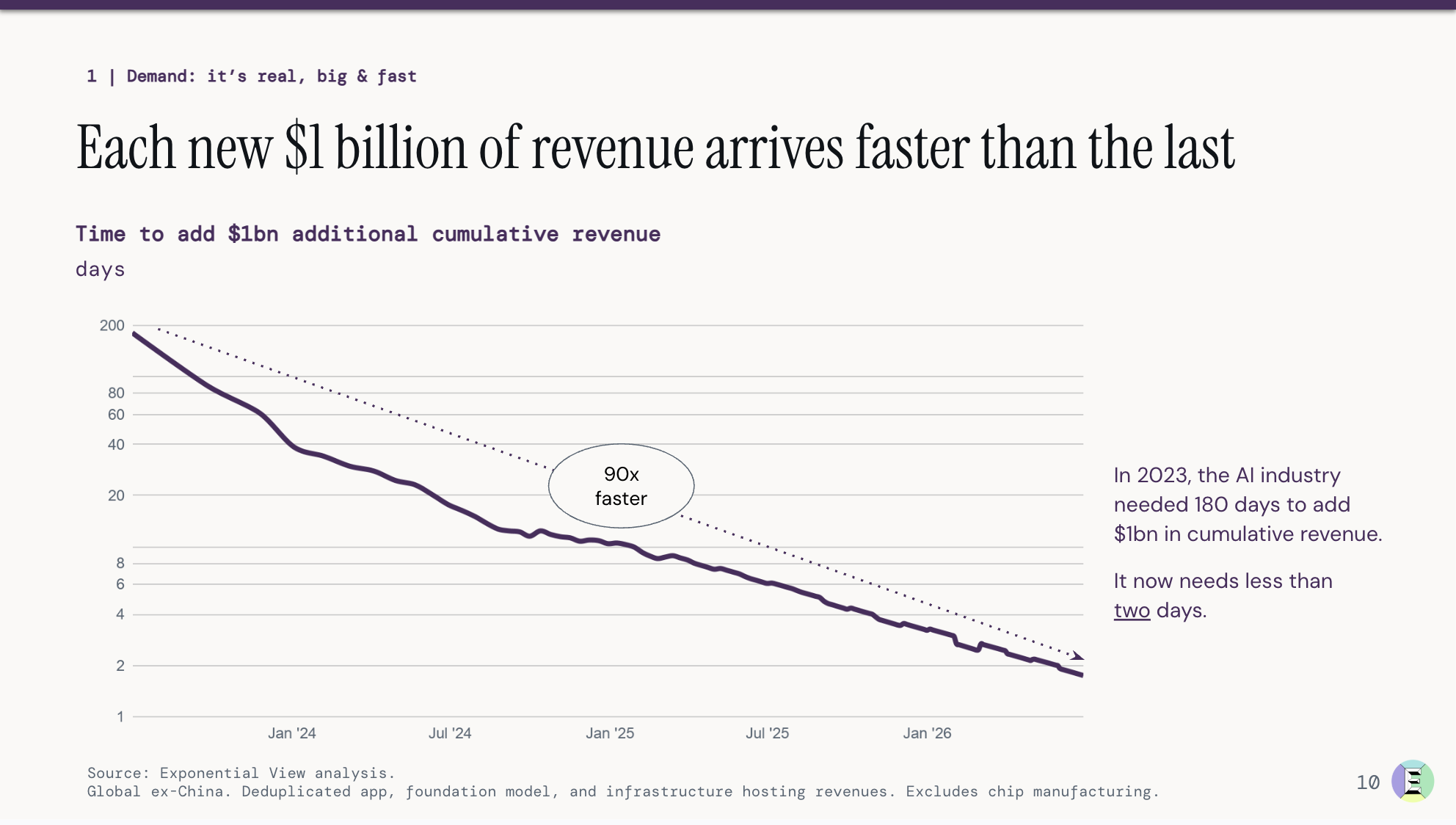
The penetration curve is in the very earliest innings of a generational platform shift – and the data proves it.
AI Capex Is Starting to Clear Its First Payback Test
And the spending debate just got even bigger.
T. Rowe Price (TROW) technology investor Dom Rizzo believes AI-related capital spending could hit $1.6 trillion in 2027. That sits well above the current Wall Street consensus, but it shows how quickly expectations are moving.
Rizzo sees echoes of 1998, when semiconductor revenue was still climbing and the companies funding the buildout had the cash to keep going.
Bears look at a $1.6 trillion spending bill and see a bubble. The numbers are starting to push back.
The AI economy is now generating enough revenue to cover depreciation: the ongoing cost of using up the infrastructure built to run it. Not with room to spare, but the gap has closed, and the direction is positive.
For every dollar of AI infrastructure that depreciates, roughly $1.19 in hyperscaler and neocloud revenue is coming in to cover it – and $1.32 when you count the full GenAI economy. A year ago, that ratio was below 1. Now it’s above it.
Demand on One Side, Capacity on the Other
Then Microsoft showed us where the money is coming from.
The company closed its fiscal fourth quarter with $90 billion in revenue. Microsoft Cloud grew 27% to $59.3 billion. Azure jumped 43%. Commercial revenue already under contract rose to $678 billion. And Microsoft 365 Copilot passed 30 million paid seats.
That is the demand side of the story: paying users, faster cloud growth, and an enormous amount of business already under contract.
Taiwan Semiconductor is seeing the same boom from the other side of the supply chain. The world’s leading chip manufacturer generated $40.2 billion in Q2 revenue, guided to between $44.6 billion and $45.8 billion for the current quarter, and raised its 2026 capital budget to $60–$64 billion.
Microsoft shows the customers arriving. TSM shows the suppliers racing to keep up.
Of course, none of this means every AI data center has already earned back its cost. Power, labor, leases, financing, and plenty of other expenses still have to be covered.
But the buildout has cleared its first real economic hurdle. Revenue is keeping pace with estimated depreciation, and neither customers nor suppliers are pulling back.
The old idea that Big Tech is building a bunch of empty AI factories is getting much harder to defend.
Why Cheaper AI Can Increase Infrastructure Demand
One of the more sophisticated bear arguments has to do with token cost. Some believe that as token prices continue to collapse – with blended pricing falling from ~$17 per million tokens to ~$2 – AI companies are destroying the economics of the industry.
‘Margins are going to zero. The boom is over.’
But that argument confuses price with value – and ignores how technology adoption actually works.
For technologies with elastic demand, falling prices create value; cheaper tokens = more use cases.
Better models expand what AI can actually do. Reasoning models consume more tokens as they think through complex problems. So the very thing bears are pointing to as a headwind – price compression – is actually the accelerant for the next leg of volume growth.
More apps, more agents, more inference, more memory, more networking, more storage, more power, more cooling, more data centers…
The Jevons paradox – the observation that efficiency improvements in resource use lead to increased total consumption – is playing out in real time across the AI infrastructure stack.
Rizzo expects that rising usage to spread across two kinds of models: open and lower-cost systems handling as much as 80% of token volume, while the most capable proprietary models capture most of the economic value.
The cheaper models will handle routine work at enormous scale. The premium models will take the hardest, highest-value jobs.
And either way, the chips keep running.
Why Enterprise AI Shows Up in Productivity Before Revenue
Seven in 10 AI benefits cited by S&P 500 companies involve lower costs, faster work, more output, or better quality. Only about 6% point to direct revenue gains. The first killer enterprise AI app is not “create a magical new business line.” It’s “do the same work faster, cheaper, better.”
This is actually the normal pattern for platform shifts. The efficiency wave always comes first. Productivity gains show up in margins and labor leverage before they show up in GDP or revenue. The internet’s first decade was dominated by cost reduction and efficiency. Revenue came later – and when it came, it was enormous.
AI is following the same path: efficiency first, new revenue later. And if the efficiency wave alone is already supporting $175 billion in annualized demand, the next phase could be much larger.
What This Means for AI Stocks
The macro data on AI has never been more bullish. The micro data – real company revenues, utilization trends, and capex payback – is inflecting positively. And yet AI stocks have been choppy, volatile, and in some cases well off their highs.
That combination – improving fundamentals, weak stock prices – is the definition of a buying opportunity.
Cisco’s latest quarter offers a fresh example. Networking revenue rose 28% year over year, while AI infrastructure orders reached $9.3 billion for fiscal 2026. Its shares still fell as investors focused on narrower margins. Demand is real, but Wall Street is becoming more selective about which companies can turn that demand into lasting profits.
The names best positioned to benefit from this data are across the full AI Builder stack:
- Chips and semiconductors
- Memory
- Networking and optics
- Servers and infrastructure
- Power and cooling
The Bottom Line: AI Revenue Is Starting to Catch the Capex
For the past two years, the biggest question surrounding AI was if this technology would ever make enough money to justify all the spending.
We are starting to get the answer.
Exponential View’s math shows AI revenue now covering estimated infrastructure depreciation. Microsoft is turning AI into faster cloud growth, paid Copilot seats, and a massive contracted backlog. TSM is expanding capacity to keep up. Cisco is booking billions in AI networking orders.
And one respected technology investor now believes annual AI spending could reach $1.6 trillion in 2027.
There are still real risks. Some projects will disappoint. Margins will get squeezed. Financing costs and valuations will matter.
But the simplest version of the bear case – that nobody would pay enough for AI to support the infrastructure underneath it – is losing its footing.
That does not make every AI stock a buy. It makes choosing the right stocks, fitting them together, and deciding how much capital each one deserves even more important.
After combing through more than 200 AI recommendations, Louis Navellier, Eric Fry, and I narrowed the field to roughly 20 stocks we believe deserve capital now.
We also assigned a recommended allocation to every holding, so investors can see how we think the positions should fit together and how much each idea deserves.
We’ll be unveiling this newly rebuilt portfolio this Wednesday, August 19. Join us to see which stocks made the cut.
