


Editor’s Note — This article is sponsored by Grocery TV. As with all sponsored content in Fintech Takes, this article was written, edited, and published by me, Alex Johnson. I hope you enjoy it!
If your entire product lives behind a pane of glass that everyone carries in their pocket, how do you stand out?
That’s the core problem for every B2C fintech company competing for customers, and most don’t have a great answer. If you’re an app on someone’s phone, there’s only so much that digital advertising and a good-looking logo can do.
So if you’re a B2C fintech company, two questions follow:
- How do you find the specific customer segment(s) that your product is best suited for?
- How do you appear to customers at the exact moment they’re open to considering a new financial services provider?
When it comes to B2C fintech companies offering payments and lending products, both answers point to the same place: one that reaches 95 million people weekly, self-sorts by income and spending behavior, and catches them at the moment they’re deciding how to transact.
What I’m hinting at – bear with me, I know this may sound bizarre – is the grocery store.
Segmentation
Digital advertising is tantalizing. It puts every customer, theoretically, on the table.
Trust me, this is a trap! Truly great products are never generic. They’re built to solve a specific problem for a specific set of people, and the marketing should be just as specific.
Grocery stores turn out to be one of the most accurately segmented environments for finding the customers you care about. I’ve had enough conversations with people who build credit risk and customer segmentation models to know this firsthand. Their job is to analyze data (such as bank transaction data) to figure out who you are and how risky you are. What they’ll tell you is that where someone shops for groceries is an incredibly strong predictor of their income, and how careful they are with their spending.
Put simply, where you buy groceries signals what you can afford and what you value.
Take Whole Foods versus Costco. Both skew affluent, but one shopper may be paying a premium for organic food and another for being proudly cheap. Interestingly, a recent YouGov survey found Costco is the primary supermarket for 11% of Americans earning $150,000 or more, the largest segment of high-income consumers at grocery retailers, despite an annual membership fee that would send plenty of shoppers elsewhere.
That willingness to become a Costco member indicates something beyond groceries. Someone already paying for the privilege of shopping at Costco may be an easier sell on an annual-fee credit card with strong rewards than someone who balks at fees altogether. That’s less a demographic fact than a psychographic one, and it’s the kind of signal a credit card issuer can build a targeting strategy around.
Every supermarket comes with a clear demographic picture of its base; no personal data required.
Open Wallet
Finding where customers are is only half the job. Reaching them at a moment when they’re open to reconsidering their financial habits requires perfect timing.
The payments industry is obsessed with “top of wallet”. Every card issuer wants to be the default card on top. But let’s flip the wallet on its side for a moment: When is it open, and when is it closed?
Most advertising catches people when their wallet’s closed, like when someone’s scrolling on their couch.
Now imagine yourself standing at a register, groceries moving down the belt, the total rising with every beep. You reach for your wallet (or phone) and decide which card fits this week’s budget. That’s an open wallet moment, and they’re remarkably rare.
Buy Now, Pay Later is a useful example here. Its success has everything to do with the fact that it’s an open wallet moment. But it answers the inverse question. BNPL exists for people who want something they can’t afford. Supermarket shoppers are going to buy groceries. That’s a foregone conclusion. What’s interesting are the questions that come to mind when you’re buying groceries, regardless of whether you shop at Whole Foods, Walmart: What will this leave me for the week? Am I spending too much? Is the card in my hand doing enough for me?
And shoppers have time to wonder. The average shopper stands at checkout for about four and a half minutes.
What It Looks Like
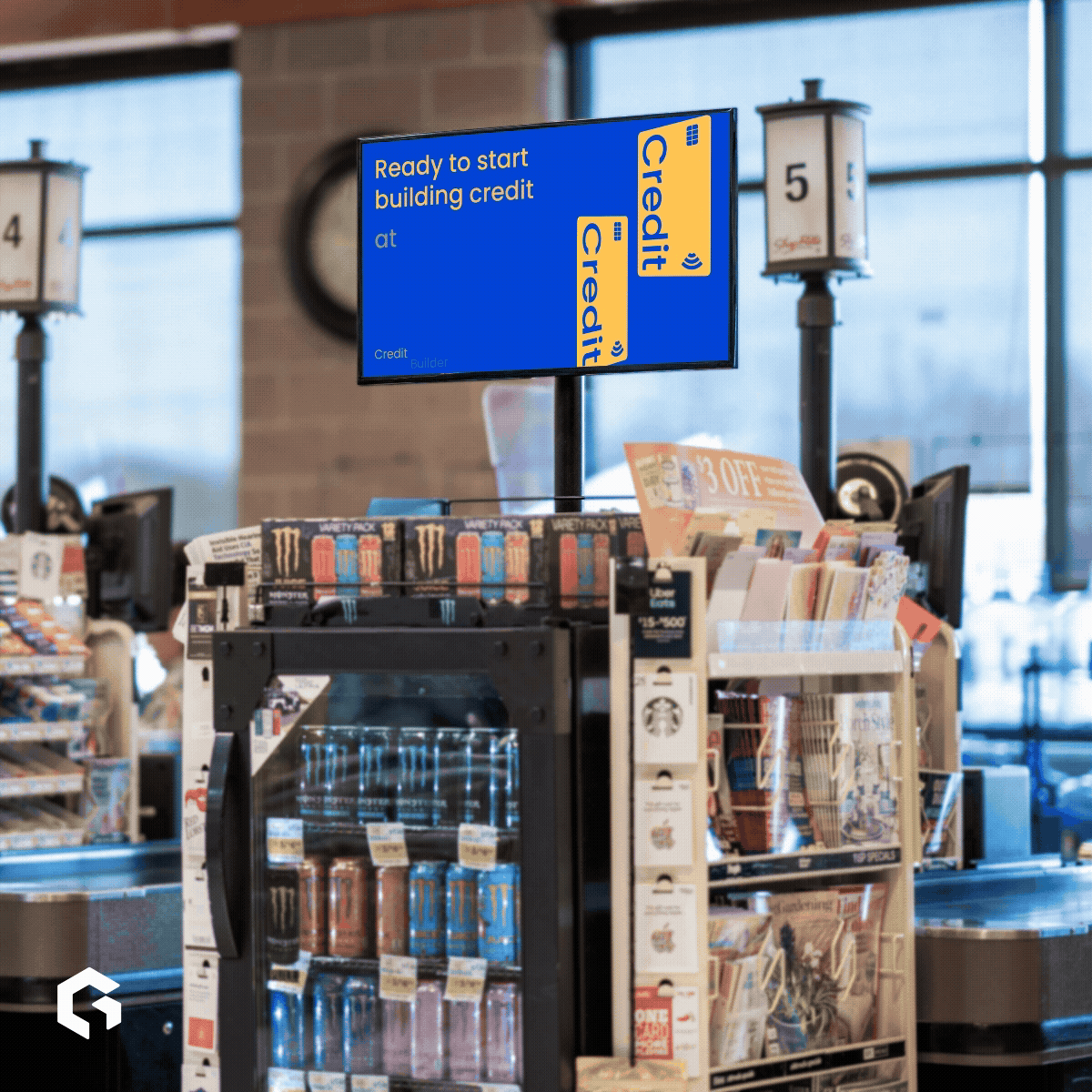
Digitally native fintech companies tend to underestimate the value of physical presence when it comes to advertising and marketing. Plus, certain forms of brick-and-mortar advertising may look horrifically expensive to early-stage fintech companies watching their burn rate (there’s a reason SoFi put its name on a stadium when it did).
For all our focus on URLs, we still live IRL. We drive by bank branches, attend games at stadiums, and go to grocery stores.
Financial products carry unusually high stakes, so consumers look for real-world proof that a company is solid enough to trust with their money. Advertising on, say, a screen in a grocery store isn’t the same as having a branch. But it is physical, and part of the community in a way that an ad in Instagram isn’t.
For a category that lives entirely on someone’s phone, a physical presence carries more weight than another digital impression.
When fintech brands have run the test, the numbers are hard to dismiss.
In-store advertising reaches more people than any single channel since lots of people at the grocery store aren’t reachable anywhere else.
For example, a credit card campaign that partnered with Grocery TV, the largest retail media network inside physical grocery stores, found that +24% more shoppers recognized the brand unprompted, and 18% more say they’d recommend it. At a checkout line where someone is already deciding which card to use, that’s the right message for the moment.
For B2C fintech companies, grocery checkout resolves the two major questions that anyone working on customer acquisition needs to reckon with.
How do you find the specific customer segment your product was built for?
Go where they’ve already sorted themselves.
How do you reach them when they’re open to reconsidering their financial choices?
Go where their wallet is already out.
