Forex Swap Fees Explained: How Overnight Charges Work
If you’ve ever held a forex trade overnight and noticed a small charge, or occasionally a small credit, on your account the next morning, you’ve met the forex swap. It’s easy to ignore on a single night, but for traders who hold positions for days or weeks, swap fees can quietly take a big share of the profit. This guide explains forex swap fees in plain English: why they exist, how to calculate them, when they’re tripled, and how to keep them under control.
Quick summary
- Forex swap fees (also called rollover or overnight financing) are charged or paid when you keep a position open past the broker’s daily cut-off.
- They come from the interest rate difference between the two currencies, plus the broker’s markup.
- At an example swap of −6.5 points, holding 1 lot of EUR/USD costs about $6.50 a night, or about $195 over 30 days.
- Many brokers apply three days of swap on one weekday to cover the weekend.
What are forex swap fees?
When you trade a currency pair, you’re effectively borrowing one currency to buy another. Each currency has its own interest rate, set mainly by its central bank. If you hold the position overnight, you pay interest on the currency you’ve “borrowed” and earn interest on the one you’ve “bought”.
The difference between the two, adjusted by your broker, is the swap:
- If the currency you bought has a higher interest rate than the one you sold, the swap may be positive, and you receive a small credit.
- If it has a lower rate, the swap is negative, and you pay a charge.
In practice, brokers add a markup, so swaps are often negative in both directions on many pairs. The swap is applied at the broker’s daily rollover time, commonly around 5 p.m. New York time, which marks the end of the trading day in forex.
How brokers show swap rates
Most trading platforms list two swap rates for each pair, one for long (buy) positions and one for short (sell) positions, usually in points per standard lot per night. On many platforms, 1 point = 0.1 pip.
Example quote (illustrative only):
| EUR/USD | Swap per standard lot per night |
|---|---|
| Long (buy) | −6.5 points |
| Short (sell) | +2.0 points |
On EUR/USD with a US dollar account, 1 point on 1 standard lot is worth about $1. So in this example, holding 1 lot long costs about $6.50 a night, while holding it short earns about $2.00 a night.
You can find your broker’s actual rates in the platform, usually under the pair’s contract specifications or symbol details. They change regularly as interest rates move.
How to calculate forex swap fees
Swap per night = swap rate (points) × value of 1 point × lots
Using the example rate of −6.5 points on EUR/USD:
| Position size | Cost per night |
|---|---|
| 1 standard lot | about $6.50 |
| 0.1 lot (mini) | about $0.65 |
| 0.01 lot (micro) | about $0.07 |
The value of a point depends on the pair and your account currency, just like pip value. Our pip value calculator shows what a pip is worth on any pair; a point is one-tenth of that on most platforms.
Where the number comes from
Behind the scenes, the swap roughly reflects the interest rate gap on the full position size. One lot of EUR/USD at 1.0850 controls about $108,500. If the interest rate difference against you were 1.75% a year, the cost before any broker markup would be about:
$108,500 × 1.75% ÷ 365 ≈ $5.20 a night
The broker’s quoted swap is usually a little worse than this, because it includes their markup.
Triple swap days
The forex market is closed at weekends, but interest still accrues. To account for this, most brokers charge three days of swap on one weekday, often Wednesday, because of how currency trades settle. Some instruments use a different day, so check your broker’s schedule.
At −6.5 points, holding 1 lot of EUR/USD past the rollover on the triple-swap day costs about $19.50 for that night.
How swap fees add up over time
Holding a position for weeks turns a small nightly charge into a real cost. At the example rate of −6.5 points on 1 lot:
| Holding period | Approximate swap cost |
|---|---|
| 1 night | about $6.50 |
| 1 week (including one triple day) | about $45.50 |
| 30 days | about $195 |
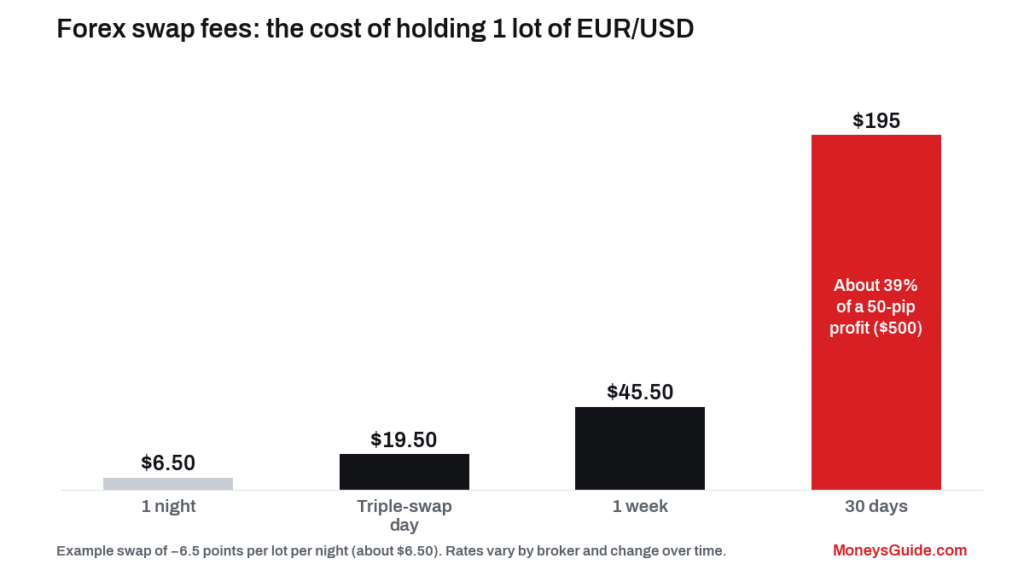
Now compare that with your profit. If the trade made 50 pips on 1 lot, that’s $500. A month of swaps at $195 would take about 39% of it. On a 0.1-lot position, the same month costs about $19.50, which is smaller in dollars but the same share of the profit.
Positive swaps and the carry trade
When the currency you buy pays meaningfully higher interest than the one you sell, the swap can be positive, and you get paid for holding the trade. Some traders deliberately look for these pairs, which is known as a carry trade.
At an example +2.0 points a night, 1 lot held for 30 days would earn about $60. But be careful:
- Price moves matter far more. A small move against you can wipe out months of positive swap.
- Rates change. Central bank decisions can turn a positive swap negative.
- Markups apply. Some brokers’ markups mean even the “positive” side earns very little.
Who needs to worry about swap fees?
- Day traders who close positions before the rollover time usually don’t pay swaps at all.
- Swing traders holding for days or weeks should include swaps in their trade planning.
- Position traders holding for months can find swaps are one of their biggest costs. Holding large positions for a long time also ties up margin (see what yours needs with our margin calculator), so see our forex margin call example.
- Gold, indices and other CFDs also carry overnight financing charges, often calculated differently. Check your broker’s terms.
Swap-free accounts
Some brokers offer swap-free accounts, sometimes called Islamic accounts, which don’t charge or pay overnight interest. They often replace swaps with a fixed holding fee after a set number of days, or with wider spreads, so they aren’t necessarily cheaper. Compare the full cost before switching.
How to reduce forex swap fees
- Check the swap before you enter. Look up both the long and short rates for the pair.
- Close before rollover if your strategy allows, especially before the triple-swap day.
- Size positions sensibly. Swaps scale with lot size, just like profits and losses. See how to calculate lot size in forex, or use our position size calculator.
- Favour the cheaper direction when two trades look equally good.
- Compare brokers. Swap markups vary a lot between brokers.
- Factor swaps into your risk-reward. A trade with a long expected holding time needs a bigger target to cover them. See risk-reward ratio in forex and the 2% rule in forex.
Common mistakes
- Ignoring swaps on long-term trades, then wondering where the profit went
- Forgetting the triple-swap day
- Chasing positive swaps while ignoring the price risk
- Assuming swap-free accounts have no costs
- Using old swap rates. They change as interest rates move.
Understanding forex swap fees turns a mysterious overnight charge into a cost you can plan for, and sometimes avoid altogether.
A word on risk
Forex trading with leverage carries a high level of risk, and many retail traders lose money. Regulators such as the Commodity Futures Trading Commission have warned the public about the risks of retail forex trading and fraud. Only trade with money you can afford to lose.
Frequently asked questions
What is a swap fee in forex?
It’s the interest charged or paid when you hold a forex position past the broker’s daily rollover time. It reflects the interest rate difference between the two currencies, plus the broker’s markup.
How do I calculate forex swap fees?
Multiply the broker’s swap rate (in points) by the value of one point and by your number of lots. At −6.5 points on 1 lot of EUR/USD, that’s about $6.50 a night.
Why are swaps tripled on Wednesday?
Because positions held over the weekend still accrue interest. Many brokers apply the weekend’s swaps on Wednesday because of how currency trades settle.
Do I pay swap fees if I close my trade the same day?
Usually not. Swaps apply only to positions still open at the broker’s rollover time.
Can swap fees be positive?
Yes. If the currency you bought has a sufficiently higher interest rate than the one you sold, you may earn a small daily credit, after the broker’s markup.
This article is for education only and is not financial or trading advice. Swap rates shown are examples; check your broker’s current rates. Forex and leveraged trading carry a high level of risk and can result in losses that exceed your deposit.