Forex Lots Explained: Standard, Mini and Micro
In forex, you don’t buy “one euro” or “ten dollars”. You trade in set amounts called lots. Your forex lot size is one of the most important choices on any trade, because it decides how much each pip is worth, how much margin you need, and how much you could gain or lose.
This guide explains the different lot sizes, how they connect to pips, and how to choose a size that matches your account and your risk.
Quick summary
- A standard lot is 100,000 units, a mini lot 10,000 and a micro lot 1,000.
- On EUR/USD with a dollar account, one pip is worth $10, $1 or $0.10 per lot.
- Bigger lots mean bigger gains and bigger losses from the same price move.
- Choose your forex lot size after deciding how much you’re willing to risk.
What is a lot in forex?
A lot is a standard trade size, measured in units of the base currency, the first currency in a pair. If you buy one standard lot of EUR/USD, you’re buying 100,000 euros’ worth of exposure against the US dollar.
Most platforms let you trade in decimals. A trade of 0.10 lots is one mini lot, and 0.01 lots is one micro lot.
The main forex lot sizes
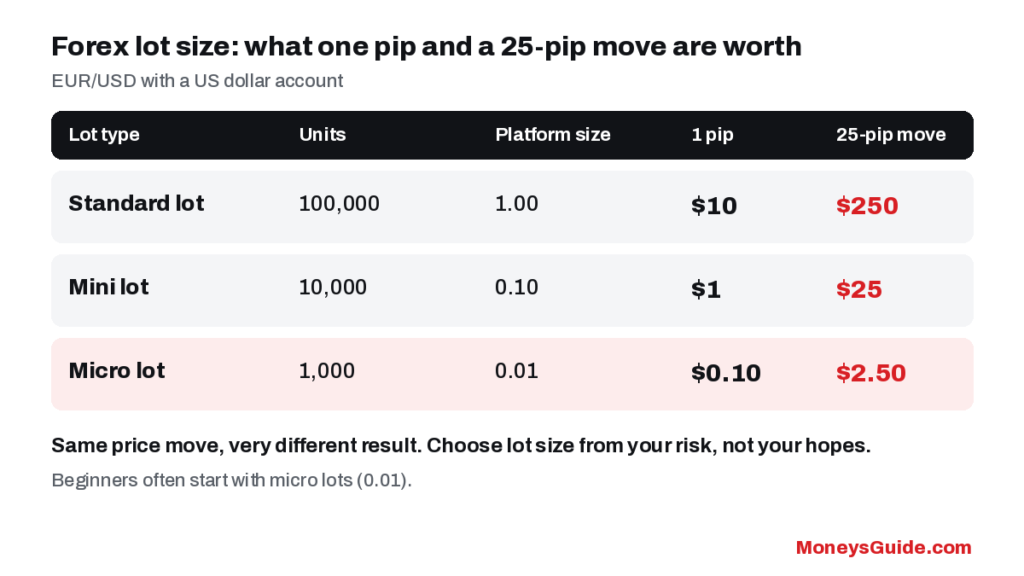
| Lot type | Units | Platform size | Value of 1 pip (EUR/USD, USD account) |
|---|---|---|---|
| Standard lot | 100,000 | 1.00 | $10 |
| Mini lot | 10,000 | 0.10 | $1 |
| Micro lot | 1,000 | 0.01 | $0.10 |
| Nano lot* | 100 | 0.001 | $0.01 |
*Nano lots are only offered by some brokers.
If you’re new to pips, read our guide what is a pip in forex? first. It explains how price moves are measured.
How forex lot size changes your profit and loss
Take a 25-pip move on EUR/USD, for example from 1.0850 to 1.0875:
- 1 standard lot: 25 × $10 = $250
- 1 mini lot: 25 × $1 = $25
- 1 micro lot: 25 × $0.10 = $2.50
The market moved by exactly the same amount in all three cases. Only the lot size changed the result. The same is true of losses: a 25-pip move against a standard lot costs $250.
Lot size and margin
When you trade with leverage, your broker holds part of your account as margin. The bigger the lot, the more margin you need.
One standard lot of EUR/USD at 1.0850 controls about $108,500:
- At 1:30 leverage, you’d need about $3,617 in margin.
- At 1:100 leverage, you’d need about $1,085.
High leverage lets you open bigger trades with less money, but it doesn’t make them less risky. A $250 loss is the same $250 whether you used $1,085 or $3,617 of margin. Higher leverage simply makes it easier to take on too much.
How to choose the right forex lot size
Professional traders usually work backwards from risk, not forwards from what feels exciting:
- Decide your risk per trade. Many traders use 1–2% of their account. On a $5,000 account, 1% is $50.
- Set your stop-loss in pips. For example, 25 pips below your entry, based on your analysis.
- Work out the pip value you can afford: $50 ÷ 25 pips = $2 per pip.
- Convert to lots. On EUR/USD, $2 per pip is 0.20 lots, or two mini lots.
Forex lot size = (account risk ÷ stop-loss in pips) ÷ pip value per standard lot
Here: ($50 ÷ 25) ÷ $10 = 0.20 lots.
If you used a full standard lot instead, the same 25-pip stop would risk $250, or 5% of the account on one trade.
Pairs where the US dollar comes first
The $10-per-pip shortcut works when the US dollar is the second currency (EUR/USD, GBP/USD, AUD/USD) and your account is in dollars. For pairs like USD/JPY or USD/CHF, pip value changes with the exchange rate. For example, at USD/JPY 150.50, one standard lot is worth about $6.64 per pip. Most platforms calculate this for you before you confirm a trade.
Common forex lot size mistakes
- Choosing lot size by feel. Always calculate it from your risk and stop-loss.
- Keeping the same lot size on every pair. Pip values differ, so the same lot size can carry very different risk.
- Moving your stop-loss further away without reducing the lot size. Wider stops need smaller lots to keep risk the same.
- Starting with standard lots. Micro lots let you learn with real money while keeping losses small.
- Ignoring spreads. The spread is a cost on every trade and grows with lot size.
Getting your forex lot size right won’t make a bad strategy profitable, but getting it wrong can ruin a good one.
A word on risk
Forex trading is high risk, and many retail traders lose money. Regulators such as the Commodity Futures Trading Commission have warned the public about forex trading frauds and how quickly losses can build. Only trade with money you can afford to lose, and use a broker regulated in your country.
Frequently asked questions
What lot size should a beginner use?
Many beginners start with micro lots (0.01) so each pip is worth only a few cents. This lets you learn how trades behave without large losses.
How much is 0.01 lot?
On EUR/USD with a dollar account, 0.01 lot is a micro lot of 1,000 units, worth $0.10 per pip.
Is a bigger lot size better?
No. A bigger lot size only increases how much you win or lose per pip. The right size is the one that keeps your risk per trade within your limit.
Does lot size affect the spread?
The spread in pips stays the same, but its cost in money grows with lot size. A 2-pip spread costs $20 on a standard lot and $0.20 on a micro lot.
This article is for education only and is not financial or trading advice. Forex and leveraged trading carry a high level of risk and can result in losses that exceed your deposit. Examples are for illustration only.