How Mortgage Amortization Works
Every month you pay the same mortgage amount, yet your balance barely seems to move in the first few years. That’s not a mistake. It’s how mortgage amortization works. Understanding it helps you see where your money goes, why extra payments are so powerful, and what really happens when you refinance or sell.
Quick summary
- Each payment covers that month’s interest first, and the rest reduces your loan.
- Early on, most of each payment is interest. Later, most of it reduces the balance.
- On a $320,000 loan at 6.5% over 25 years, the first payment is about 80% interest.
- Small extra payments early in the loan save the most interest.
What is mortgage amortization?
Amortization means paying off a loan through regular, equal payments over a set time. Each payment is split between:
- Interest: charged on the balance you still owe that month
- Principal: the part that reduces your loan and builds your equity
Because interest is worked out on the remaining balance, the split changes every month. The Consumer Financial Protection Bureau explains that most of your early payment goes to interest, and more goes to principal as the balance falls.
A real mortgage amortization example
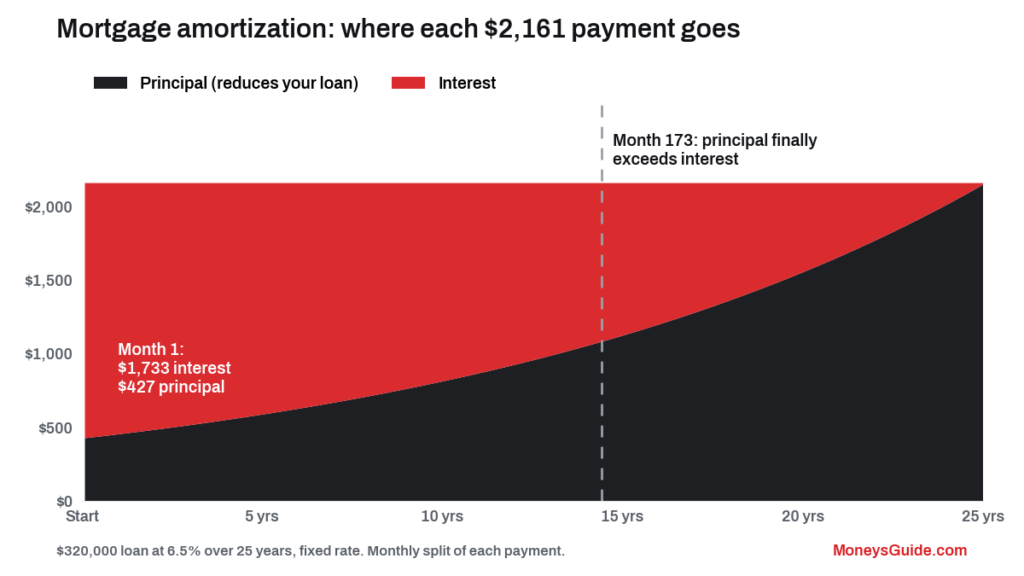
You borrow $320,000 at 6.5% for 25 years. Your monthly payment is about $2,160.66.
Month 1:
- Interest: $320,000 × 6.5% ÷ 12 ≈ $1,733.33
- Principal: $2,160.66 − $1,733.33 ≈ $427.33
So in the first month, about 80% of your payment is interest.
Year 1 overall: you pay about $20,644 in interest and only about $5,284 off the loan.
Year 25: you pay only about $890 in interest and about $25,038 off the loan.
When does the balance start falling faster?
In this example, the principal part of your payment only becomes bigger than the interest part in month 173, during year 15. Before that, you’re paying more to the lender in interest than you are reducing your loan.
Here’s how the balance falls:
| After | Balance remaining | Paid off so far |
|---|---|---|
| 5 years | about $289,799 | about $30,201 |
| 10 years | about $248,036 | about $71,964 |
| 15 years | about $190,286 | about $129,714 |
| 20 years | about $110,429 | about $209,571 |
| 25 years | $0 | $320,000 |
In the first five years, you’d pay about $129,640 in total, but only about $30,201 of it reduces the loan. The rest, about $99,439, is interest.
Why this matters
Selling or refinancing early: if you sell or refinance after a few years, you’ll still owe most of the original loan. Your equity comes mainly from your down payment and any rise in the home’s value.
Extra payments are most powerful early: money you pay on top of your regular payment goes straight to principal. Paying it early cuts the balance that interest is charged on for all the years that follow.
Total cost: over 25 years, this loan costs about $328,199 in interest, more than the amount borrowed.
How extra payments change your schedule
Add $200 a month to the same loan:
- The loan is paid off in about 20 years and 6 months instead of 25 years.
- Total interest falls to about $259,117.
- You save about $69,082.
Other ways to speed things up:
- One extra payment a year, for example from a bonus
- Rounding up your payment, say from $2,160 to $2,300
- A shorter term when you first take the loan, if the higher payment is affordable
Before you overpay, check with your lender whether there are early repayment charges or limits on extra payments, and make sure the extra goes to principal.
You can test any extra payment amount with our loan and EMI calculator, or see a full year-by-year schedule, including taxes and fees, in our mortgage calculator.
Fixed vs variable rates and amortization
With a fixed-rate mortgage, your payment stays the same and the schedule is set from day one.
With a variable or adjustable rate, the lender recalculates when rates change. Your payment may rise or fall, or your term may change, and the split between interest and principal shifts with it.
Common misunderstandings
- “I’ve paid for five years, so I own a big share of my home.” Most early payments are interest, so the balance falls slowly at first.
- “Extra payments make little difference.” Early on, even small amounts can save thousands in interest.
- “A longer term is always cheaper because the payment is lower.” The monthly payment is lower, but total interest is much higher.
Once you understand mortgage amortization, these misconceptions disappear.
Frequently asked questions
What is an amortization schedule?
A table showing every payment over the life of your loan: how much goes to interest, how much to principal, and the balance left afterwards. Lenders provide one, and our mortgage calculator shows a yearly version.
Why is so much of my payment interest?
Interest is calculated on what you still owe. At the start, that balance is at its highest, so the interest part of each payment is largest.
Does paying extra reduce my monthly payment?
Usually it shortens your term instead. Some lenders let you choose to lower the payment after a large overpayment.
Is it better to invest or overpay my mortgage?
It depends on your mortgage rate, your other debts, your emergency fund and your attitude to risk. Overpaying gives a guaranteed saving equal to your interest rate. Investing may earn more, but returns aren’t guaranteed.
This article is for education only and is not financial or mortgage advice. Figures are illustrative, based on a fixed rate with no fees. Check your own schedule and terms with your lender.