What Is a Pip in Forex? Pips and Pip Value Explained
If you’ve read anything about forex trading, you’ve seen the word “pip”. Traders say a currency “moved 50 pips” or that they “made 20 pips” on a trade. So what is a pip in forex? It’s the most basic unit of price movement in the currency market, and understanding it is the first step to understanding profit, loss and risk in forex.
Quick summary
- A pip is usually a move of 0.0001 in a currency price, or 0.01 for Japanese yen pairs.
- On a standard lot of EUR/USD, one pip is worth $10.
- Pips measure your profit, your loss and the cost of trading (the spread).
- Knowing pip value before you trade is the key to controlling risk.
This guide explains what a pip is, how to count pips, how to work out what a pip is worth in money, and why that matters before you place any trade.
What is a pip in forex?
Pip is short for “percentage in point” or “price interest point”. It is the standard unit used to measure how much an exchange rate changes.
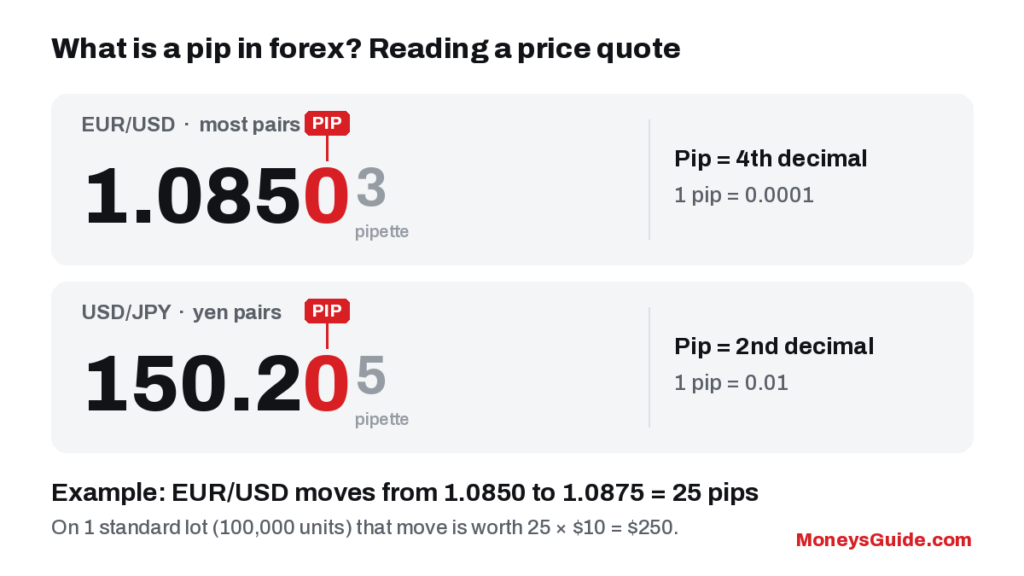
For most currency pairs, a pip is a move in the fourth decimal place, or 0.0001.
For example, if EUR/USD moves from 1.0850 to 1.0851, it has moved 1 pip. If it moves from 1.0850 to 1.0875, that’s 25 pips.
The exception: Japanese yen pairs
Pairs that include the Japanese yen (JPY) are quoted with fewer decimal places, because one yen is worth much less than one dollar or euro. For these pairs, a pip is a move in the second decimal place, or 0.01.
So if USD/JPY moves from 150.20 to 150.50, it has moved 30 pips.
What is a pipette?
Many brokers now quote prices with one extra decimal place for more precision. That extra digit is called a pipette, or fractional pip, and is worth one-tenth of a pip.
- EUR/USD at 1.08503: the final “3” is pipettes
- USD/JPY at 150.205: the final “5” is pipettes
When counting pips, ignore the last digit if your platform shows five decimals (or three for yen pairs). A move from 1.08500 to 1.08750 is still 25 pips.
Why pips matter
A pip on its own is a tiny change in price. What makes it important is how much money each pip is worth in your trade. That depends on your trade size, which in forex is measured in lots:
- Standard lot: 100,000 units of the base currency
- Mini lot: 10,000 units
- Micro lot: 1,000 units
The bigger the lot, the more each pip is worth, and the faster profits or losses add up.
How to calculate pip value
The general formula is:
Pip value = (one pip ÷ exchange rate) × trade size
The result is in the base currency of the pair (the first currency). If your account is in a different currency, you then convert it.
There’s a simpler shortcut for the most common case.
When the US dollar is the second currency
For pairs like EUR/USD, GBP/USD and AUD/USD, where USD is the quote currency and your account is in dollars, pip value is fixed:
| Trade size | Units | Value of 1 pip |
|---|---|---|
| Standard lot | 100,000 | $10 |
| Mini lot | 10,000 | $1 |
| Micro lot | 1,000 | $0.10 |
Example: you buy 1 standard lot of EUR/USD at 1.0850, and the price rises to 1.0875. That’s 25 pips × $10 = $250 profit. If the price had fallen 25 pips instead, you would have lost $250.
The same 25-pip move is worth $25 on a mini lot and $2.50 on a micro lot.
When the US dollar is the first currency
For pairs like USD/JPY or USD/CHF, the pip value in dollars changes with the exchange rate.
Example: USD/JPY is trading at 150.50, and you trade 1 standard lot.
- One pip = 0.01
- Pip value = 0.01 ÷ 150.50 × 100,000 ≈ $6.64
So a 30-pip move on a standard lot is worth about 30 × $6.64 ≈ $199.
Cross pairs
For pairs without the US dollar, like EUR/GBP, the pip value is first worked out in the quote currency (GBP), then converted into your account currency at the current rate. Most trading platforms show this automatically, and you can check conversion rates with our currency converter.
Pips, spreads and trading costs
Pips also measure the cost of trading. The spread is the difference between the buy (ask) and sell (bid) price, and it’s quoted in pips.
If EUR/USD shows a bid of 1.0850 and an ask of 1.0852, the spread is 2 pips. On a standard lot, that’s $20 you pay just to open the trade. The price has to move 2 pips in your favour before you break even.
Spreads are usually tighter on major pairs like EUR/USD and wider on less-traded pairs, and they can widen sharply during news releases or quiet market hours.
Pips and risk management
Thinking in pips helps you control risk before you trade:
- Decide your stop-loss distance in pips. For example, 30 pips below your entry.
- Decide how much money you’re willing to risk on the trade, for example 1% of your account.
- Choose a trade size so that 30 pips equals that amount.
If you have a $5,000 account and risk 1% ($50) with a 30-pip stop on EUR/USD, each pip can be worth at most about $1.67. That’s under 2 mini lots, rather than a standard lot where 30 pips would cost $300.
Working this out before placing a trade is one of the most important habits in forex.
Common pip mistakes beginners make
- Counting the pipette as a pip. On a five-decimal quote, a move from 1.08500 to 1.08510 is 1 pip, not 10.
- Assuming every pair has the same pip value. $10 per standard lot only applies when the US dollar is the second currency and your account is in dollars.
- Forgetting the spread. A trade starts slightly negative because you buy at the ask and sell at the bid.
- Sizing trades by feel. Without converting your stop-loss from pips into money, it’s easy to risk far more than you intended.
- Ignoring news events. Prices can jump many pips in seconds around major announcements, and stop-losses may fill at a worse price than planned.
Once you understand what a pip in forex is worth on each trade, these mistakes become much easier to avoid.
A word on leverage and risk
Forex brokers often offer high leverage, which lets you control a large position with a small deposit. Leverage magnifies pip value relative to your account, so a small move against you can wipe out a large share of your balance. Many retail traders lose money trading forex, and regulators such as the Commodity Futures Trading Commission have warned that losses in retail forex trading can build up very quickly. Only trade with money you can afford to lose, and make sure you fully understand how pip value, lot size and leverage interact.
Frequently asked questions
What is a pip in forex, in simple terms?
A pip is the smallest standard step a currency price moves in, usually 0.0001. Traders use it to measure price changes, profit and loss in a consistent way across different currency pairs.
How much is 1 pip worth?
It depends on the currency pair, your trade size and your account currency. For EUR/USD with a US dollar account, 1 pip is worth $10 on a standard lot, $1 on a mini lot and $0.10 on a micro lot.
How many pips does a currency move in a day?
It varies by pair and market conditions. Major pairs often move several dozen pips on an ordinary day and much more around major economic announcements. Check recent price ranges on our Markets page to get a feel for typical moves.
Is a pip the same as a point?
Not always. Some platforms use “point” to mean the smallest price increment, which may be a pipette rather than a full pip. Check how your broker defines it.
Do pips apply to crypto or stocks?
The term comes from forex. Stocks are usually measured in cents or points, and crypto in dollars or percentages. If you trade crypto, our crypto profit calculator shows profit and loss including fees.
This article is for education only and is not financial or trading advice. Forex trading involves a high level of risk, and leveraged products can result in losses that exceed your deposit. Prices in examples are for illustration only.