
How to Calculate Crypto Profit, Including Fees
Many people judge a crypto trade by comparing the price they bought at with the price they sold at. But that leaves out fees, and fees are charged twice: once when you buy and again when you sell. This guide shows you how to calculate crypto profit properly, so you know what you actually made or lost.
Quick summary
- Profit = what you receive after fees minus what you invested.
- Fees are charged on both the buy and the sell.
- Your break-even price is always a little above your buy price.
- Small, frequent trades can lose a surprising amount to fees.
How to calculate crypto profit: the 5 steps
- Coins bought = amount invested × (1 − buy fee) ÷ buy price
- Sale value = coins bought × sell price
- You receive = sale value × (1 − sell fee)
- Profit or loss = you receive − amount invested
- ROI = profit or loss ÷ amount invested × 100
Write the fees as decimals: 0.1% is 0.001.
A worked example: a profitable trade
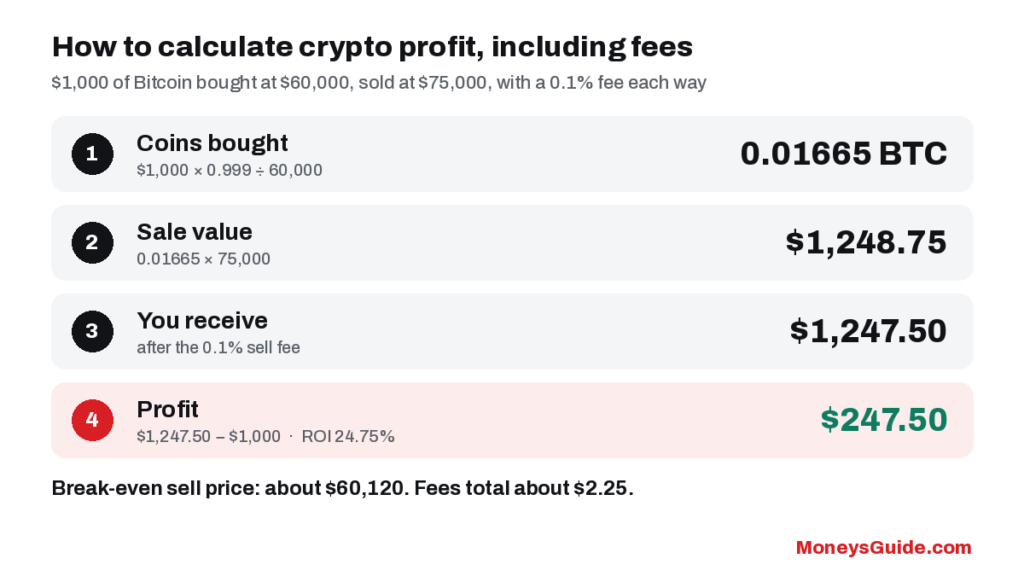
You invest $1,000 in Bitcoin at $60,000 per coin and later sell at $75,000. Your exchange charges 0.1% on each trade.
- Coins bought: $1,000 × 0.999 ÷ 60,000 = 0.01665 BTC
- Sale value: 0.01665 × 75,000 = $1,248.75
- You receive: $1,248.75 × 0.999 = $1,247.50
- Profit: $1,247.50 − $1,000 = $247.50
- ROI: $247.50 ÷ $1,000 = 24.75%
Total fees paid: about $2.25.
Our free crypto profit calculator does all five steps instantly for any coin.
The same trade at a loss
If the price had fallen to $50,000 instead and you sold:
- Sale value: 0.01665 × 50,000 = $832.50
- You receive: $832.50 × 0.999 ≈ $831.67
- Loss: about $168.33, or −16.8%
The fees still apply, so a loss is always slightly bigger than the price drop alone.
What is your break-even price?
Your break-even price is the sell price where you get back exactly what you put in. Because you pay fees on both sides, it’s always above your buy price:
Break-even price = amount invested ÷ (coins bought × (1 − sell fee))
In the example, it’s about $60,120, or $120 above the $60,000 buy price. The price has to rise that far just to cover your fees.
Why fees matter more than you think
A 0.1% fee looks tiny, but many apps and brokers charge more, often through a spread (a gap between the buy and sell price) rather than a visible fee.
Say you make 20 round trips of $500 each, with a 0.5% fee on each buy and each sell. That’s $100 in fees, before any price movement. Frequent small trades need bigger price moves just to break even.
To keep fees down:
- Compare maker and taker fees on your exchange’s fee page.
- Check the spread on “simple” buy and sell screens.
- Trade less often, with clear reasons for each trade.
Costs the basic formula doesn’t include
- Network (gas) fees for moving coins between wallets or exchanges
- Deposit and withdrawal fees charged by some platforms
- Slippage on large or fast-moving orders
- Taxes on gains, depending on where you live
Keep a record of each trade, with the date, amount, price and fees. That makes your real profit easy to check and helps if you ever need to report gains.
Crypto risk: know before you trade
Crypto prices can rise or fall sharply within hours, and some platforms and tokens carry extra risks. The Securities and Exchange Commission’s crypto assets resource page urges investors to be cautious and to check who they’re dealing with. Only invest money you can afford to lose.
Common mistakes when calculating crypto profit
- Ignoring fees on one side of the trade. Both the buy and the sell cost money.
- Using the price, not what you received. Profit is based on the cash you actually get back.
- Forgetting transfer fees. Moving coins between platforms can add up.
- Not tracking every trade. Without records, it’s easy to think you’re ahead when you’re not.
Once you know how to calculate crypto profit properly, these are easy to avoid.
Frequently asked questions
How do I calculate crypto profit percentage?
Divide your profit (after fees) by the amount you invested, then multiply by 100. A $247.50 profit on $1,000 is a 24.75% return.
Does the formula work for any coin?
Yes. It works for Bitcoin, Ethereum or any token. Just use the prices and fees for your trade.
What fee should I use?
Use your exchange’s actual fee for your order type. If you’re unsure, use the higher “taker” fee for a cautious estimate.
Is unrealised profit real profit?
Not yet. Until you sell, any gain on paper can disappear if the price falls.
This article is for education only and is not financial or investment advice. Cryptocurrency is highly volatile and you can lose some or all of your money. Prices and fees in examples are for illustration only.
