
Bitcoin for Beginners: How It Works and the Real Risks
Bitcoin is the best-known cryptocurrency, but many people buy it without really understanding what it is. This Bitcoin for beginners guide explains how it works in plain English: the network, wallets and keys, why there will only ever be 21 million coins, and the risks you should understand before putting in any money.
Quick summary
- Bitcoin is a digital currency that runs on a public network with no central bank.
- Transactions are recorded on a shared ledger called the blockchain.
- Supply is capped at 21 million coins, and new supply is cut roughly every four years.
- Prices are highly volatile, and lost keys or scams can mean losing everything.
What is Bitcoin?
Bitcoin was introduced in a 2008 paper by a person or group using the name Satoshi Nakamoto, and the network launched in January 2009. It lets people send value directly to each other over the internet without a bank or payment company in the middle.
Bitcoin isn’t issued by a government. Its rules are set by open-source software run by thousands of computers around the world.
How does Bitcoin work?
The blockchain
Every Bitcoin transaction is recorded on the blockchain, a public ledger shared across the network. Transactions are grouped into blocks, and a new block is added about every 10 minutes. Each block links to the one before it, which makes past records extremely hard to change.
Mining
New blocks are added by miners, who use computers to solve a mathematical puzzle. This process, called proof of work, secures the network. The miner who adds a block receives newly created bitcoin plus transaction fees.
Units
One bitcoin can be split into 100 million units called satoshis. You don’t have to buy a whole coin. You can buy a small fraction.
Why is Bitcoin’s supply limited?
Bitcoin’s rules allow a maximum of 21 million coins. New coins enter circulation as mining rewards, and that reward is cut in half roughly every four years in an event called the halving:
| Year | Reward per block |
|---|---|
| 2009 | 50 BTC |
| 2012 | 25 BTC |
| 2016 | 12.5 BTC |
| 2020 | 6.25 BTC |
| 2024 | 3.125 BTC |
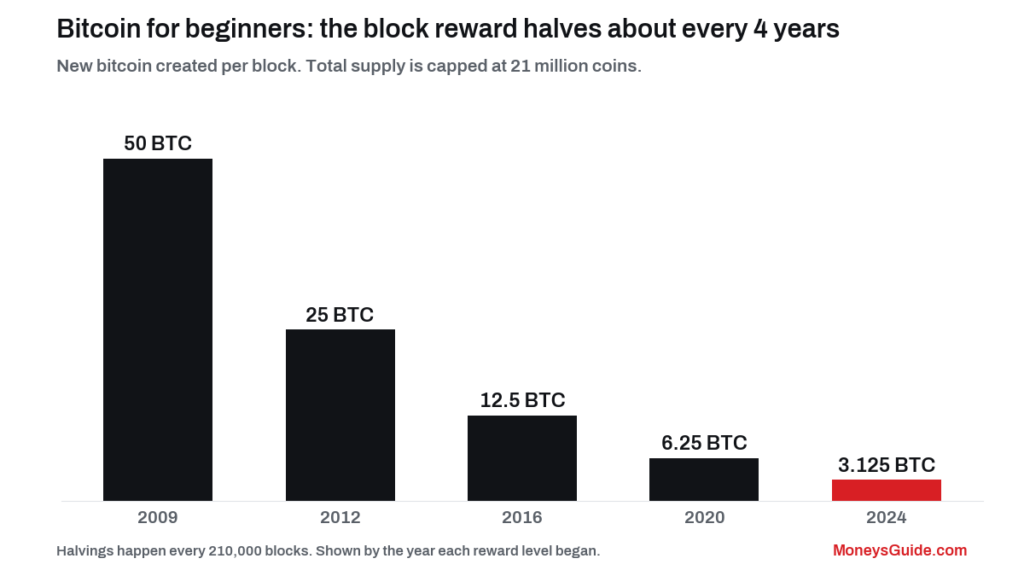
This fixed, shrinking supply is one reason some people see Bitcoin as “digital gold”. But limited supply doesn’t guarantee a rising price. Demand can fall too.
Wallets and keys: who controls your Bitcoin?
Your bitcoin isn’t stored “in” a wallet like cash. It’s recorded on the blockchain, and your wallet holds the private keys that let you move it.
- Public address: like an account number, which you can share to receive bitcoin
- Private key or seed phrase: like a master password, which you must never share
There are two main ways to hold it:
- On an exchange or app (custodial): easy to use, but the company holds the keys. If it’s hacked or fails, you can lose access.
- In your own wallet (self-custody): you hold the keys. Safer from company failure, but if you lose your seed phrase, nobody can recover your coins.
Our guide on hot and cold crypto wallets explains the options in more detail.
How do people buy Bitcoin?
The most common route is a crypto exchange or app. Before using one:
- Check that it’s registered or licensed with the financial regulator where you live. Most regulators publish a public register and warning lists of unauthorised firms.
- Compare fees and spreads, which can be much higher on “instant buy” screens.
- Turn on two-factor authentication and use a strong, unique password.
Some markets also offer regulated Bitcoin funds or ETFs, which give price exposure through a normal brokerage account.
The real risks of Bitcoin
- Volatility: Bitcoin’s price can rise or fall by large amounts within days or even hours.
- Scams: fake exchanges, “guaranteed return” schemes, and impersonators on social media are common.
- Irreversible transactions: if you send bitcoin to the wrong address or to a scammer, it usually can’t be reversed.
- Lost keys: forget your seed phrase and your coins may be gone forever.
- Platform failure: exchanges have collapsed or been hacked in the past.
- Changing rules: regulation and tax treatment vary by country and keep evolving.
The Commodity Futures Trading Commission runs a dedicated Bitcoin and virtual currency education page with warnings about common risks and frauds. Only invest money you can afford to lose completely.
Bitcoin for beginners: a sensible approach
- Learn first. Understand wallets, fees and risks before buying.
- Start small, with an amount that wouldn’t hurt if it went to zero.
- Use a regulated platform and secure your account.
- Avoid leverage and anything promising guaranteed returns.
- Keep records of every purchase and sale.
- Don’t let crypto replace your emergency fund or long-term savings.
To work out whether a trade made money after fees, use our crypto profit calculator, or read our guide on how to calculate crypto profit.
Frequently asked questions
Can I buy less than one bitcoin?
Yes. Bitcoin can be divided into tiny fractions, so you can buy as little as your platform allows.
Is Bitcoin legal?
It’s legal to buy and hold in many countries, but each has its own rules for platforms and tax. Check the rules where you live.
Is Bitcoin a safe investment?
Bitcoin is high risk. Its price is very volatile, and losses can be large. Treat it as a speculative investment, not a replacement for savings.
What happens when all 21 million bitcoins are mined?
Miners would be paid only through transaction fees. Under the current schedule, the last bitcoin is expected to be mined around the year 2140.
This article is for education only and is not financial or investment advice. Cryptocurrency is highly volatile and largely unregulated in some countries, and you can lose some or all of your money.