
$45,000 a Year Is How Much an Hour? (Judging a Job Offer)
$45,000 is a common salary for early-career and entry-level roles, and you may be weighing an offer at this level right now. The headline number matters, but so do the hours, the benefits and the room to grow. So, $45,000 a year is how much an hour? At a standard 40-hour week, it’s $21.63. This guide breaks $45,000 down by pay period, shows your real hourly rate at different hours, and explains how to judge and negotiate a $45,000 job offer.
Quick summary
- $45,000 a year is $21.63 an hour at 40 hours a week for 52 weeks.
- That’s $3,750 a month, about $1,731 every two weeks and about $865 a week, before tax.
- At 50 hours a week, your real hourly rate drops to about $17.31.
- Benefits such as a 4% retirement match add about $1,800 a year on top of salary.
$45,000 a year is how much an hour?
Hourly rate = yearly salary ÷ (hours per week × weeks per year)
$45,000 ÷ 2,080 = $21.63 an hour
$45,000 by pay period
| Pay period | Before tax |
|---|---|
| Hourly (40 hours a week) | $21.63 |
| Daily (5 days a week) | $173.08 |
| Weekly | $865.38 |
| Every two weeks | $1,730.77 |
| Twice a month | $1,875.00 |
| Monthly | $3,750.00 |
| Yearly | $45,000.00 |
Convert any salary with our free salary converter.
How $45,000 compares with nearby salaries
| Yearly salary | Hourly rate (40 hours) | Monthly pay |
|---|---|---|
| $35,000 | $16.83 | about $2,917 |
| $40,000 | $19.23 | about $3,333 |
| $45,000 | $21.63 | $3,750 |
| $50,000 | $24.04 | about $4,167 |
| $55,000 | $26.44 | about $4,583 |
Your real hourly rate depends on the hours
| Typical hours per week | Effective hourly rate |
|---|---|
| 37.5 | about $23.08 |
| 40 | $21.63 |
| 45 | about $19.23 |
| 50 | about $17.31 |
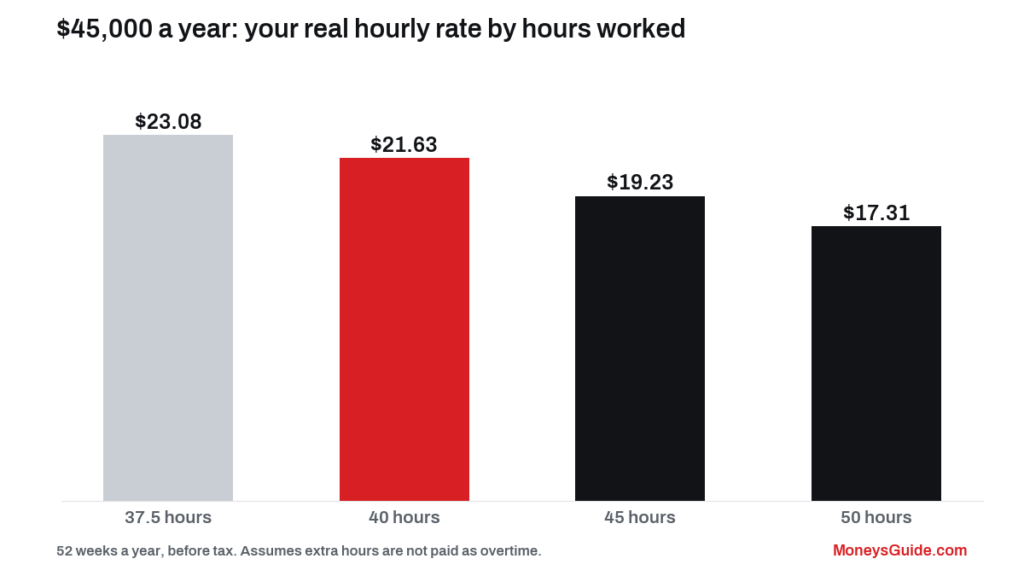
Before accepting an offer, ask what a typical week really looks like. A $45,000 salaried job with regular 50-hour weeks pays less per hour than a $20-an-hour job with paid overtime. See $20 an hour is how much a year for that comparison.
How to judge a $45,000 job offer
Look beyond the salary at five things:
- Real hours. Ask about typical weekly hours, on-call duties and busy seasons.
- Retirement contributions. A 4% employer match on $45,000 is $1,800 a year.
- Health cover and insurance. These can be worth thousands of dollars a year, depending on where you live.
- Paid time off. Extra paid leave is worth real money. One week of pay on $45,000 is about $865.
- Growth. Training, promotion paths and regular pay reviews shape your salary in two or three years.
Example: comparing two offers
| Offer A | Offer B | |
|---|---|---|
| Salary | $45,000 | $48,000 |
| Typical hours | 40 a week | 45 a week |
| Effective hourly rate | $21.63 | about $20.51 |
| Retirement match | 4% ($1,800) | none |
| Salary + match | $46,800 | $48,000 |
Offer B pays more on paper, but less per hour and with no match. The total package is close, so growth, commute and work-life balance may decide it.
How to negotiate a $45,000 offer
- Research the market rate for the role and location using job listings and salary surveys.
- Ask for a specific number. “Could you do $48,000?” is clearer than “Is there any flexibility?”
- Talk in yearly terms. $3,000 more is about $1.44 an hour, or $250 a month before tax.
- Negotiate the package. If the salary is fixed, ask about extra leave, a signing bonus, flexible hours, training or an early pay review.
- Get it in writing before you resign from your current job.
Salaried vs hourly at $45,000
Some jobs offer a choice, or you may be comparing a salaried role with an hourly one. At this level:
- Salaried at $45,000: a fixed $3,750 a month, but extra hours may be unpaid.
- Hourly at $21.63: the same pay at 40 hours, but overtime is often paid at time-and-a-half, about $32.45 an hour.
If a role regularly needs extra hours, an hourly job with paid overtime can pay noticeably more over a year. Five hours of overtime a week at time-and-a-half would add about $8,437 to $45,000.
Your first-year pay plan
- Months 1–3: learn the role and note your wins, such as tasks completed, problems solved and positive feedback.
- Months 4–9: take on extra responsibility where you can, and ask how pay reviews work.
- Months 10–12: go into your review with evidence, and ask for a specific raise.
A 5% raise on $45,000 is $2,250 a year. Combined with a strong track record, that sets you up for faster growth in year two.
Take-home pay on $45,000
These figures are gross pay. Take-home pay depends on the tax rules where you live and your deductions.
An example only: if about 19% went to tax and deductions, $45,000 would leave about $36,450 a year, or roughly $3,038 a month.
A 50/30/20 budget on that example gives about $1,519 for needs, $911 for wants and $608 for savings and extra debt payments. Our budget planner calculates this for your own take-home pay.
Starting a new job: money checklist
- Expect a gap before your first paycheck. Some employers pay monthly, so keep enough savings to cover a few weeks.
- Join the retirement plan straight away if there’s a match.
- Set up automatic savings from your first paycheck, even a small amount.
- Check your first payslip carefully to make sure tax and deductions are right.
- Build an emergency fund. Start with $1,000, then aim for three months of essential costs. See how to build an emergency fund.
Questions to ask before you accept
- What does a typical week look like, and how often are extra hours needed?
- When is the first pay review, and how are raises decided?
- What training or development is offered in the first year?
- When do benefits such as retirement matching start?
The answers often tell you more about the real value of an offer than the salary figure.
Is $45,000 a good salary?
For an entry-level or early-career role, it’s a common starting point. For a single person sharing housing in an area with moderate costs, it can cover the essentials with room to save. In expensive cities, or as the only income for a family, it’s tight.
The bigger question is often where the job leads. A $45,000 role with strong training and regular raises can be worth more over a few years than a higher-paying dead end. To track whether raises keep up with prices, use our salary vs inflation calculator. The Federal Trade Commission’s consumer site also has a simple guide to making a budget for your new salary.
Common mistakes
- Comparing offers on salary alone, without hours and benefits
- Not negotiating, even politely, when an offer allows it
- Forgetting the gap before the first paycheck
- Skipping the employer retirement match
- Accepting long unpaid hours without counting what they do to your hourly rate
So, $45,000 a year is how much an hour? $21.63 at a standard 40-hour week, or $3,750 a month. Judge any offer on its real hourly rate, benefits and growth, not just the headline salary.
Frequently asked questions
How much is $45,000 a year per month?
$3,750 a month before tax.
How much is $45,000 a year biweekly?
About $1,730.77 before tax, across 26 paychecks.
How much is $45,000 a year weekly?
About $865.38 a week before tax.
What benefits are worth asking about?
Retirement matching, health cover, paid leave, training budgets and flexible or remote working. Some of these can be easier for an employer to improve than salary.
How do I compare a $45,000 offer with my hourly job?
Divide the salary by the hours you’d really work in a year, then add the value of benefits. Compare that with your current hourly rate, including any overtime you regularly earn.
Should I accept the first offer at $45,000?
Not necessarily. Many employers expect some negotiation. A polite, well-researched request is rarely held against you, even if the answer is no.
Is $22 an hour the same as $45,000 a year?
Close. $22 an hour at 40 hours a week is $45,760 a year, slightly more than $45,000.
How much is $45,000 a year after tax?
It depends on where you live and your deductions. As an example, if about 19% went to tax and deductions, you’d take home about $36,450 a year, or $3,038 a month.
This article is for education only and is not financial, tax or employment advice. Figures are gross pay unless stated. Examples are illustrative.