
$75,000 a Year Is How Much an Hour? (And What It Can Afford)
$75,000 is a salary many people work towards for years. It often marks a move into a more experienced or specialist role, and it opens up real choices about where you live, what you drive and how much you save. But what is it worth by the hour, and how far does it really go each month? So, $75,000 a year is how much an hour? At a standard 40-hour week, it’s $36.06. This guide breaks $75,000 down by pay period, shows your real hourly rate if you work longer hours, and explains what this salary can realistically afford.
Quick summary
- $75,000 a year is $36.06 an hour at 40 hours a week for 52 weeks.
- That’s $6,250 a month, about $2,885 every two weeks and about $1,442 a week, before tax.
- At 50 hours a week, your real hourly rate drops to about $28.85.
- Common guidelines suggest about $1,750 a month for housing and $938 a month for saving on this salary.
$75,000 a year is how much an hour?
Hourly rate = yearly salary ÷ (hours per week × weeks per year)
$75,000 ÷ (40 × 52) = $75,000 ÷ 2,080 = $36.06 an hour
You may see other figures quoted online, such as $35.59 or $36.15. Those are calculation errors: at 40 hours a week for 52 weeks, the correct figure is $36.06.
$75,000 by pay period
| Pay period | Before tax |
|---|---|
| Hourly (40 hours a week) | $36.06 |
| Daily (5 days a week) | $288.46 |
| Weekly | $1,442.31 |
| Every two weeks | $2,884.62 |
| Twice a month | $3,125.00 |
| Monthly | $6,250.00 |
| Yearly | $75,000.00 |
Convert any salary or hourly rate with our free salary converter.
Your real hourly rate if you work longer hours
Many salaried roles at this level involve more than 40 hours a week, often without overtime pay:
| Typical hours per week | Effective hourly rate |
|---|---|
| 37.5 | about $38.46 |
| 40 | $36.06 |
| 45 | about $32.05 |
| 50 | about $28.85 |
A $75,000 job with regular 50-hour weeks pays about the same per hour as a $60,000 job with 40-hour weeks. That’s worth knowing when you compare offers. See $60,000 a year is how much an hour for a deeper look at real hourly rates and benefits.
How $75,000 compares with nearby salaries
| Yearly salary | Hourly rate (40 hours) | Monthly pay |
|---|---|---|
| $65,000 | $31.25 | about $5,417 |
| $70,000 | $33.65 | about $5,833 |
| $75,000 | $36.06 | $6,250 |
| $80,000 | $38.46 | about $6,667 |
| $85,000 | $40.87 | about $7,083 |
Every extra $5,000 a year adds about $2.40 an hour and $417 a month before tax.
A four-day week on $75,000
Some employers offer compressed or shorter working weeks. On the same $75,000:
- Four 10-hour days (40 hours): still $36.06 an hour, but $360.58 per working day.
- Four 8-hour days (32 hours): about $45.07 an hour, if the salary stays the same.
A shorter week at the same pay is effectively a big hourly raise, which is worth weighing when comparing offers.
Take-home pay on $75,000
These figures are gross pay, before tax. Your take-home pay depends on the tax rules where you live and your deductions, such as retirement contributions and health cover.
An example only: if about 24% went to tax and deductions, $75,000 would leave about $57,000 a year, or roughly $4,750 a month. Check your own payslip or local tax authority’s calculator for real figures.
What can $75,000 a year afford?
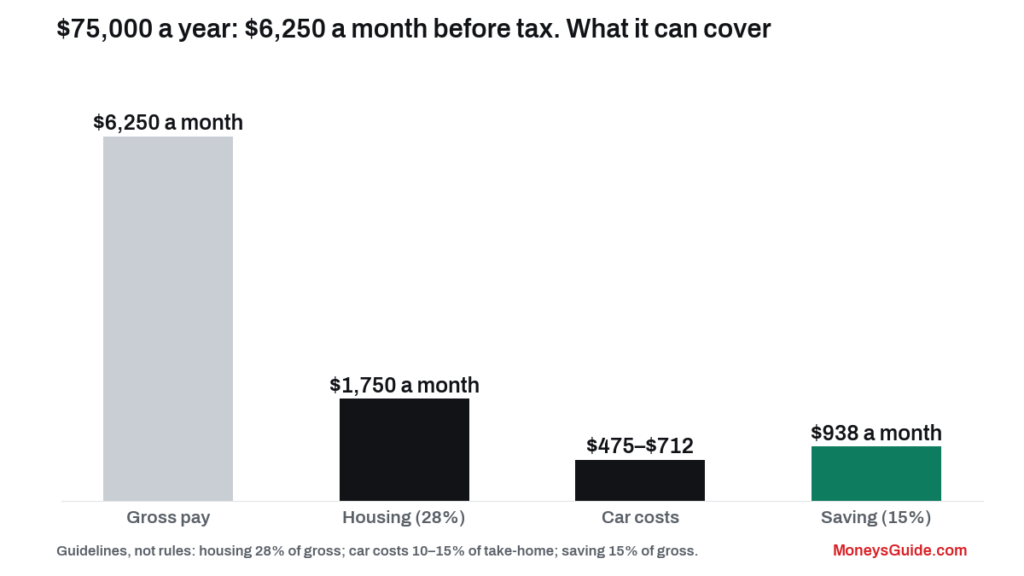
Here’s what common guidelines suggest on $6,250 a month of gross pay. They’re starting points, not rules, and keeping costs below them is what leaves room to build wealth.
Housing: up to about $1,750 a month
Many lenders use a 28% guideline: total housing costs of no more than 28% of gross monthly income. On $6,250, that’s about $1,750 a month.
- Buying: a $1,750 total monthly payment, including example taxes and insurance, supports a home of roughly $281,000 with 20% down at 6.5%, or about $240,000 with 10% down.
- Renting: many people use around 30% of gross income as a ceiling, about $1,875 here, and aim lower to save more.
See what house you can afford with a $2,000 a month mortgage and how much house can I afford for more detail.
A car: about $475 to $712 a month for all car costs
A common guideline keeps all car costs, including the loan, insurance, fuel and maintenance, to around 10% to 15% of take-home pay. On the example take-home of $4,750, that’s roughly $475 to $712 a month. That comfortably covers a modest new car or a good used one, but a large loan can quickly use it up. A $35,000 car loan at 7% over 60 months is about $693 a month on its own. See the $35,000 car loan payment.
Saving and investing: about $938 a month
Saving 15% of gross pay is about $938 a month. Invested at an average 7% a year, that could grow to about $488,000 in 20 years, or over $1.1 million in 30 years. Returns aren’t guaranteed and markets go up and down, but the numbers show how powerful steady investing is at this income. Check your own plan with our retirement calculator.
A sample monthly budget on $75,000
Using the example take-home pay of about $4,750 a month:
| Category | Example monthly amount |
|---|---|
| Housing and utilities | $1,700 |
| Food | $550 |
| Transport | $500 |
| Insurance and health costs | $250 |
| Personal spending and fun | $800 |
| Emergency fund and goals | $350 |
| Investing (on top of any workplace plan) | $600 |
| Total | $4,750 |
Our budget planner builds a version for your own take-home pay and lets you test a 50/30/20 split.
Is $75,000 a good salary?
For most single people in most areas, yes. $75,000 typically covers a comfortable lifestyle with room to save and invest. In very high-cost cities, or as the only income for a family, it can feel tighter, mainly because of housing.
Two quick checks help:
- Housing: if typical local rents or mortgage payments for the home you want are well under 28% to 30% of your gross pay, $75,000 should feel comfortable.
- Inflation: if your pay hasn’t risen for a while, check it against rising prices with our salary vs inflation calculator.
How to make the most of $75,000
- Build a 3 to 6-month emergency fund. Our emergency fund calculator helps you set a target.
- Take any employer retirement match, so you don’t leave money on the table.
- Clear high-interest debt before increasing your spending.
- Avoid lifestyle creep. When you get a raise, save at least half of it before adjusting your spending.
- Keep housing and car costs moderate, so more of your income can grow.
Keeping fees low matters more as your savings grow. The Securities and Exchange Commission’s investor site explains how fees affect your returns.
Common mistakes
- Comparing offers on salary alone, without adjusting for hours and benefits
- Buying at the top of your housing budget, leaving little room to save
- Financing an expensive car that uses up most of your car budget on the loan alone
- Budgeting with gross pay instead of take-home pay
- Assuming a raise keeps pace with inflation without checking
So, $75,000 a year is how much an hour? $36.06 at a standard 40-hour week, or $6,250 a month before tax. Used well, it’s enough for a comfortable life today and serious long-term saving for the future.
Frequently asked questions
How much is $75,000 a year per month?
$6,250 a month before tax and deductions.
How much is $75,000 a year biweekly?
About $2,884.62 before tax, across 26 paychecks.
How much is $75,000 a year weekly?
About $1,442.31 a week before tax.
How much is $75,000 a year after tax?
It depends on where you live and your deductions. As an example, if about 24% went to tax and deductions, you’d take home about $57,000 a year, or $4,750 a month.
Can a family live on $75,000 a year?
Many do, especially in areas with moderate housing costs. A bigger emergency fund and careful housing choices make one income go further.
Is $36 an hour the same as $75,000 a year?
Very close. $36 an hour at 40 hours a week for 52 weeks is $74,880 a year.
What hourly rate equals $75,000 a year?
$36.06 an hour at 40 hours a week for 52 weeks. At 37.5 hours a week, about $38.46.
This article is for education only and is not financial, tax or employment advice. Figures are gross pay unless stated. Take-home, housing and investment examples are illustrative.