How Long Does It Take to Pay Off $10,000 in Credit Card Debt?
Owing $10,000 on a credit card can feel like running on a treadmill: you pay every month, but the balance barely moves. The good news is that how long to pay off $10,000 credit card debt is pure maths, and small changes to your monthly payment make a dramatic difference.
This guide shows exactly how long it takes to pay off $10,000 in credit card debt at different payment levels, how much interest you’ll pay along the way, and the fastest realistic ways to get to zero.
Quick summary
- At a typical 22% APR, paying only the minimum could take around 25 years and cost over $17,000 in interest.
- Paying a fixed $300 a month clears it in about 4 years and 4 months with $5,596 in interest.
- Paying $500 a month clears it in about 26 months with $2,571 in interest.
- A 0% balance transfer can save thousands if you clear the balance before the promotional rate ends.
How long to pay off $10,000 credit card debt: the short answer
It depends on two numbers: your interest rate (APR) and how much you pay each month. The table below uses a $10,000 balance at 22% APR, which is close to what many cards charge, and assumes you stop using the card.
| Monthly payment | Time to pay off | Total interest paid |
|---|---|---|
| Minimum only (1% of balance + interest) | about 25 years | about $17,266 |
| $250 | about 6 years 1 month | about $8,189 |
| $300 | about 4 years 4 months | about $5,596 |
| $400 | about 2 years 10 months | about $3,500 |
| $500 | about 2 years 2 months | about $2,571 |
| $750 | about 1 year 4 months | about $1,573 |
| $1,000 | just under 1 year | about $1,149 |
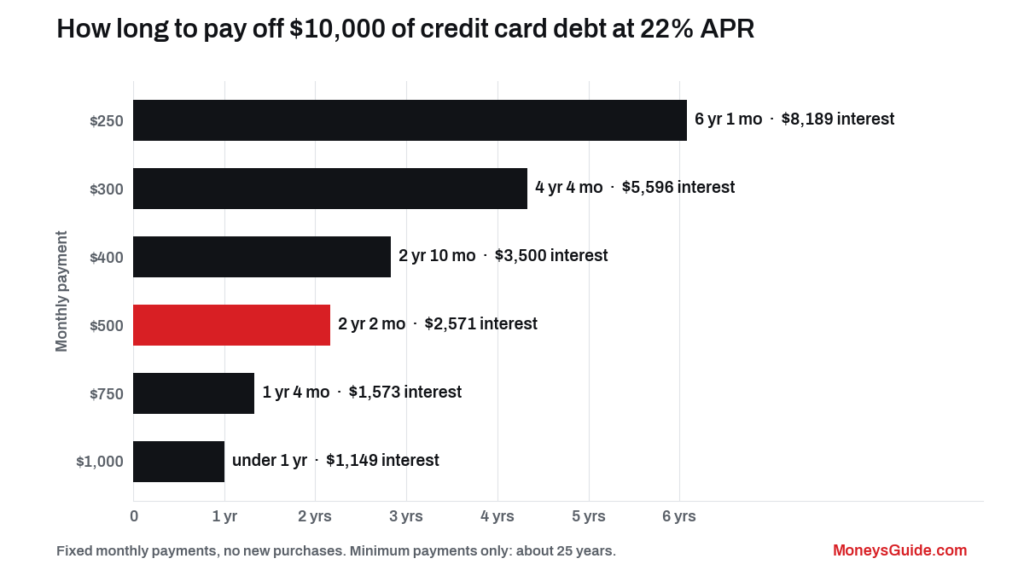
The pattern is striking. Going from $250 to $500 a month doesn’t just halve the time. It cuts the interest you pay by more than two-thirds, from about $8,189 to $2,571.
You can run your own numbers with our loan payment calculator. Enter your balance, your card’s APR and the number of months you want to be debt-free.
The minimum payment trap
Card issuers often set the minimum payment at around 1% of your balance plus that month’s interest, or a small fixed amount, whichever is higher. On $10,000 at 22% APR, the first minimum payment works out to about $283.
That sounds manageable, but here’s the catch: as your balance falls, so does the minimum. Each month you pay a little less, so the debt shrinks slower and slower. Paying only the minimum, the $10,000 would take about 25 years to clear and cost around $17,266 in interest, more than the original debt.
The simple fix: work out your first minimum payment and keep paying that same amount every month, even as the minimum drops. Paying a fixed $283 a month would clear the debt in about 4 years and 10 months with roughly $6,243 in interest. That one habit saves about 20 years and $11,000.
How much to pay to be debt-free by a deadline
If you’d rather pick a target date, here’s the monthly payment you’d need on $10,000 at 22% APR:
| Debt-free in | Monthly payment | Total interest |
|---|---|---|
| 1 year | about $936 | about $1,231 |
| 2 years | about $519 | about $2,451 |
| 3 years | about $382 | about $3,749 |
| 4 years | about $315 | about $5,123 |
A two- or three-year plan is a realistic goal for many households. To find room in your budget, try the 50/30/20 budget rule and direct part of your “wants” money to the card until it’s gone.
How much does your APR matter?
A lot. Here’s the same $10,000 balance with a fixed $300 a month payment at three different rates:
- 18% APR: about 3 years 11 months, roughly $3,967 in interest
- 22% APR: about 4 years 4 months, roughly $5,596 in interest
- 28% APR: about 5 years 6 months, roughly $9,563 in interest
The higher the rate, the more of each payment disappears into interest. That’s why lowering your rate, even temporarily, can be as powerful as paying more.
6 ways to pay off $10,000 of credit card debt faster
1. Stop adding to the balance
Every new purchase pushes the finish line further away. Switch to a debit card or cash for everyday spending while you pay the card down.
2. Pay a fixed amount, not the minimum
As shown above, simply refusing to let your payment shrink cuts decades off the timeline. Set up an automatic payment for a fixed amount so it happens without willpower.
3. Use a 0% balance transfer, carefully
A balance transfer card moves your debt to a new card with 0% interest for a promotional period, often 12 to 21 months. There’s usually a transfer fee of around 3% to 5%.
Example: moving $10,000 to a card with an 18-month 0% offer and a 3% fee costs $300 upfront. To clear the full $10,300 before the offer ends, you’d pay about $572 a month, and pay no interest at all. Compared with paying $500 a month at 22% APR, that saves over $2,000.
The risks: if you don’t clear the balance in time, the remaining debt jumps to the card’s standard rate. You also need a good credit history to qualify, and new purchases on the card may not get the 0% rate.
4. Consider a debt consolidation loan
A personal loan at a lower fixed rate can replace high-interest card debt with one predictable payment and a fixed end date. It only helps if the loan’s APR, including fees, is clearly lower than your card’s, and if you don’t run the card balance back up afterwards.
5. Ask your card issuer for a lower rate
If you’ve paid on time, call and ask whether they can reduce your APR. It doesn’t always work, but a few percentage points can save hundreds of dollars.
6. Put windfalls toward the balance
Tax refunds, bonuses and gifts can make a big dent. On a 22% card, every extra dollar you pay saves you 22 cents a year in interest, which is a guaranteed return few investments can match.
Multiple cards? Choose a payoff method
If your $10,000 is spread across several cards, decide which to attack first:
- Debt avalanche: pay extra on the highest interest rate first. This saves the most money.
- Debt snowball: pay extra on the smallest balance first. This gives you faster wins and motivation.
We compare both with real numbers in our guide to debt snowball vs avalanche.
Keep a small emergency fund while you pay
It sounds backwards to save while you’re in debt, but without any cash buffer, the next car repair goes straight back on the card. Aim for a small starter fund of around one month’s essential expenses, then focus everything else on the debt. Our guide on how to build an emergency fund explains how.
Common mistakes to avoid
- Paying only the minimum. It’s designed to keep you in debt for years.
- Closing paid-off cards immediately. Closing old accounts can affect your credit utilization and credit history. Consider keeping them open with no balance.
- Transferring the balance without a plan. A 0% offer only helps if you clear the debt before it ends.
- Using savings you’ll need soon. Paying off debt with your entire emergency fund can backfire when the next expense arrives.
- Ignoring help when you need it. If payments feel unmanageable, the Federal Trade Commission’s guide to coping with debt explains how to talk to creditors and spot risky “debt relief” offers.
Knowing how long to pay off $10,000 credit card debt at different payments turns a vague worry into a plan with a finish date.
Frequently asked questions
How long does it take to pay off $10,000 in credit card debt with $300 a month?
At 22% APR, about 4 years and 4 months, with roughly $5,596 in interest. At a lower rate like 18%, it takes about 3 years and 11 months.
Is $10,000 in credit card debt a lot?
It’s a significant balance, mainly because of the high interest rates cards charge. At 22% APR, it costs around $180 a month in interest alone at the start. With a steady plan, though, it can usually be cleared in two to four years.
Should I use savings to pay off credit card debt?
Using extra savings can make sense because card interest is so high, but keep a small emergency fund so you don’t end up back on the card when something unexpected happens.
Will paying off my credit card debt improve my credit score?
Lower balances usually help, because they reduce your credit utilization, the share of your available credit you’re using. Paying on time every month also builds a stronger credit history.
What’s the fastest way to pay off $10,000 in credit card debt?
Combine a 0% balance transfer (if you qualify) with a fixed monthly payment high enough to clear the balance before the offer ends, and stop adding new purchases.
This article is for education only and is not financial advice. Examples assume a fixed APR, no new purchases and no fees unless stated. Your card’s terms, rates and minimum payment formula may differ.