
$34 an Hour Is How Much a Year? (Planning for Yearly Costs)
Many budgets fail not because of monthly bills, but because of the costs that come once or twice a year: car insurance, repairs, gifts, holidays and annual subscriptions. On a good income like $34 an hour, these can still knock a budget off course if you don’t plan for them. So, $34 an hour is how much a year? At standard full-time hours, it’s $70,720 before tax. This guide breaks that down, then shows how sinking funds turn irregular costs into simple monthly amounts.
Quick summary
- $34 an hour at 40 hours a week for 52 weeks is $70,720 a year before tax.
- That’s about $5,893 a month, $2,720 every two weeks and $1,360 a week.
- In our example, irregular yearly costs add up to $6,600, or $550 a month.
- Sinking funds set that money aside monthly, so big bills never come as a surprise.
$34 an hour is how much a year?
Yearly pay = hourly rate × hours per week × weeks per year
$34 × 40 × 52 = $70,720 a year, before tax and deductions.
| Pay period | Before tax |
|---|---|
| Hourly | $34.00 |
| Daily (8 hours) | $272.00 |
| Weekly | $1,360.00 |
| Every two weeks | $2,720.00 |
| Twice a month | $2,946.67 |
| Monthly | $5,893.33 |
| Yearly | $70,720.00 |
See every rate from $10 to $100 in our hourly to salary chart, or use our free salary converter.
Different schedules
| Schedule | Yearly pay |
|---|---|
| 20 hours a week | $35,360 |
| 30 hours a week | $53,040 |
| 40 hours a week | $70,720 |
| 40 hours + 5 hours overtime at 1.5× | $83,980 |
Take-home pay
These figures are gross pay. Take-home pay depends on the tax rules where you live and your deductions.
An example only: if about 24% went to tax and deductions, $70,720 would leave about $53,747 a year, or roughly $4,479 a month.
What are sinking funds?
A sinking fund is money you set aside every month for a known, irregular cost. Instead of finding $1,200 when car insurance renews, you save $100 a month towards it all year.
Sinking funds are different from an emergency fund:
- An emergency fund covers the unexpected, such as job loss or a medical emergency.
- Sinking funds cover costs you know are coming, even if you’re not sure of the exact date.
An example on $34 an hour
| Irregular cost | Example yearly amount | Monthly to set aside |
|---|---|---|
| Car insurance | $1,200 | $100 |
| Car maintenance and tyres | $900 | $75 |
| Gifts and holidays | $1,200 | $100 |
| Annual subscriptions | $300 | $25 |
| Home or rental repairs | $600 | $50 |
| Medical and dental | $600 | $50 |
| Travel | $1,800 | $150 |
| Total | $6,600 | $550 |
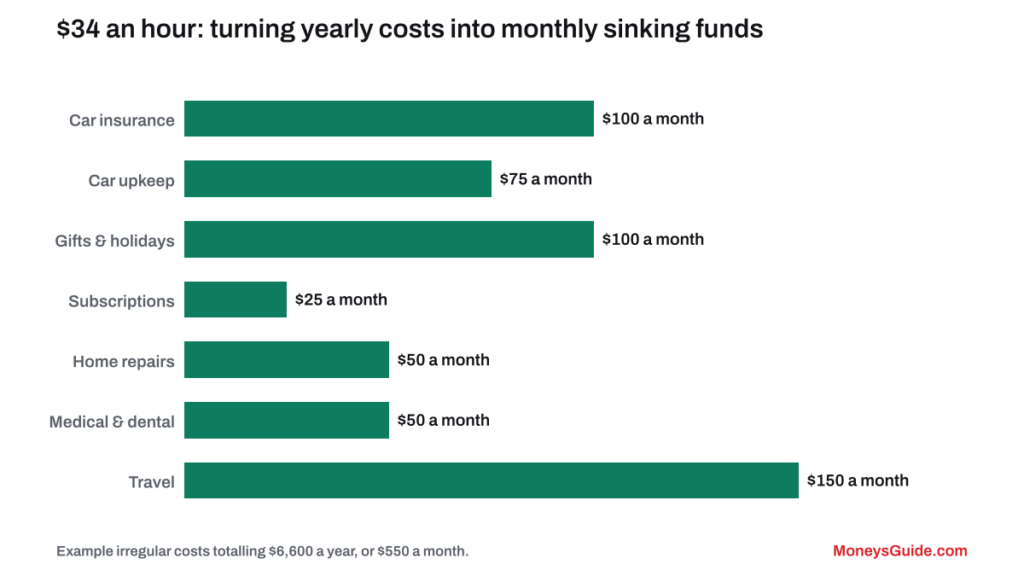
That’s about 12% of the example take-home pay. Without sinking funds, these costs often end up on a credit card, where 22% interest makes them far more expensive.
Why sinking funds beat using a credit card
Putting a $1,200 insurance renewal on a credit card at 22% and paying it off over 6 months costs about $78 in interest. Over 12 months, about $148. Spread across all your yearly costs, that adds up quickly, and it’s money that a simple monthly transfer would have saved.
Sinking funds also reduce stress: when the bill arrives, the money is already there.
Common sinking fund categories
Depending on your life, you might also include:
- Holidays and celebrations, including travel to see family
- Back-to-school costs or childcare gaps during school breaks
- Pet costs, such as vet visits and annual vaccinations
- Professional costs, like licences, memberships or training
- Replacing electronics, such as a phone or laptop every few years
- Your next car, saved monthly so you can pay cash. See $32 an hour: cash vs financing a car.
Start with your three or four biggest irregular costs. You can always add more over time.
How to set up sinking funds
- List every irregular cost from the last 12 months. Bank statements make this easy.
- Estimate the yearly amount for each, and divide by 12.
- Open a separate savings account, or use “pots” or sub-accounts if your bank offers them, one for each fund.
- Automate the transfers on payday.
- Spend from the right pot when a bill arrives, and top up if a cost was higher than expected.
Our budget planner helps you fit sinking funds into your monthly budget, and our savings goal calculator works out the monthly amount for any target date.
A sample monthly budget on $34 an hour
Using the example take-home pay of about $4,479:
| Category | Example monthly amount |
|---|---|
| Rent or mortgage and utilities | $1,650 |
| Food | $500 |
| Transport (fuel, transit, loan) | $350 |
| Phone and internet | $90 |
| Personal spending | $539 |
| Sinking funds | $550 |
| Emergency fund | $200 |
| Saving and investing | $600 |
| Total | $4,479 |
Keeping sinking funds on track
- Review them twice a year. Insurance premiums and travel costs often rise, so update the monthly amounts.
- Roll over any leftovers. If a fund wasn’t fully used, leave it to grow for next year, or move it to savings.
- Don’t borrow between funds unless it’s planned, or one goal ends up short.
- Name your pots clearly, such as “Car insurance – due March”, so you always know what each balance is for.
Where sinking funds fit in your money plan
- Starter emergency fund of $1,000 or more. See how to build an emergency fund.
- Sinking funds for known irregular costs.
- Clear high-interest debt. See debt snowball vs avalanche.
- Grow your emergency fund to 3 to 6 months of essential costs.
- Invest for the long term.
The Consumer Financial Protection Bureau’s guide to building an emergency fund explains how to keep short-term savings separate and accessible.
How $34 an hour compares with nearby rates
| Hourly rate | Yearly pay | Monthly pay |
|---|---|---|
| $30 | $62,400 | $5,200 |
| $32 | $66,560 | about $5,547 |
| $34 | $70,720 | about $5,893 |
| $35 | $72,800 | about $6,067 |
| $36 | $74,880 | $6,240 |
See $32 an hour and $35 an hour.
Is $34 an hour good pay?
For most people in most areas, yes. At $70,720 a year, you can cover a comfortable lifestyle and save steadily, as long as irregular costs are planned for. Check whether your pay has kept up with prices using our salary vs inflation calculator.
Common mistakes
- Treating predictable costs as emergencies
- Using the emergency fund for yearly bills
- Putting irregular costs on a credit card
- Keeping sinking funds in your everyday account, where they get spent
- Forgetting to update amounts when costs rise
So, $34 an hour is how much a year? $70,720 at full-time hours before tax, or about $5,893 a month. Add sinking funds to your budget, and the big yearly bills stop being stressful surprises and become simple, planned monthly amounts.
Frequently asked questions
How much is $34 an hour a month?
About $5,893 a month before tax, at 40 hours a week for 52 weeks.
How much is $34 an hour every two weeks?
$2,720 before tax, at 40 hours a week.
How much is $34 an hour after tax?
It depends on where you live and your deductions. As an example, if about 24% went to tax and deductions, you’d take home about $53,747 a year, or $4,479 a month.
What is a sinking fund?
Money you save each month for a known, irregular cost, such as car insurance, gifts or travel, so you can pay it without borrowing.
How many sinking funds should I have?
Start with a few for your largest irregular costs, such as car insurance, gifts and travel, and add more as you go. Some people combine smaller ones into a single “irregular costs” pot.
Where should I keep sinking funds?
In a separate savings account, or in labelled pots within your bank, so the money is easy to reach but kept apart from everyday spending.
How much is $34 an hour with overtime?
With 5 hours of overtime a week at time-and-a-half, about $83,980 a year before tax.
Are sinking funds the same as an emergency fund?
No. Sinking funds cover expected costs; an emergency fund covers the unexpected, like job loss.
How much is $34 an hour a week?
$1,360 a week before tax, at a full-time 40 hours.
Is $34 an hour the same as $70,000 a year?
Close. At 40 hours a week for 52 weeks, it’s $70,720.
This article is for education only and is not financial, tax or employment advice. Figures are gross pay unless stated. Cost and take-home examples are illustrative.