
$70,000 a Year Is How Much an Hour? (Budgets for Every Household)
$70,000 a year is a solid income, but how comfortable it feels depends a lot on who it supports. For a single person it can mean plenty of room to save. For a family on one income, it needs careful planning. So, $70,000 a year is how much an hour? At a standard 40-hour week, it’s $33.65. This guide breaks $70,000 down by pay period, then shows how to budget on it as a single person, a couple and a family.
Quick summary
- $70,000 a year is $33.65 an hour at 40 hours a week for 52 weeks.
- That’s about $5,833 a month, $2,692 every two weeks and $1,346 a week, before tax.
- At 45 hours a week, your real hourly rate is about $29.91.
- A single person might aim for a 3-month emergency fund; a family on one income, 6 months or more.
$70,000 a year is how much an hour?
Hourly rate = yearly salary ÷ (hours per week × weeks per year)
$70,000 ÷ 2,080 = $33.65 an hour
$70,000 by pay period
| Pay period | Before tax |
|---|---|
| Hourly (40 hours a week) | $33.65 |
| Daily (5 days a week) | $269.23 |
| Weekly | $1,346.15 |
| Every two weeks | $2,692.31 |
| Twice a month | $2,916.67 |
| Monthly | $5,833.33 |
| Yearly | $70,000.00 |
Your real hourly rate
| Typical hours per week | Effective hourly rate |
|---|---|
| 40 | $33.65 |
| 45 | about $29.91 |
| 50 | about $26.92 |
Convert any salary with our free salary converter.
How $70,000 compares with nearby salaries
| Yearly salary | Hourly rate (40 hours) | Monthly pay |
|---|---|---|
| $60,000 | $28.85 | $5,000 |
| $65,000 | $31.25 | about $5,417 |
| $70,000 | $33.65 | about $5,833 |
| $75,000 | $36.06 | $6,250 |
| $80,000 | $38.46 | about $6,667 |
Take-home pay
These are gross figures. Take-home pay depends on the tax rules where you live, your household, and deductions such as retirement contributions.
An example only: if about 23% went to tax and deductions, $70,000 would leave about $53,900 a year, or roughly $4,492 a month. We’ll use that figure in the budgets below. Your own payslip is the best guide.
Budgeting $70,000 as a single person
On about $4,492 a month take-home, a 50/30/20 split gives:
| Bucket | Share | Monthly |
|---|---|---|
| Needs | 50% | about $2,246 |
| Wants | 30% | about $1,348 |
| Savings and extra debt payments | 20% | about $898 |
For a single person in an area with moderate costs, this usually leaves room to rent or buy a modest home, run a car, and still save around $900 a month. Many single earners on $70,000 push savings higher, to 25% or more, while their costs are low. Our budget planner tests different splits on your own pay.
Budgeting $70,000 as a couple
If $70,000 is one of two incomes, the picture changes completely. For example, $70,000 plus a partner earning $45,000 is a combined $115,000, or about $9,583 a month before tax. Shared housing and bills mean a much larger share can go to saving.
A simple approach many couples use:
- Pool shared costs: housing, bills, groceries and savings goals, usually in proportion to each person’s income.
- Keep some personal spending money each, so day-to-day choices don’t need discussion.
- Set joint goals: an emergency fund, a home deposit, retirement.
Budgeting $70,000 for a family on one income
As the only income for a family, $70,000 has to cover more, so priorities matter:
- Housing first: aim to keep total housing costs within about 28% to 30% of gross pay, roughly $1,630 to $1,750 a month.
- Childcare and food can take a big share; budget for them separately.
- A bigger emergency fund: with dependants and one income, many aim for 6 months or more of essential costs.
- Insurance: life and income protection cover become much more important when others rely on your income.
A 60/30/10 or 60/20/20 split can be more realistic than 50/30/20 while children are young, as long as something goes to savings every month.
Saving for goals on $70,000
Whatever your household, it helps to give every savings goal its own target and timeline:
| Goal | Example target | Monthly saving | Time |
|---|---|---|---|
| Starter emergency fund | $2,000 | $250 | 8 months |
| Car replacement fund | $6,000 | $250 | 2 years |
| Home deposit | $30,000 | $500 | 5 years |
These ignore interest, so a high-yield savings account would get you there a little faster. Our savings goal calculator works out the exact monthly amount for any target and date.
Tip for couples and families: keep each goal in its own savings pot or account, so you can see progress and avoid dipping into the wrong one.
Emergency fund targets on $70,000
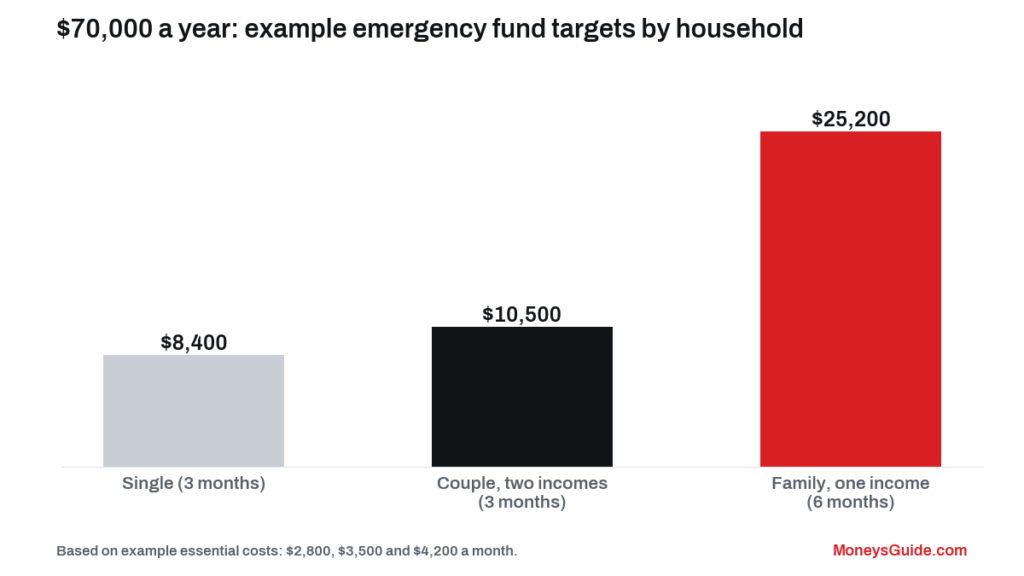
| Household (example essential costs) | Suggested cover | Target |
|---|---|---|
| Single person ($2,800 a month) | 3 months | about $8,400 |
| Couple, two incomes ($3,500 a month) | 3 months | about $10,500 |
| Family, one income ($4,200 a month) | 6 months | about $25,200 |
Use our emergency fund calculator with your own costs, and see how to build an emergency fund for practical steps.
Insurance and protection on one income
When others rely on your $70,000, protecting that income matters as much as growing it:
- Life insurance can replace your income for your family if you die.
- Income protection or disability cover can replace part of your pay if illness or injury stops you working.
- A will makes sure your wishes are followed and can simplify things for your family.
Costs vary widely by age, health and where you live, so compare quotes and check what your employer already provides before buying extra cover.
Is $70,000 a good salary?
For a single person in most areas, it’s a comfortable income with room to save. For a couple with two incomes, it’s a strong foundation. For a family on one income, it can work well in lower-cost areas but feels tight where housing is expensive.
If your pay hasn’t risen in a while, check whether it has kept pace with prices using our salary vs inflation calculator. The Bureau of Labor Statistics’ CPI Inflation Calculator shows how much prices have changed.
Making $70,000 go further
- Automate savings on payday, before spending.
- Take any employer retirement match.
- Clear high-interest debt quickly. See how long it takes to pay off $10,000 in credit card debt.
- Keep housing and car costs moderate, especially on a single family income.
- Review your budget yearly as your household changes.
Common mistakes
- Using a single person’s budget for a family, with no room for childcare or a bigger emergency fund
- Ignoring insurance when others depend on your income
- Comparing salaries without adjusting for hours worked
- Not agreeing shared goals as a couple
- Letting spending rise to match every raise
So, $70,000 a year is how much an hour? $33.65 at a standard 40-hour week, or about $5,833 a month. Plan it around your household, and it can support a comfortable life and steady progress towards your goals.
Frequently asked questions
How much is $70,000 a year per month?
About $5,833 a month before tax.
How much is $70,000 a year biweekly?
About $2,692.31 before tax, across 26 paychecks.
How much is $70,000 a year weekly?
About $1,346.15 a week before tax.
How much is $70,000 a year after tax?
It depends on where you live and your deductions. As an example, if about 23% went to tax and deductions, you’d take home about $53,900 a year, or $4,492 a month.
How much should a single person save on $70,000?
Many aim for at least 20% of take-home pay, about $900 a month on the example figures, and more while costs are low.
How big should a family’s emergency fund be on $70,000?
On one income, six months or more of essential costs is a common target, for example about $25,200 on $4,200 a month of essentials.
Is $34 an hour the same as $70,000 a year?
Close. $34 an hour at 40 hours a week is $70,720 a year, slightly more than $70,000.
How much house can I afford on $70,000?
Using a 28% housing guideline, total housing costs of about $1,633 a month. With example taxes and insurance, that supports a home of roughly $260,000 with 20% down at 6.5%. Your rate, debts and local costs will change this.
Can a family live on $70,000 a year?
Many families do, especially in areas with moderate housing costs. Careful budgeting, a larger emergency fund and the right insurance help make one income work.
This article is for education only and is not financial, tax or employment advice. Figures are gross pay unless stated. Take-home and budget examples are illustrative.