Debt Snowball vs Debt Avalanche: Which Is Faster?
If you have several debts, deciding which one to pay off first can feel overwhelming. Two popular methods give you a clear plan: the debt snowball and the debt avalanche. Both work. The difference is whether you’d rather save the most money or get motivating wins sooner. This guide compares debt snowball vs avalanche with a real example so you can choose.
Quick summary
- Snowball: pay off the smallest balance first for quick wins.
- Avalanche: pay off the highest interest rate first to save the most money.
- In our example, avalanche saves $61 in interest, while snowball clears the first debt 9 months sooner.
- The best method is the one you’ll stick with until every debt is gone.
How both methods start
Both methods follow the same basic rules:
- List every debt with its balance, interest rate and minimum payment.
- Decide on a fixed monthly amount for debt repayment, more than the total minimums.
- Pay the minimum on every debt each month.
- Put all the extra money on one target debt.
- When that debt is cleared, roll its payment into the next target.
The only difference is which debt you target first.
The debt snowball method
Order your debts from smallest balance to largest, ignoring interest rates. Clear the smallest first, then the next.
Why people like it: you see a debt disappear quickly, which builds motivation. Each cleared debt frees up a payment to throw at the next one, so the “snowball” grows.
The debt avalanche method
Order your debts from highest interest rate to lowest. Clear the most expensive debt first.
Why people like it: it attacks the debt that costs the most, so you pay the least total interest and often finish slightly sooner.
A real example: debt snowball vs avalanche
Imagine three debts and a budget of $500 a month for repayments ($200 more than the $300 in minimums):
| Debt | Balance | Interest rate | Minimum payment |
|---|---|---|---|
| Credit card | $3,500 | 24% | $90 |
| Store card | $900 | 18% | $30 |
| Personal loan | $6,000 | 11% | $180 |
Snowball order: store card → credit card → personal loan
Avalanche order: credit card → store card → personal loan
The results
| Snowball | Avalanche | |
|---|---|---|
| First debt cleared | Month 5 (store card) | Month 14 (credit card) |
| All debts cleared | Month 25 | Month 25 |
| Total interest paid | about $1,684 | about $1,623 |
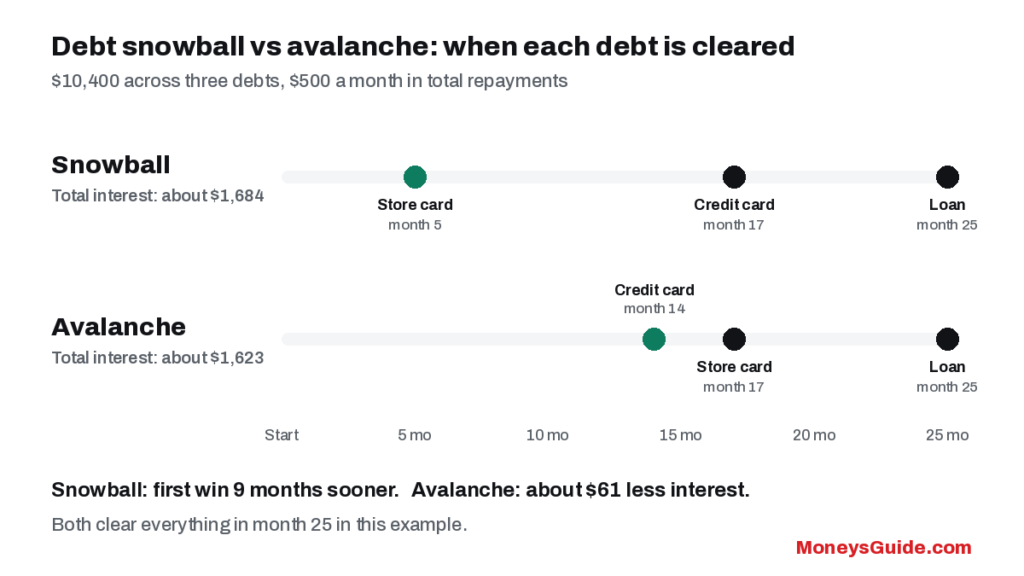
In this example, the avalanche saves about $61, and both finish in the same month. The snowball gives you your first win nine months earlier.
The gap between the two methods grows when interest rates are very different and the high-rate debt has a large balance. If your most expensive debt is also your biggest, the avalanche can save a lot more.
Which method should you choose?
Choose the avalanche if:
- You’re motivated by saving the most money.
- Your high-interest debt has a large balance.
- You’re confident you’ll stay on track without early wins.
Choose the snowball if:
- You’ve struggled to stick with debt plans before.
- You have several small balances you could clear quickly.
- Seeing progress keeps you going.
A hybrid works too: clear one or two tiny balances first for momentum, then switch to the avalanche.
Whichever you pick, the biggest factor is how much extra you can pay each month. Paying only the minimums in this example would take far longer and cost much more interest.
Tips to get out of debt faster
- Stop adding new debt. Put cards away while you pay them down.
- Find extra money with a simple budget. See our guide to the 50/30/20 budget rule.
- Keep a small emergency fund, so a surprise bill doesn’t go back on a card. Our guide on how to build an emergency fund explains how.
- Ask about a lower rate. Some lenders will reduce your rate, or a cheaper consolidation loan may help, but check all fees first.
- Celebrate each cleared debt, then roll the payment straight into the next one.
The Federal Trade Commission’s guide to coping with debt covers budgeting, talking to creditors and how to spot risky “debt relief” offers.
Common debt snowball vs avalanche mistakes
- Missing minimum payments on other debts while focusing on one
- Not rolling over freed-up payments, which stops the method from working
- Switching methods every month instead of committing
- Using the freed-up money for spending once a debt is cleared
Frequently asked questions
Is the debt avalanche always cheaper?
It usually saves the most interest, but the difference can be small, as in our example. If the snowball keeps you motivated to finish, it may work better for you in practice.
Should I include my mortgage?
Usually not. These methods are best for consumer debts like credit cards, store cards and personal loans. Keep paying your mortgage as normal.
What if two debts have the same rate?
With the avalanche, target the smaller balance first. You’ll clear it sooner and free up its payment.
How can I see how long one debt will take?
Enter its balance, rate and your planned payment into our loan and EMI calculator to see how quickly it can be cleared.
This article is for education only and is not financial advice. Figures are illustrative. If you’re struggling with debt, consider speaking to a reputable, non-profit credit counselling service.