How Long Does It Take to Pay Off $15,000 in Credit Card Debt?
$15,000 of credit card debt is a common balance, and an expensive one. At typical card rates, the interest alone can cost more than many people’s phone, internet and streaming bills combined. So how long does it take to pay off $15,000 in credit card debt? This guide shows exact timelines at different payment levels, what each costs in interest, and the quickest realistic routes to zero.
Quick summary
- At 22% APR, $15,000 of card debt charges about $275 of interest in the first month.
- Paying only the minimum could take around 28 years and cost about $26,400 in interest.
- Paying $500 a month clears it in about 3 years 8 months, with about $6,977 of interest.
- A 0% balance transfer or lower-rate personal loan can cut the cost sharply, if you qualify.
How long to pay off $15,000 in credit card debt
Here’s how long it takes at 22% APR, assuming you stop using the card:
| Monthly payment | Time to pay off | Total interest |
|---|---|---|
| Minimum only (1% + interest) | about 28 years 4 months | about $26,433 |
| $300 | about 11 years 5 months | about $26,034 |
| $400 | about 5 years 5 months | about $10,610 |
| $500 | about 3 years 8 months | about $6,977 |
| $600 | about 2 years 10 months | about $5,250 |
| $750 | about 2 years 2 months | about $3,857 |
| $1,000 | 18 months | about $2,703 |
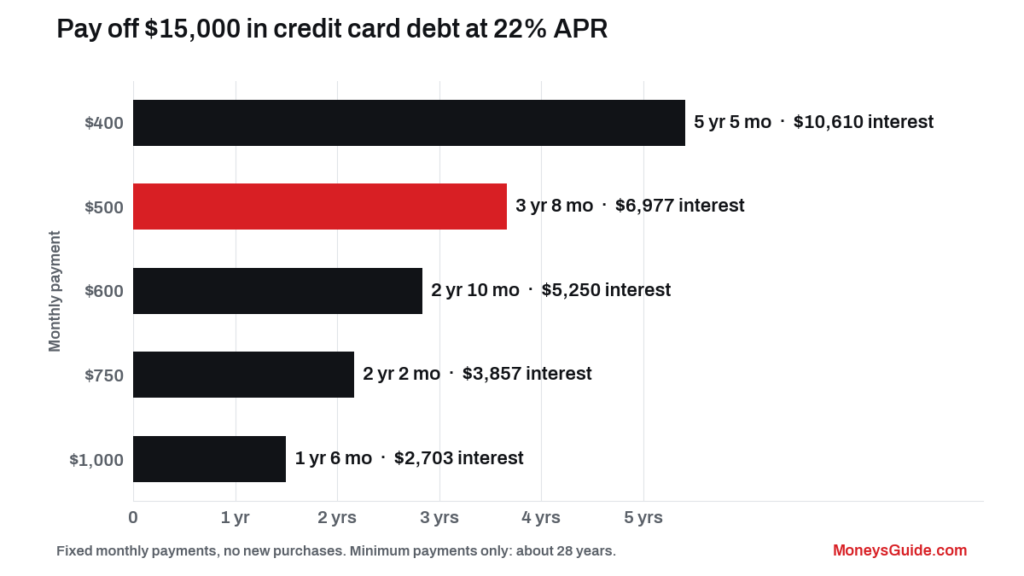
Look at the gap between $300 and $400 a month. At $300, only about $25 of the first payment reduces the balance, because $275 goes to interest. Adding $100 a month cuts the time by six years and saves over $15,000 in interest.
See your own debt-free date with our credit card payoff calculator.
The minimum payment trap
On $15,000 at 22%, a typical first minimum payment (1% of the balance plus interest) is about $425. That sounds like a serious payment, but the minimum shrinks as the balance falls, so the debt takes decades to clear.
The fix: keep paying that first amount, about $425, every month, even as the minimum drops. You’d be debt-free in about 4 years 10 months, with about $9,364 of interest, instead of 28 years and $26,400.
Be wary of online calculators showing “100+ years” for minimum payments. Results depend heavily on the minimum payment formula, so check your statement for the formula your card actually uses.
How much to pay to be debt-free by a deadline
| Debt-free in | Monthly payment at 22% APR | Total interest |
|---|---|---|
| 2 years | about $778 | about $3,676 |
| 3 years | about $573 | about $5,623 |
| 4 years | about $473 | about $7,684 |
A 3-year plan at around $573 a month is a realistic target for many households.
Faster ways to pay off $15,000
1. Move it to a 0% balance transfer card
If you qualify, an 18-month 0% offer with a 3% fee costs $450 upfront. To clear the full $15,450 before the offer ends, you’d pay about $858 a month, with no interest. Compared with a 2-year plan at 22% ($3,676 of interest), that saves about $3,200.
The catches: you’ll need good credit, the limit may not cover the whole balance, and anything left when the offer ends goes back to a high rate. See is a balance transfer worth it.
2. Consolidate with a lower-rate personal loan
A personal loan at, for example, 11% over 4 years would cost about $388 a month and $3,609 in interest, compared with about $7,684 for a 4-year plan at 22%. You also get a fixed end date. Compare APRs and fees carefully, and avoid running the cards back up. See whether you can pay off a personal loan early.
3. Use the avalanche or snowball method
If the $15,000 is spread over several cards, choose an order:
- Avalanche: extra money to the highest rate first, which saves the most interest
- Snowball: extra money to the smallest balance first, for faster wins
Our debt payoff calculator compares both with your own balances.
4. Ask your card issuers for a lower rate
If you’ve paid on time, call and ask. Even a few points lower saves money every month.
5. Find more money each month
Every extra $100 a month cuts years off a balance this size. Our budget planner helps you see where your money goes.
A realistic 3-year plan
Paying about $573 a month at 22% APR:
- Months 1–12: a large share of each payment goes to interest, so the balance falls slowly. Stay consistent.
- Months 13–24: with a smaller balance, more of each payment reduces the debt, and progress speeds up.
- Months 25–36: the balance falls quickly, and you finish debt-free with about $5,623 of interest paid in total.
Seeing the balance fall each month is one of the best motivators. Track it, and celebrate milestones like the first $5,000 paid off.
If the $15,000 is spread over several cards
Many people carry their balance across two or three cards with different rates. Before you choose a strategy:
- List every card with its balance, APR and minimum payment.
- Decide on a total monthly amount you can pay across all of them.
- Pay the minimum on every card, and put everything extra on one target card: the highest rate for the avalanche, or the smallest balance for the snowball.
- When a card is paid off, roll its payment into the next target.
Our debt snowball vs avalanche guide shows how much each approach saves with real numbers.
Should you use savings?
Paying off a 22% card is like earning a guaranteed 22% return. But keep a starter emergency fund, about one month of essential costs, so the next surprise doesn’t go straight back on a card. See how to build an emergency fund, or use our emergency fund calculator.
Will paying it off help your credit score?
Usually, yes. Lower balances reduce your credit utilization, the share of your available credit you’re using, which is an important factor in many credit scores. Keep paying on time, and avoid closing paid-off cards straight away, since that can raise your utilization on the cards you keep.
When to get help
If minimum payments are becoming hard to manage, contact your card issuers early, as many offer hardship plans. A reputable non-profit credit counselling service can also help. Be cautious of companies promising to wipe out debt for a fee. The Federal Trade Commission’s guide to coping with debt explains your options and the warning signs of debt relief scams.
Common mistakes
- Paying only the minimum, which can stretch $15,000 over nearly three decades
- Moving debt to a 0% card, then running the old card back up
- Missing payments during a promotional period, which can end the 0% rate
- Consolidating at a rate that isn’t much lower once fees are included
- Draining every dollar of savings and leaving no emergency cushion
With a fixed payment, a lower rate where possible and a clear deadline, you can pay off $15,000 in credit card debt in a few years rather than decades. For other balances, see $10,000 and $20,000 in credit card debt.
Frequently asked questions
How long does it take to pay off $15,000 in credit card debt?
At 22% APR, about 3 years 8 months at $500 a month, 2 years 10 months at $600, or 18 months at $1,000.
How much interest does $15,000 of credit card debt cost a month?
About $275 in the first month at 22% APR. At 18%, about $225. At 26%, about $325.
How much should I pay to clear $15,000 in 3 years?
About $573 a month at 22% APR, with about $5,623 in total interest.
Should I close my cards after paying them off?
Usually not straight away. Keeping paid-off cards open, with no balance, can help your credit utilization. If a card tempts you to spend or charges an annual fee, closing it may still be the right call.
Is $15,000 in credit card debt a lot?
It’s a significant balance because of the high interest. With a steady plan of $500 to $750 a month, it can usually be cleared in two to four years.
What’s the fastest way to pay off $15,000 in credit card debt?
Combine a 0% balance transfer or lower-rate loan, if you qualify, with the biggest fixed monthly payment you can afford, and stop adding new purchases.
This article is for education only and is not financial advice. Examples assume a fixed APR, no new purchases and no fees unless stated. Your card’s terms and minimum payment formula may differ.