Can You Pay Off a Personal Loan Early? (And Should You?)
Personal loans come with a fixed end date, but that doesn’t mean you have to wait for it. If you’ve had a pay rise, a bonus or simply want to be debt-free sooner, you might be wondering: can you pay off a personal loan early? Usually, yes. This guide shows how much you could save with real numbers, the fees and catches to check first, and when paying early isn’t the smartest use of your money.
Quick summary
- Most personal loans can be paid off early, but some charge a prepayment penalty.
- On a $15,000 loan at 12% over 5 years, total interest is about $5,020.
- Paying $200 extra a month saves about $2,321 and clears the loan 26 months early.
- Pay off higher-interest debt and build an emergency fund before prepaying a personal loan.
Can you pay off a personal loan early?
In most cases, yes. Many lenders let you make extra payments or pay off the full balance at any time. Some, however, include fees or conditions in the loan agreement. Before you pay early, check three things:
- Is there a prepayment penalty? Some lenders charge a fee if you repay early, often a percentage of the remaining balance or a set number of months’ interest.
- How is interest calculated? Most personal loans use simple interest on the remaining balance, so paying early cuts your interest directly. A few use precomputed interest, where the interest is calculated upfront and paying early saves much less.
- Where do extra payments go? Make sure extra money goes to your principal, not toward next month’s payment.
You’ll find these details in your loan agreement, or you can simply ask your lender.
How much could you save? A real example
Let’s take a typical loan:
- Amount: $15,000
- Interest rate: 12% APR
- Term: 60 months (5 years)
- Monthly payment: about $333.67
- Total interest if paid on schedule: about $5,020
Here’s what different ways of paying early would save:
| Approach | Paid off in | Interest paid | Interest saved |
|---|---|---|---|
| Normal payments | 60 months | about $5,020 | — |
| $100 extra a month | about 43 months | about $3,500 | about $1,520 |
| $200 extra a month | about 34 months | about $2,699 | about $2,321 |
| $5,000 lump sum after 12 months | about 39 months | about $2,764 | about $2,256 |
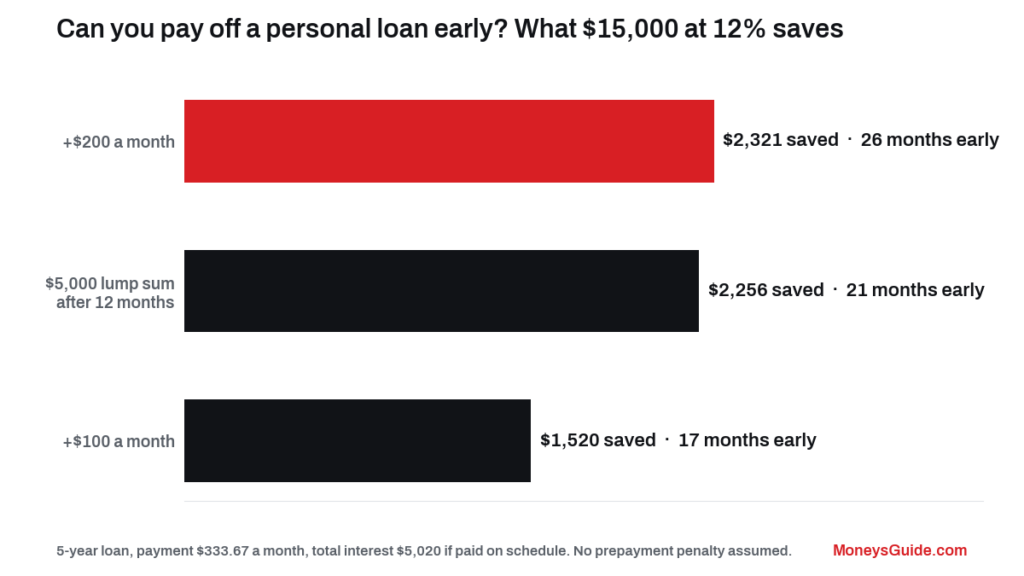
The earlier you pay extra, the more you save, because interest is charged on a larger balance at the start of the loan. Try your own numbers in our loan payment calculator.
Is it worth paying a prepayment penalty?
Sometimes. Compare the penalty with the interest you’d save.
Example: two years into the loan above, you still owe about $10,046. If you kept paying normally, you’d pay about $1,966 more in interest over the remaining three years. A 2% prepayment penalty on $10,046 would be about $201.
Paying it off early would still save about $1,765, so the penalty is worth paying in this case. Near the end of a loan, when little interest is left, a penalty is more likely to cancel out the savings.
Common types of prepayment penalty
If your loan does have an early repayment charge, it’s usually one of these:
- A percentage of the remaining balance, for example 1% to 5% of what you still owe
- A set number of months’ interest, for example two or three months
- A flat fee, a fixed dollar amount whatever the balance
- Precomputed interest, where interest is calculated upfront for the whole term, so paying early returns only part of it
Some lenders only charge a penalty in the first year or two, or only on full early repayment, not on smaller extra payments. Read the exact wording, or ask the lender to show you the payoff amount with and without early repayment.
Does paying off a personal loan early hurt your credit?
It can cause a small, temporary dip in your credit score. When an installment loan is closed, it may slightly change your mix of credit accounts or the average age of your accounts. For most people, the effect is minor and short-lived, and having less debt is better for your finances overall.
If you’re about to apply for a mortgage or another big loan, ask the lender whether timing matters. Paying off debt usually helps by lowering your debt-to-income ratio, the share of your income that goes on debt repayments.
When paying off early isn’t the best move
Paying off a personal loan early is a guaranteed saving, but other uses for the money may be more valuable.
You have higher-interest debt
If you also carry credit card debt at 20% or more, pay that off first. It costs much more than a 12% personal loan. See how long it takes to pay off $10,000 in credit card debt.
You don’t have an emergency fund
If paying off the loan would empty your savings, the next unexpected bill could push you back into debt at a worse rate. Keep at least a starter emergency fund first. See how to build an emergency fund.
Your loan rate is very low
If your personal loan has a low rate, the money might do more good elsewhere, for example in a workplace retirement plan with employer matching, or in long-term investments, although these carry risk.
There’s a large penalty
If the penalty is close to or more than the interest you’d save, keep paying as normal.
Which debt should you pay off first?
If you have several debts and some extra money, rank them by interest rate. Typical rates look something like this:
| Debt | Typical rate range | Priority for extra payments |
|---|---|---|
| Credit cards | around 18%–29% | First |
| Personal loans | around 8%–20% | Second |
| Car loans | around 5%–12% | Third |
| Mortgages | around 5%–7% | Usually last |
Rates vary widely by lender and credit history, so use your own figures. The higher the rate, the more each extra dollar saves.
How to pay off a personal loan early: 5 ways
- Add a fixed extra amount each month. Even $50–$100 makes a noticeable difference.
- Round up your payment. Paying $350 instead of $333.67 is easy to budget for.
- Use windfalls. Tax refunds, bonuses and gifts can go straight to the balance.
- Make biweekly half-payments. This works out to one extra full payment a year, if your lender applies payments when they arrive.
- Refinance to a lower rate, if your credit has improved, but compare fees and avoid stretching the term.
If you have several debts, choose an order using the debt snowball or avalanche method.
Steps to pay off the full balance
- Ask your lender for a payoff quote. This shows the exact amount needed on a specific date, including any interest up to that day.
- Pay the exact amount before the quote expires.
- Get written confirmation that the loan is paid in full and the account is closed.
- Check your credit report a month or two later to make sure the account shows as paid.
- Cancel any automatic payments linked to the loan.
Where to get help if you’re struggling
If you’re finding loan payments hard to manage, contact your lender early, as many have hardship options. The Federal Trade Commission’s guide to coping with debt explains how to talk to creditors and avoid risky “debt relief” offers.
So, can you pay off a personal loan early? In most cases, yes, and if there’s no big penalty and you’ve covered your emergency fund and expensive debts, it’s usually a smart move.
Frequently asked questions
Can you pay off a personal loan early without a penalty?
Many lenders allow it, but not all. Check your loan agreement or ask your lender whether there’s a prepayment penalty before you pay.
How much will I save by paying off my personal loan early?
It depends on your balance, rate and how early you pay. On a $15,000 loan at 12% over 5 years, $100 extra a month saves about $1,520 and $200 extra saves about $2,321.
Is it better to pay off a loan early or save the money?
If you don’t have an emergency fund, build that first. After that, paying off the loan early is usually a good choice, especially if the rate is high.
Does paying a loan off early lower my credit score?
It may cause a small, temporary drop. Over time, lower debt and a history of on-time payments generally support a healthy credit score.
Should I pay off my personal loan or my credit card first?
Usually the credit card, because card interest rates are typically much higher than personal loan rates.
This article is for education only and is not financial advice. Examples assume a fixed APR, simple interest and extra payments applied to principal. Check your own loan terms with your lender.