How Much House Can I Afford? A Step-by-Step Guide
“How much house can I afford?” is the first question to answer before you start viewing properties. You need one number: the most you can comfortably spend. Not the most a bank will lend you, but a price that leaves room in your budget for everything else in your life.
Quick summary
- A common guideline is to keep housing costs to about 28% of your gross monthly income.
- Other common tests include income multiples and “stress-tested” interest rates.
- Your maximum price is the loan your payment supports plus your down payment.
- Budget separately for upfront fees and the ongoing costs of owning a home.
This guide walks through how lenders judge affordability, works through a real example, and covers the costs that catch many first-time buyers out.
How much house can I afford? The two questions that decide it
How much house you can afford comes down to two things:
- How big a monthly payment can you handle? This depends on your income, your other debts and your living costs.
- How much cash do you have upfront? This covers your down payment plus one-off buying costs.
The answer to the first question sets the size of your loan. The answer to the second sets how much you can add on top. Together, they give you a price range.
Step 1: Work out a safe monthly housing payment
Lenders look at how much of your income goes on debt. Different countries use different rules, but two common approaches are:
The 28/36 rule (a widely used guideline)
- Spend no more than 28% of your gross monthly income on housing costs: the mortgage payment plus property tax and insurance.
- Spend no more than 36% on all debts combined, including car loans, credit cards and student loans.
The Consumer Financial Protection Bureau’s Your Home Loan Toolkit includes free worksheets for estimating a total monthly home payment you’re comfortable with.
Other tests lenders commonly use
- Income multiples: many lenders cap borrowing at around 4 to 4.5 times your annual income.
- Debt-service ratios: some lenders cap housing costs at around 39% of gross income and all debts at around 44%.
- Stress tests: many lenders check you could still afford repayments if your rate were 2 to 3 percentage points higher than the rate you’re actually offered.
Exact limits vary by lender, loan type and where you live, so ask which figures apply to you.
Treat these limits as a maximum, not a target. A payment at the very top of what a bank allows can leave you stretched if rates rise, your income dips or an unexpected bill arrives.
Step 2: Turn that payment into a loan amount
Once you know your comfortable monthly payment, you can work out roughly how much you could borrow. The loan amount depends on:
- The interest rate: a higher rate means a smaller loan for the same payment.
- The loan term: a longer term lowers the payment but increases total interest.
The easiest way to do this is to try different prices in our mortgage calculator until the monthly payment matches your budget.
Step 3: Add your down payment
Your down payment is the part of the price you pay yourself. Lenders usually require a minimum, often somewhere between 5% and 25% depending on your country, the property and whether you are a first-time buyer or a resident. A bigger down payment means:
- a smaller loan and lower monthly payments
- less total interest over the life of the mortgage
- in some countries, avoiding extra mortgage insurance
Loan amount plus down payment gives you your maximum purchase price.
A worked example
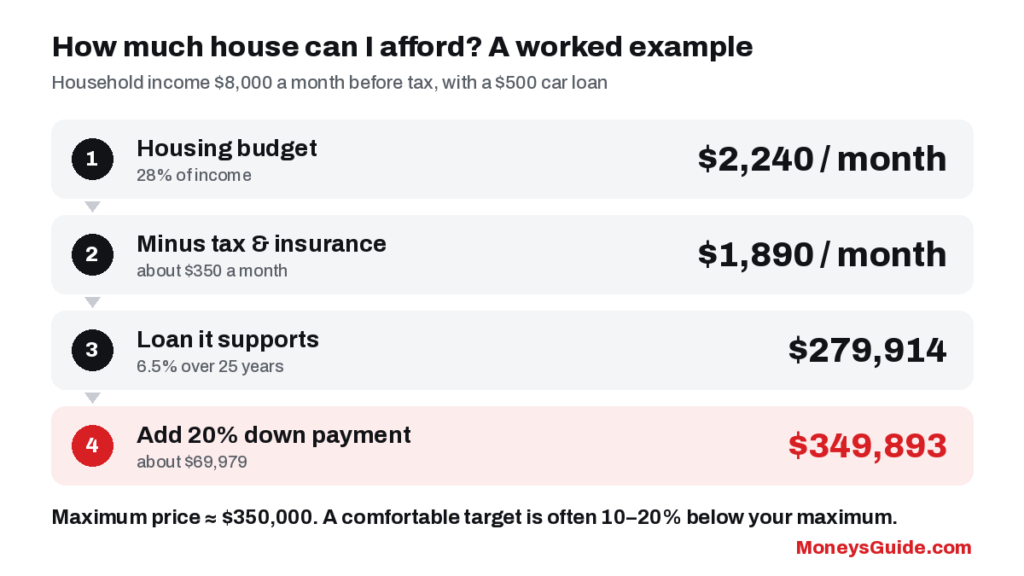
Let’s say a household earns $8,000 a month before tax and already pays $500 a month on a car loan.
Using the 28/36 rule:
- 28% of $8,000 = $2,240 maximum for housing
- 36% of $8,000 = $2,880 for all debts. Minus the $500 car loan leaves $2,380 for housing
- The lower of the two is $2,240 a month
Allowing for tax and insurance: if property tax and home insurance add about $350 a month, that leaves $1,890 for the mortgage itself.
Turning that into a loan: at 6.5% over 25 years, a $1,890 monthly payment supports a loan of about $279,914.
Adding the down payment: if that loan is 80% of the price, with a 20% down payment, the maximum price is about $349,893, with a down payment of roughly $69,979.
So this household’s ceiling is around $350,000. A more comfortable target might be 10–20% below that, leaving room for savings, rate rises and life’s surprises.
Step 4: Don’t forget the upfront costs
The down payment isn’t the only cash you need. Budget for:
- Government taxes and fees on the purchase, such as stamp duty, land transfer tax or recording fees, depending on where you buy
- Legal or conveyancing fees
- Agent commission, if the buyer pays it in your market
- Mortgage arrangement and valuation fees
- Moving costs and basic furniture
- An emergency fund that stays untouched after you buy
These costs vary a lot by country, but together they can add several percent to the purchase price. Ask your lender and agent for a written estimate early.
Step 5: Include the ongoing costs of owning
Your mortgage payment is only part of the monthly cost of a home. Also plan for:
- Property tax, where it applies
- Home and building insurance
- Service charges or owners’ association fees, especially for apartments
- Utilities, which may be higher than in a rental
- Maintenance and repairs. A common guideline is to set aside about 1% of the home’s value each year.
Our mortgage calculator lets you add tax, insurance and fees, so you can see the full monthly figure rather than just the loan repayment.
How to afford more house safely
If the numbers come up short, these are the healthiest ways to close the gap:
- Pay down other debts first. Clearing a car loan or credit card frees up room in your monthly budget.
- Save a bigger down payment. Our savings goal calculator shows how much to put aside each month to reach your target by a set date.
- Shop around for a better rate. Even a small difference adds up over 20 or 25 years.
- Improve your credit profile. Paying bills on time and keeping card balances low can help you qualify for better terms.
Stretching the loan term to the maximum or borrowing for the deposit can make a bigger price look affordable on paper, but both increase your risk and your total cost.
Frequently asked questions
How much house can I afford on my salary?
As a quick estimate, multiply your gross monthly salary by 0.28 to get a comfortable housing payment, then subtract any monthly debts that would push you past your lender’s limit. Many lenders also cap total debt payments at around 36–44% of gross income, or limit borrowing to around 4 to 4.5 times your annual salary. Enter the payment you arrive at into our mortgage calculator to see the price range it supports.
Should I buy at the top of my budget?
Usually not. The maximum a lender approves assumes everything goes to plan. Buying below your limit gives you breathing room for rate rises, job changes and repairs.
Should I use gross or net income?
Lender rules usually use gross income, before tax. For your own budget, it’s safer to check the payment against your take-home pay and real monthly spending.
Is a shorter mortgage term better?
A shorter term means higher monthly payments but much less interest. Over 15 years instead of 25, a $320,000 loan at 6.5% costs about $146,000 less in interest, but the monthly payment rises from about $2,161 to $2,788. Choose the shortest term you can comfortably afford.
This article is for education only and is not financial or mortgage advice. Lending rules, fees and taxes vary by country and lender. Speak to a licensed mortgage adviser or your bank before making a decision.