How to Build an Emergency Fund (and How Big It Should Be)
A car repair, a medical bill, a sudden job loss: unexpected costs are a normal part of life. What turns them into a crisis is not having money set aside. An emergency fund is a pot of cash kept for exactly these moments, so you can deal with surprises without borrowing or derailing your other plans.
This guide shows you how to build an emergency fund: how much you need, where to keep it, and a straightforward plan you can follow, even if you’re starting from zero.
Quick summary
- Aim for 3 to 6 months of essential expenses. Start with one month.
- Keep it in a separate, instant-access savings account, not in investments.
- Automate a transfer the day after payday and add windfalls like bonuses.
- Build a starter fund first, clear expensive debt, then grow the full fund.
What is an emergency fund?
An emergency fund is money you set aside only for genuine, unplanned expenses or a loss of income. It’s different from general savings because it has one job: to be there, untouched, until something goes wrong.
Without one, emergencies often end up on a credit card or a personal loan. That turns a one-off problem into months of repayments with interest on top.
What counts as an emergency?
A useful test: is it unexpected, necessary and urgent?
Examples that usually qualify:
- Losing your job or a drop in income
- Urgent medical or dental costs
- Essential car or home repairs
- Last-minute travel for a family emergency
Examples that usually don’t:
- Holidays, gadgets or sales
- Planned expenses such as annual insurance, school fees or car registration. These are predictable, so save for them separately.
How big should your emergency fund be?
The most common guideline is three to six months of essential living expenses. Essential means what you must pay to get by: rent or mortgage, utilities, food, transport, insurance and minimum debt repayments. It does not include eating out or entertainment.
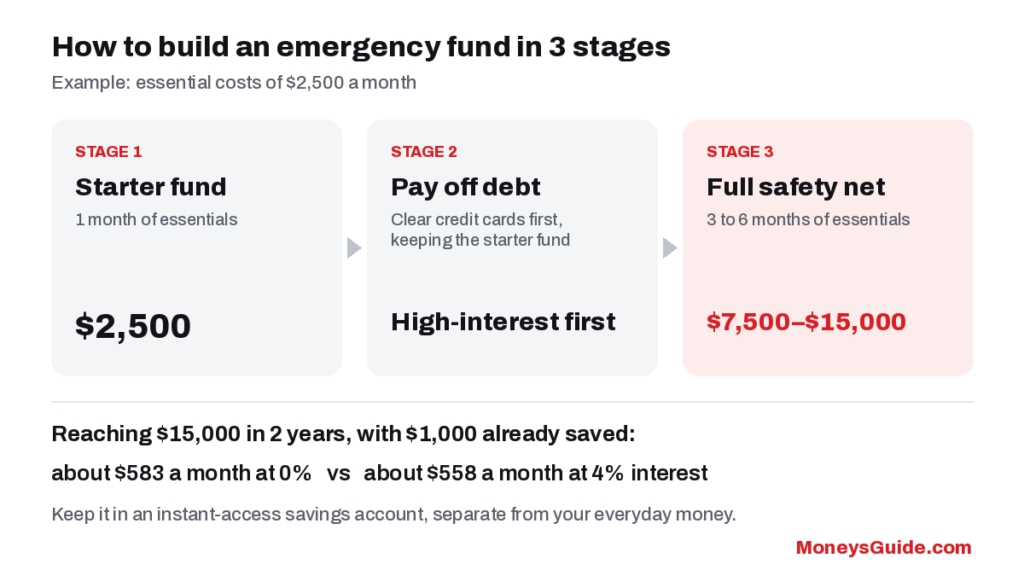
Example: if your essential costs are $2,500 a month:
- 3 months = $7,500
- 6 months = $15,000
If that feels out of reach, start smaller. The Consumer Financial Protection Bureau’s essential guide to building an emergency fund suggests setting an achievable first goal and building consistently from there.
Where should you sit in that range?
Aim towards the lower end if you:
- have a stable job and steady income
- have a partner with a separate income
- have no dependants
Aim towards the higher end, or beyond, if you:
- are self-employed, freelance or paid on commission
- are the only earner in your household
- have children or other dependants
- work in an industry with frequent layoffs
- have a large fixed cost like a mortgage that you couldn’t easily cut
Where to keep your emergency fund
Your emergency fund needs to be safe, easy to access and separate from your everyday spending money. Good options usually include:
- A high-interest or instant-access savings account. You earn some interest and can withdraw quickly.
- A separate account from your current account. Out of sight helps keep it out of mind.
Places that usually aren’t suitable:
- Stocks, crypto or other investments. Their value can fall just when you need the money.
- Fixed-term deposits that charge penalties or lock your money away.
- Cash at home, which earns nothing and can be lost or stolen.
How to build an emergency fund, step by step
1. Work out your essential monthly costs
Go through your last two or three months of bank statements and add up the essentials. This gives you a realistic monthly figure to multiply.
2. Set a target and a deadline
Choose your target, for example three months, and a realistic deadline. Our savings goal calculator shows exactly how much to save each month to get there.
Example: you want a $15,000 fund in 2 years and already have $1,000 saved.
- In an account paying 0%, you’d need to save about $583 a month.
- In an account paying 4% a year, you’d need about $558 a month, because interest does a little of the work.
3. Start with a starter goal
If the full target feels overwhelming, start smaller. A first milestone of one month’s expenses, or even a fixed amount like $1,000, covers many common emergencies and builds the habit. Then keep going.
4. Automate it
Set up a standing transfer into your emergency account the day after you’re paid. Treat it like a bill. Saving first and spending what’s left works far better than saving whatever remains at the end of the month.
5. Boost it with extra money
Put part of any bonus, tax refund, gift or side income straight into the fund. These lump sums can shorten your timeline by months.
6. Cut one or two costs
Look for spending you won’t miss: unused subscriptions, a cheaper phone plan, fewer takeaway meals. Redirect what you save into the fund.
Should you build an emergency fund or pay off debt first?
It’s usually best to do both in stages:
- Build a small starter fund of around one month’s expenses, so new emergencies don’t go on a credit card.
- Focus on high-interest debt, like credit cards, while keeping the starter fund in place.
- Grow the fund to three to six months once expensive debt is under control.
Without any buffer, the next surprise sends you straight back into debt. You can see how much interest a balance is costing you with our loan and EMI calculator.
Common mistakes to avoid
- Investing your emergency money. A market fall can shrink your fund just when you need it.
- Dipping in for non-emergencies. A sale or a holiday isn’t an emergency. Save for those separately.
- Setting a target too big to start. A huge number can feel impossible. Begin with one month and build from there.
- Not refilling after using it. Once you’ve used the fund, rebuilding it should come before other savings goals.
- Forgetting to update it. If your rent or family size goes up, your target should too.
Avoiding these is a big part of how to build an emergency fund that actually lasts.
Using and refilling your fund
If you need to use your emergency fund, use it. That’s what it’s for, and it’s far better than borrowing at high interest. Afterwards, make refilling it your first savings priority before going back to other goals.
Review your target once a year, or whenever your life changes: a new job, a move, a new baby or a big rise in rent. Your fund should grow as your essential costs do.
Frequently asked questions
How long does it take to build an emergency fund?
It depends on your target and how much you can save. Saving about $558 a month in an account paying 4% would turn $1,000 into a $15,000 fund in two years. Our savings goal calculator works out your own timeline in seconds.
Is three months enough?
For someone with a stable job and no dependants, three months is often a reasonable minimum. If your income is irregular or you support others, six months or more gives much better protection.
Should my emergency fund earn interest?
Yes, if you can earn interest without losing quick access or taking risk. An instant-access savings account is usually a good balance. Just don’t chase a higher return by investing it.
Can I invest once my emergency fund is full?
That’s usually the right order. With a full emergency fund in place, you can invest for longer-term goals without worrying about being forced to sell at a bad time. Our compound interest calculator shows how regular investing can grow over the years.
This article is for education only and is not financial advice. Interest rates in examples are for illustration. Check the terms and protections of any account before you open it.