How to Pay Off Your Car Loan Faster (and Should You, or Invest?)
A car payment is one of the biggest monthly bills for many households, and it keeps going long after the new-car smell has gone. If you want to pay off your car loan faster, you have more options than you might think, and some of them barely change your monthly budget.
This guide shows six ways to clear a car loan early, with real figures for each. It also answers the bigger question: should you pay off your car loan early, or invest the extra money instead?
Quick summary
- On a $30,000 loan at 7.5% over 5 years, the payment is about $601 a month and total interest is about $6,068.
- Paying $100 extra a month clears it 10 months sooner and saves about $1,050.
- Paying $200 extra a month clears it 17 months sooner and saves about $1,784.
- If your loan rate is high, paying it off early is usually the better deal. If it’s very low, investing may come out ahead.
Before you start: check these 3 things
1. Is there a prepayment penalty?
Most car loans let you pay early without a fee, but some contracts include a prepayment penalty. Check your loan agreement or call your lender before you send extra money.
2. Is it a simple interest loan?
Most car loans are simple interest loans: interest is charged on the balance you still owe, so paying it down faster directly cuts your interest. A few loans use precomputed interest, where the interest is calculated upfront. With those, paying early saves much less. Your contract will say which type you have.
3. Will extra money go to the principal?
When you pay extra, make sure the lender applies it to the principal (the loan balance), not to next month’s payment. Many lenders let you choose “apply to principal” online, or you can add a note with your payment.
Our example loan
To show what each strategy is worth, we’ll use one example:
- Loan amount: $30,000
- Interest rate: 7.5% APR
- Term: 60 months (5 years)
- Monthly payment: about $601.14
- Total interest if paid on schedule: about $6,068
You can enter your own numbers in our loan payment calculator, and use the “extra payment” box to test each idea below.
6 ways to pay off your car loan faster
1. Round up your payment
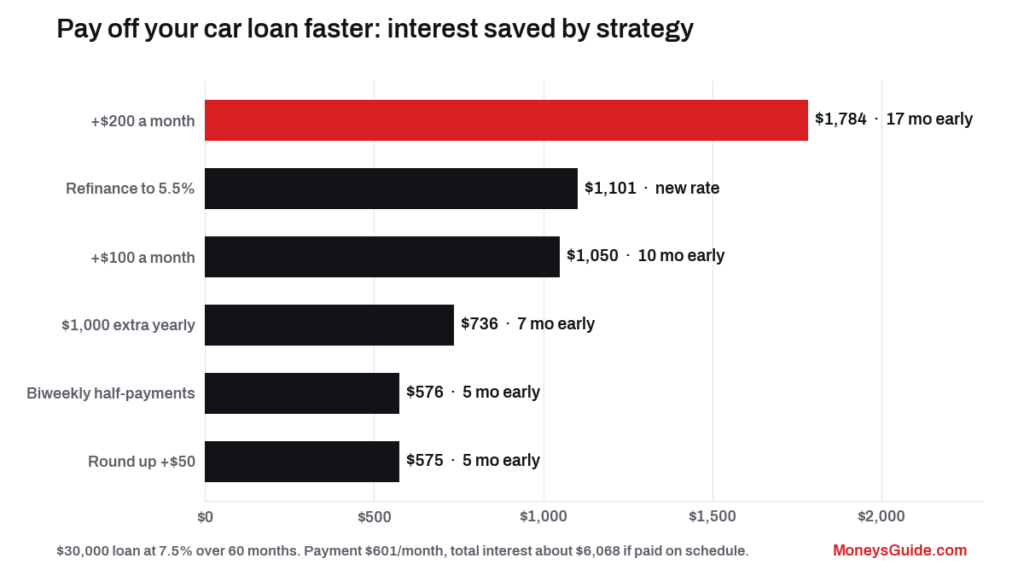
Round $601 up to $651 (an extra $50 a month). It’s a small change you’ll hardly notice, but it clears the loan in about 55 months instead of 60 and saves about $575 in interest.
2. Add a fixed extra amount every month
Bigger regular extras have a bigger effect:
| Extra each month | Paid off in | Interest saved |
|---|---|---|
| $50 | about 55 months | about $575 |
| $100 | about 50 months | about $1,050 |
| $200 | about 43 months | about $1,784 |
3. Make half-payments every two weeks
Paying half your payment (about $300) every two weeks means 26 half-payments a year, which equals 13 full payments instead of 12. On our example, that’s like paying an extra $50 a month: the loan is cleared about 5 months early, saving around $576.
Check first that your lender applies each half-payment when it arrives, rather than holding it until the full payment is due. Otherwise, there’s no interest benefit.
4. Make one extra lump-sum payment each year
Put part of a tax refund or bonus toward the loan. A $1,000 extra payment once a year clears our example loan about 7 months early and saves about $736.
5. Refinance to a lower rate
If rates have fallen or your credit has improved, refinancing could lower your rate. For example, refinancing the remaining balance after one year (about $24,862) from 7.5% to 5.5% over the remaining 48 months drops the payment to about $578 and saves roughly $1,100 in interest overall.
Then keep paying your old $601 payment on the new loan, and you’ll finish even sooner. Watch for refinancing fees, and avoid stretching the loan over a longer term, which can cost more in the end.
6. Free up cash in your budget
The money for extra payments has to come from somewhere. Look for:
- Car insurance: compare quotes each year
- Subscriptions you no longer use
- Pay rises: send part of every raise straight to the loan
A simple budget like the 50/30/20 rule can help you find a realistic amount.
Should you pay off your car loan early or invest?
This is where many people get stuck. The answer mainly comes down to comparing your loan’s interest rate with the return you could reasonably expect from investing, and how much risk you’re comfortable with.
Paying off early = a guaranteed return
Every extra dollar you put toward a 7.5% loan saves you 7.5% a year in interest, guaranteed. No investment can promise that.
Investing = a possible higher return, with risk
Long-term stock market investments have historically grown faster than inflation, but returns vary a lot from year to year and are never guaranteed.
A real comparison
Say you have an extra $200 a month for five years:
- Option A, pay off early: the 7.5% loan is cleared in month 43. You then invest the full freed-up payment (about $801 a month) at 7% for the remaining 17 months. After 5 years, you’d have about $14,274 invested.
- Option B, invest instead: you keep paying the normal loan payment and invest $200 a month at 7% for 60 months. After 5 years, you’d have about $14,319.
That’s almost a tie, but Option A’s result is guaranteed for the loan part, while Option B depends on the market actually returning 7%. With a loan rate around 7% or higher, paying off early is usually the safer bet.
When investing may make more sense
If your car loan has a very low rate, say 3%, the loan only costs about $2,344 in interest in total on $30,000 over 5 years. In that case, extra money may do more good:
- in an emergency fund, if you don’t have one yet
- paying off higher-interest debt, like credit cards
- in long-term investments, especially any workplace retirement plan with employer matching
A simple order of priorities
- Build a starter emergency fund. See how to build an emergency fund.
- Pay off credit cards and other high-rate debt.
- If your car loan rate is above roughly 6–7%, pay it off early.
- If it’s low, invest the extra money instead, if you’re comfortable with the risk.
Does paying off a car loan early hurt your credit score?
It can cause a small, temporary dip, because closing an installment loan slightly changes your mix of credit accounts. For most people the effect is minor, and having less debt is better for your finances overall. If you’re about to apply for a mortgage, ask your lender whether timing matters.
How car loan interest works
Car loans are amortized: each payment covers that month’s interest first, and the rest reduces the balance. Early payments are mostly interest, so extra payments made early in the loan save the most. The Consumer Financial Protection Bureau explains how amortization can affect your auto loan. For a deeper look at the formula behind your payment, see our guide on how loan payments are calculated.
Common mistakes to avoid
- Not checking for prepayment penalties or precomputed interest
- Extra payments that don’t go to principal
- Draining your emergency fund to pay off the car
- Refinancing into a longer term, which can cost more overall
- Paying off a 3% car loan while carrying 22% credit card debt
Once you know how to pay off your car loan faster, and whether it’s the right move, you can turn a five-year commitment into a much shorter one.
Frequently asked questions
Can you pay off a car loan early?
Usually, yes. Most car loans allow early repayment without a fee, but check your contract for a prepayment penalty or precomputed interest.
Is it better to pay off a car loan early or keep the money?
If your loan rate is high and you already have an emergency fund, paying it off early is usually a strong move. If the rate is very low, keeping the money for savings, other debt or investing may be better.
How much can I save by paying $100 extra on my car loan?
On a $30,000 loan at 7.5% over 5 years, about $1,050 in interest, and the loan finishes about 10 months early.
Do biweekly car payments really help?
They help if your lender applies each half-payment immediately. Making 26 half-payments a year equals one extra full payment annually, which shortens the loan by a few months.
What happens when you pay off your car loan?
The lender releases its claim on the car and sends you, or your local vehicle registration office, the paperwork showing you own it outright. Keep that document safe, and update your insurance if needed.
This article is for education only and is not financial advice. Examples use a fixed 7.5% rate and assume extra payments go to principal with no fees. Investment returns are not guaranteed.