
$65,000 a Year Is How Much an Hour? (Raises and Job Offers)
If you earn around $65,000, you’re probably thinking about your next step: a raise, a promotion or a new job. Comparing those options is much easier when you know what your salary is worth by the hour and what each change adds up to. So, $65,000 a year is how much an hour? At a standard 40-hour week, it’s $31.25. This guide breaks $65,000 down by pay period, shows what different raises are really worth, and explains how to compare job offers fairly.
Quick summary
- $65,000 a year is $31.25 an hour at 40 hours a week for 52 weeks.
- That’s about $5,417 a month, $2,500 every two weeks and $1,250 a week, before tax.
- A 5% raise adds $3,250 a year, about $271 a month before tax.
- A job offer of $72,000 that needs 45-hour weeks pays less per hour (about $30.77) than $65,000 at 40 hours.
$65,000 a year is how much an hour?
Hourly rate = yearly salary ÷ (hours per week × weeks per year)
$65,000 ÷ 2,080 = $31.25 an hour
$65,000 by pay period
| Pay period | Before tax |
|---|---|
| Hourly (40 hours a week) | $31.25 |
| Daily (5 days a week) | $250.00 |
| Weekly | $1,250.00 |
| Every two weeks | $2,500.00 |
| Twice a month | $2,708.33 |
| Monthly | $5,416.67 |
| Yearly | $65,000.00 |
Your real hourly rate
| Typical hours per week | Effective hourly rate |
|---|---|
| 37.5 | about $33.33 |
| 40 | $31.25 |
| 45 | about $27.78 |
| 50 | $25.00 |
Convert any salary or rate with our free salary converter.
What a raise on $65,000 is worth
| Raise | Extra a year | Extra a month | New salary | New hourly rate |
|---|---|---|---|---|
| 3% | $1,950 | about $163 | $66,950 | about $32.19 |
| 5% | $3,250 | about $271 | $68,250 | about $32.81 |
| 10% | $6,500 | about $542 | $71,500 | about $34.38 |
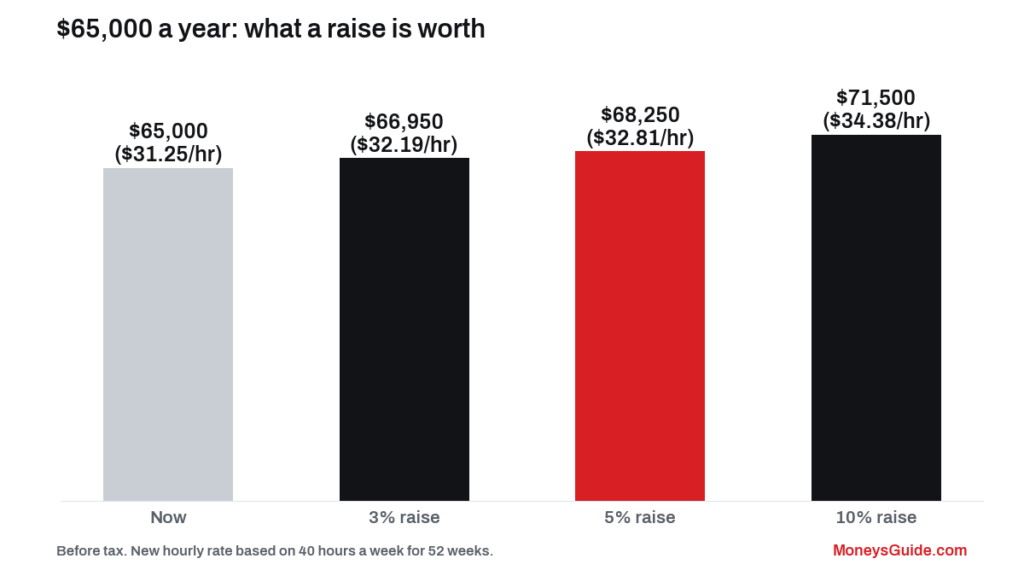
Remember these are before tax, so the extra you take home will be a little less.
Why bigger raises compound
Raises build on each other. Starting from $65,000:
- 3% a year for 10 years takes you to about $87,355.
- 5% a year for 10 years takes you to about $105,878.
That 2-point difference in yearly raises is worth over $18,000 a year by year ten. It’s why negotiating well early in your career matters so much.
Check your raise against inflation
A raise only improves your buying power if it’s bigger than inflation. For example, if you earned $60,000 three years ago and prices rose an average of 3.5% a year since, you’d need about $66,523 today just to stand still. On $65,000, you’d actually be slightly behind in real terms, despite a $5,000 raise on paper.
Check your own numbers with our salary vs inflation calculator, and see has my salary kept up with inflation for the full method.
How to compare job offers on $65,000
Headline salaries can be misleading. Compare offers on four things:
- Hourly rate after real hours. A higher salary with longer hours can pay less per hour.
- Benefits. Retirement matching, health cover and paid leave can be worth thousands a year.
- Commute and costs. A longer commute adds both time and money.
- Growth. Training, promotion paths and pay reviews affect your future salary.
Example:
| Current job | New offer | |
|---|---|---|
| Salary | $65,000 | $72,000 |
| Typical hours | 40 a week | 45 a week |
| Effective hourly rate | $31.25 | about $30.77 |
| Retirement match | 5% ($3,250) | 3% ($2,160) |
| Salary + match | $68,250 | $74,160 |
The new offer pays about $5,900 more a year including the match, but slightly less per hour. Whether it’s worth it depends on how you value the extra five hours a week, and on the growth the new role offers.
How to negotiate from $65,000
- Know your market rate. Look at job listings and salary surveys for your role and area.
- Show your impact. Bring specific results: projects delivered, money saved, responsibilities added.
- Talk in yearly figures. A 5% raise sounds modest, but it’s $3,250 a year, and it compounds with every future raise.
- Consider the whole package. If the salary can’t move, ask about extra leave, flexible hours, training or a higher retirement match.
- Agree a review date if the answer is “not now”.
How $65,000 compares with nearby salaries
| Yearly salary | Hourly rate (40 hours) | Monthly pay |
|---|---|---|
| $55,000 | $26.44 | about $4,583 |
| $60,000 | $28.85 | $5,000 |
| $65,000 | $31.25 | about $5,417 |
| $70,000 | $33.65 | about $5,833 |
| $75,000 | $36.06 | $6,250 |
Raises vs changing jobs
Moving to a new employer often brings a bigger jump in pay than an internal raise, but it isn’t always the better move. Before switching for money alone, weigh:
- Job security and how long you’d need to stay to vest in benefits such as retirement matching
- Learning and progression, which drive future raises
- Workload and commute, which affect your real hourly rate
- The cost of starting over, such as losing seniority or flexible arrangements
The Bureau of Labor Statistics’ CPI Inflation Calculator is a useful way to check how much prices have risen since your last raise, before you negotiate.
Take-home pay on $65,000
These figures are gross pay. Take-home pay depends on your local tax rules and deductions.
An example only: if about 23% went to tax and deductions, $65,000 would leave about $50,050 a year, or roughly $4,171 a month.
Timing your raise request
When you ask can matter as much as how:
- Before budgets are set, often a few months before the end of your employer’s financial year
- After a clear win, such as a finished project or great results
- At your annual review, with evidence prepared in advance
- When your role has grown, with new responsibilities that aren’t yet reflected in your pay
Making the most of each raise
The easiest time to boost your savings is right after a raise, before your spending adjusts. A simple rule:
- Save half of every raise. On a 5% raise, that’s about $135 a month before tax going straight to savings or investments.
Over a career, that habit can add up to a large amount, without ever cutting your current lifestyle. See how much $500 a month can grow for what regular investing can do, and use our budget planner to adjust your plan after each raise.
Is $65,000 a good salary?
For a single person in most areas, it’s a comfortable income with room to save. As the only income for a family, or in a very expensive city, it can be tighter. For comparison, see $60,000 a year and $70,000 a year.
Common mistakes
- Comparing offers on salary alone, without hours and benefits
- Accepting a raise below inflation without realising it’s a real-terms cut
- Thinking only in monthly or hourly terms when negotiating, instead of yearly
- Letting spending absorb every raise
- Forgetting that raises compound, so a bigger raise now lifts every future one
So, $65,000 a year is how much an hour? $31.25 at a standard 40-hour week, or about $5,417 a month. Knowing exactly what each raise and offer is worth helps you make your next career move with confidence.
Frequently asked questions
How much is $65,000 a year per month?
About $5,416.67 a month before tax.
How much is $65,000 a year biweekly?
$2,500 before tax, across 26 paychecks.
How much is $65,000 a year weekly?
$1,250 a week before tax.
What is a 5% raise on $65,000?
$3,250 a year, taking your salary to $68,250, or about $32.81 an hour.
What is a 10% raise on $65,000?
$6,500 a year, taking your salary to $71,500, or about $34.38 an hour at 40 hours a week.
How often should I ask for a raise?
Many people raise pay once a year at their review, or when their role grows significantly. Coming prepared with evidence makes each conversation stronger.
Is $31 an hour the same as $65,000 a year?
Close. $31 an hour at 40 hours a week is $64,480 a year. To reach $65,000, you’d need $31.25 an hour.
Should I take a higher salary with longer hours?
Work out the hourly rate for both jobs using your real hours, add the value of benefits, and consider growth. A higher salary isn’t always better pay for your time.
How much is $65,000 a year after tax?
It depends on where you live and your deductions. As an example, if about 23% went to tax and deductions, you’d take home about $50,050 a year, or $4,171 a month.
This article is for education only and is not financial, tax or employment advice. Figures are gross pay unless stated. Examples are illustrative.