How to Start Investing With $1,000
You don’t need a fortune to become an investor. $1,000 is a perfectly good place to start, and the habits you build with it matter far more than the amount. This guide walks through how to start investing with 1000 dollars sensibly: what to sort out first, where beginners usually start, and the mistakes worth avoiding.
Quick summary
- Build an emergency fund and clear high-interest debt before investing.
- Only invest money you won’t need for at least five years.
- Low-cost, diversified index funds or ETFs are the usual starting point.
- Fees and adding regularly matter more than picking the “perfect” investment.
Step 1: Make sure you’re ready to invest
Investing works best when you won’t be forced to sell at a bad time. Before you invest, check that you have:
- An emergency fund, ideally 3–6 months of essential costs, or at least a starter fund. Our guide on how to build an emergency fund explains how.
- No high-interest debt. Paying off a credit card charging 20% or more is a guaranteed “return” that investing rarely beats.
- A time horizon of five years or more. Markets can fall sharply in the short term. Money you need soon belongs in savings.
Step 2: Decide what you’re investing for
Your goal shapes your choices:
- Long-term growth or retirement (10+ years): you can usually accept more ups and downs in exchange for higher potential returns.
- A goal in 5–10 years: a more balanced mix may suit you.
- Under 5 years: investing is usually too risky. Use a savings account and our savings goal calculator instead.
Step 3: Choose simple, diversified investments
With $1,000, the simplest and most popular starting point is a low-cost index fund or ETF:
- Index funds and ETFs hold hundreds or thousands of companies in one investment, so your money is spread out instead of riding on a single company.
- Low cost: many charge a small annual fee, often well under 0.5%.
- No stock picking: you own a slice of the whole market.
Many beginners start with one broad global or major-market fund. You can add others later as you learn.
What to approach with caution as a beginner:
- Individual “hot” stocks
- Leveraged products, like CFDs or margin trading
- Crypto as your main investment
- Anything promising high or guaranteed returns
Step 4: Pick a regulated platform
You’ll need an account with a broker or investment platform. Before opening one:
- Check it’s regulated. Look the company up on the official public register run by the financial regulator where you live. Every legitimate broker should appear there.
- Compare all the costs: account fees, trading fees, currency conversion fees and fund fees.
- Check minimums. Many platforms let you start with small amounts or buy fractional shares.
Use a tax-advantaged account if you can
Before opening a regular investment account, check whether a tax-advantaged one fits your goal. Many countries offer:
- Workplace retirement plans, often with employer contributions. If your employer matches what you put in, that match is usually the first thing to take.
- Personal retirement accounts that give tax relief on contributions or tax-free withdrawals in retirement.
- Tax-free savings and investment accounts, sometimes with special versions or bonuses for first-time home buyers.
Rules, limits and tax treatment change regularly, so check the official government guidance where you live before contributing.
Step 5: Keep fees low
Fees seem small, but they compound against you every year. The Securities and Exchange Commission’s investor site has a clear guide to understanding investment fees.
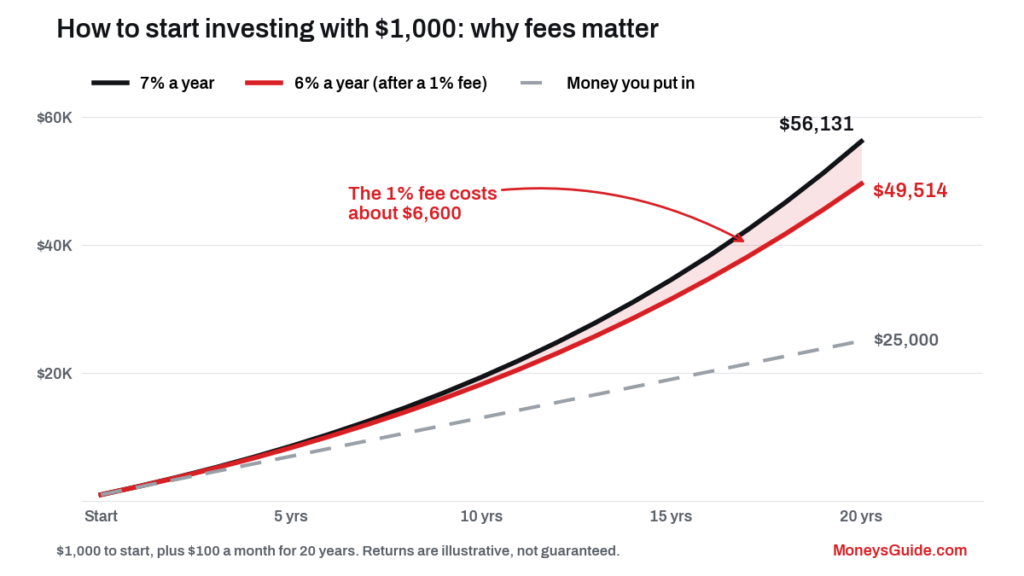
Here’s why fees matter. You invest $1,000 and add $100 a month for 20 years, depositing $25,000 in total:
- At a 7% yearly return, you’d have about $56,131.
- If 1% in fees brings that down to 6%, you’d have about $49,514.
That 1% fee costs about $6,600.
Step 6: Add a little every month
$1,000 on its own, growing at 7% a year, would become about $4,039 in 20 years. Adding just $100 a month takes it to about $56,131.
Regular investing also means you buy at a mix of high and low prices over time, which smooths out the ups and downs. See how your own plan could grow with our compound interest calculator.
Step 7: Stay calm when markets fall
Markets go down as well as up, sometimes by a lot. Selling in a panic locks in losses. If your goal is years away and your investments are diversified, the usual approach is to keep going, keep adding, and avoid checking prices every day.
Common beginner mistakes
- Investing money you’ll need soon
- Chasing last year’s best performer
- Paying high fees without noticing
- Putting everything in one stock or coin
- Trading too often, which adds costs and stress
- Following tips from social media without checking them
Knowing how to start investing with 1000 dollars is mostly about avoiding these.
Frequently asked questions
Is $1,000 enough to start investing?
Yes. Many platforms allow small investments and fractional shares. The habit of investing regularly matters more than the starting amount.
What returns can I expect?
Nobody can promise a return. Stock markets have historically grown over long periods, but they can fall sharply in some years. The examples here use 7% for illustration only.
Should I invest all $1,000 at once or bit by bit?
Both are common. Investing it all at once gives your money more time in the market. Spreading it out over a few months can feel more comfortable if you’re nervous about timing.
Should I pay off debt before investing?
Pay off high-interest debt first, like credit cards. Low-interest debt, like some mortgages, can often be repaid on schedule while you invest.
This article is for education only and is not financial or investment advice. Investments can fall as well as rise, and you may get back less than you invest. Returns in examples are for illustration only and are not guaranteed.