Dollar-Cost Averaging vs Lump Sum: What to Do With $10,000
You have $10,000 to invest. Do you put it all in today, or spread it out over the next few months? This is the classic dollar-cost averaging vs lump sum question, and it causes more hesitation than almost any other investing decision.
This guide explains both approaches, shows three worked $10,000 examples, summarises what long-term research has found, and helps you pick the approach that fits your situation.
Quick summary
- Lump sum means investing all your money at once. Dollar-cost averaging (DCA) means investing it in equal parts over time.
- Historically, lump sum investing has come out ahead about two-thirds of the time, because markets have tended to rise more often than they fall.
- DCA can reduce regret and the risk of investing everything just before a fall.
- If you’re paid monthly and invest from each paycheck, you’re already dollar-cost averaging, and that’s a great habit.
What is lump sum investing?
Lump sum investing means putting the whole amount, say $10,000, into your chosen investment at once. Your full amount is exposed to the market from day one, for better or worse.
What is dollar-cost averaging?
Dollar-cost averaging (DCA) means splitting the money into equal amounts invested at regular intervals, for example $2,000 a month for five months. When prices are low, each $2,000 buys more units. When prices are high, it buys fewer. Want to see this with your own numbers? Our dollar cost averaging calculator works out your average cost from the prices you actually paid.
Dollar-cost averaging vs lump sum: three $10,000 examples
To see how each approach behaves, imagine a fund priced at $100 today, and compare:
- Lump sum: $10,000 invested at once
- DCA: $2,000 invested each month for five months
We’ll value both at the end of month five.
| Scenario | Monthly prices | Lump sum ends at | DCA ends at | Winner |
|---|---|---|---|---|
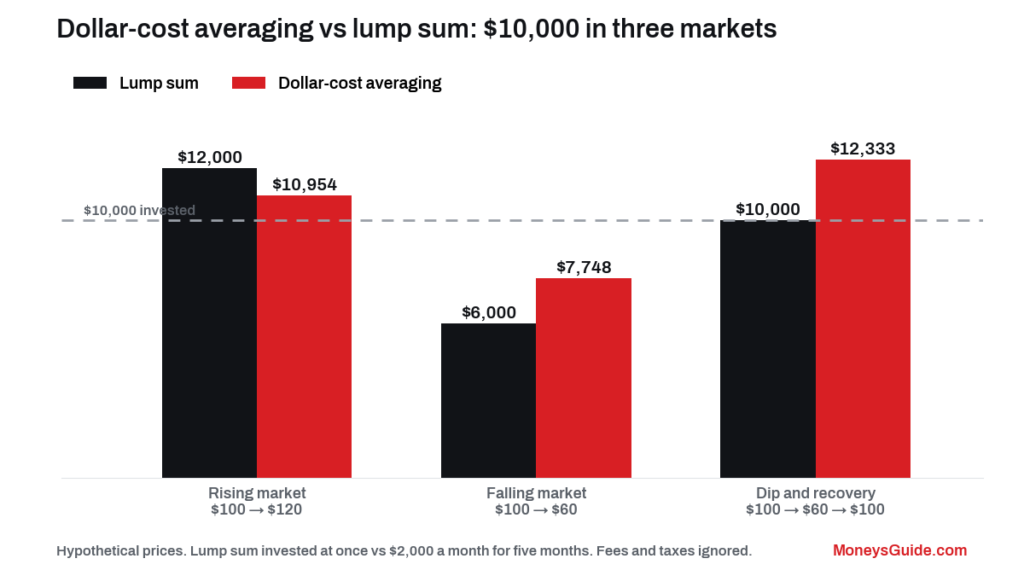
| Rising market | $100 → $105 → $110 → $115 → $120 | $12,000 | $10,954 | Lump sum |
| Falling market | $100 → $90 → $80 → $70 → $60 | $6,000 | $7,748 | DCA |
| Dip then recovery | $100 → $80 → $60 → $80 → $100 | $10,000 | $12,333 | DCA |
What the examples show
- In a rising market, lump sum wins because all the money benefits from the rise straight away.
- In a falling market, DCA loses less because later purchases happen at lower prices.
- In a market that dips and recovers, DCA can win, because it buys extra units while prices are low. In this example, DCA’s average cost per unit was about $81, below the simple average price of $84.
The problem, of course, is that nobody knows in advance which scenario is coming.
What the long-term research says
Investment firm Vanguard studied this question using decades of market history in a well-known 2012 paper. Its main findings, as summarised by Morningstar, were:
- Investing a lump sum straight away beat spreading it over 12 months about two-thirds of the time, whether the portfolio held stocks, bonds or a mix.
- The longer the DCA period, the more often lump sum won. Over a 36-month DCA period, lump sum came out ahead roughly 90% of the time.
- The average advantage of lump sum investing was modest, typically a couple of percentage points over 10 years.
- DCA did reduce the chance of losses in down markets.
The reason is simple: markets have historically risen more often than they’ve fallen, so money waiting in cash usually misses out on growth.
Why choose dollar-cost averaging anyway?
If lump sum usually wins, why does anyone use DCA? Because investing isn’t only about maths.
- It reduces regret. Investing $10,000 the day before a 20% fall is painful. DCA limits that risk.
- It makes it easier to start. Many people never invest because they’re waiting for the “right” time. DCA gets you moving.
- It suits nervous investors. If a big early drop might make you panic and sell, DCA can help you stay invested, and staying invested matters more than the starting method.
When lump sum investing makes more sense
- You have a long time horizon, ideally 10 years or more
- You’re investing in a diversified fund, not a single stock
- You’re comfortable seeing your balance fall in the short term without selling
- You’ve already built an emergency fund and cleared high-interest debt
A middle path: shorter DCA
If you’re torn, you don’t have to choose all or nothing:
- Invest half now and spread the rest over 3 to 6 months
- Use a short DCA period. The research suggests that the longer you wait, the more often lump sum wins, so keep it short
- Automate it so you don’t keep pausing to “wait for a dip”
Where to keep the cash while you dollar-cost average
If you choose DCA, the money waiting to be invested should still work for you. Keep it in a high-yield savings account or another safe, easy-access account, not in your everyday checking account.
Example: spreading $10,000 over six months means, on average, about $5,800 is still waiting in cash. At 4% interest, that earns roughly $115–$120 while you invest the rest. That’s not a lot, but it helps offset some of the growth that idle cash might miss.
Avoid putting the waiting money into anything risky. The point of DCA is to reduce timing risk, so the cash part should be steady.
How to set up a DCA plan in 4 steps
- Decide the period. For a one-off sum, three to six months is a common choice. The research suggests longer periods usually cost more growth.
- Divide the amount equally. $10,000 over five months means $2,000 a month. Over six months, about $1,667.
- Automate the purchases. Most investment platforms let you schedule recurring buys on a set date, so emotions don’t get a vote.
- Don’t pause when prices fall. That’s exactly when your fixed amount buys the most. If anything, a falling market is DCA working as designed.
Write your plan down before you start, including the dates and amounts. Having a plan makes it much easier to keep going when the headlines turn negative.
The DCA you’re probably already doing
If you invest a set amount from every paycheck, for example into a workplace retirement plan, you’re already dollar-cost averaging. That’s not a choice between methods, because the money only arrives monthly. It’s simply a great habit. See how far it can go in our guide to how much $500 a month can grow.
How to invest $10,000: a simple checklist
- Emergency fund first. Keep 3–6 months of essential costs in savings. See how to build an emergency fund.
- Clear expensive debt. Paying off a 22% credit card beats any likely investment return. See how long it takes to pay off $10,000 in credit card debt.
- Use tax-advantaged accounts where you can.
- Choose low-cost, diversified funds. Fees compound against you over time.
- Pick lump sum or DCA, then stick to your plan.
New to investing? Start with our guide on how to start investing with $1,000. You can see how a lump sum might grow over time in our compound interest calculator.
Common mistakes
- Waiting forever for the perfect moment. Time in the market usually beats timing the market.
- Stretching DCA over years. Long DCA periods leave too much cash sitting idle.
- Stopping DCA when markets fall. Falling prices are exactly when DCA buys the most units.
- Investing money you’ll need soon. Money for the next few years belongs in savings, not the stock market.
When it comes to dollar-cost averaging vs lump sum, the best choice is the one that gets you invested and keeps you invested.
Frequently asked questions
Is dollar-cost averaging better than lump sum?
Historically, no, not most of the time. Lump sum investing has outperformed about two-thirds of the time. But DCA lowers the risk of bad timing and can make it easier to stay invested.
How long should I dollar-cost average?
If you choose DCA, keep it fairly short, often 3 to 12 months. The longer the period, the more likely a lump sum would have done better.
Should I invest $10,000 all at once?
If you have a long time horizon, an emergency fund, no expensive debt and a diversified investment, investing it all at once has historically worked out better more often. If a sudden drop would make you sell, spreading it out may suit you better.
Does dollar-cost averaging work for crypto?
The method works the same way with any investment. With highly volatile assets like crypto, DCA reduces timing risk, but it doesn’t make the underlying investment less risky.
What is a good example of dollar-cost averaging?
Investing $500 from every monthly paycheck into a diversified index fund, regardless of what the market is doing, is a classic example.
This article is for education only and is not financial or investment advice. Scenarios are hypothetical and ignore fees and taxes. Past performance does not guarantee future results, and investments can fall as well as rise.