How Long Does It Take to Double Your Money at 7 Percent?
“How long until my money doubles?” is one of the most useful questions in investing. It turns abstract percentages into something easy to picture. So how long does it take to double your money at 7 percent? The short answer is about 10.2 years. This guide shows the exact calculation, the famous Rule of 72 shortcut, doubling times for other rates, and the real-world factors that can slow things down.
Quick summary
- At 7% a year, money doubles in about 10.24 years.
- The Rule of 72 (72 ÷ 7) gives about 10.3 years, very close to the exact answer.
- Over 30 years at 7%, money doubles about three times: $10,000 becomes about $76,000.
- Fees and inflation slow doubling down: a 1% fee pushes it to nearly 12 years.
How long does it take to double your money at 7 percent?
If your money grows at 7% a year and the returns are reinvested, it takes about 10.24 years to double.
Here’s what that looks like with $10,000:
| Years | Value at 7% a year | How many times bigger |
|---|---|---|
| 0 | $10,000 | 1x |
| about 10 | about $19,672 | about 2x |
| about 20 | about $38,697 | about 4x |
| about 30 | about $76,123 | about 8x |
Each doubling adds more money than the last: the first adds about $9,700, the third adds about $37,400. That’s the power of compound growth, explained in our guide on how compound interest works.
The exact formula
The exact time to double is:
Years to double = ln(2) ÷ ln(1 + r)
where r is the yearly rate as a decimal (7% = 0.07) and ln is the natural logarithm, a button found on most scientific calculators.
At 7%: ln(2) ÷ ln(1.07) = 0.6931 ÷ 0.0677 ≈ 10.24 years.
The Rule of 72: a quick shortcut
You don’t need logarithms for a good estimate. The Rule of 72 says:
Years to double ≈ 72 ÷ interest rate
At 7%: 72 ÷ 7 ≈ 10.3 years. That’s within a few weeks of the exact answer.
The rule works best for rates between about 6% and 10%. It’s slightly less accurate at very low or very high rates, but still close enough for quick decisions.
Doubling times at other rates
| Yearly rate | Exact years to double | Rule of 72 estimate |
|---|---|---|
| 3% | 23.4 | 24.0 |
| 4% | 17.7 | 18.0 |
| 5% | 14.2 | 14.4 |
| 6% | 11.9 | 12.0 |
| 7% | 10.2 | 10.3 |
| 8% | 9.0 | 9.0 |
| 9% | 8.0 | 8.0 |
| 10% | 7.3 | 7.2 |
| 12% | 6.1 | 6.0 |
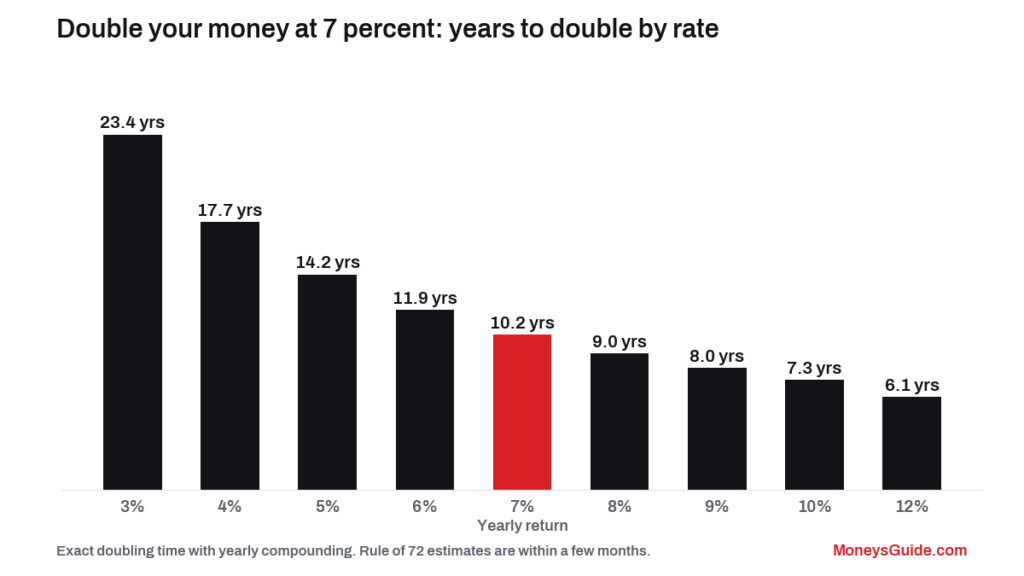
Notice how much difference a few percentage points make. Money at 4% takes about 17.7 years to double; at 8%, it takes half as long.
Does compounding frequency matter?
A little. The figures above assume yearly compounding. If 7% is compounded monthly, money doubles slightly faster, in about 9.9 years. When comparing accounts, look at the annual equivalent rate or APY, which already includes compounding.
What can slow doubling down
Fees
Fees come straight off your return. If your investments earn 7% but you pay 1% a year in fees, your effective return is 6%, and doubling takes about 11.9 years instead of 10.2. Over a lifetime of investing, that’s one fewer doubling. The Securities and Exchange Commission’s investor site explains how fees reduce your returns.
Inflation
Doubling your money isn’t the same as doubling what it can buy. If your money grows at 7% and prices rise 3% a year, your real return is about 4%. In today’s purchasing power, doubling takes about 17.7 years.
You can also use the Rule of 72 on inflation: at 3% inflation, prices double in about 24 years.
Uneven returns
Investments rarely grow by exactly 7% every year. Some years are higher, some lower, and some negative. A 7% average is a long-term planning figure, not a promise. A big fall early on can delay your first doubling, even if the long-run average holds.
Taxes
In an ordinary taxable account, taxes on interest, dividends or gains reduce your effective return. Tax-advantaged retirement or savings accounts can help more of your money keep compounding.
What $10,000 becomes in 20 years at different rates
Small differences in the rate turn into big differences over time. Here’s $10,000 left to grow for 20 years with yearly compounding:
| Yearly rate | Doublings in 20 years | Value after 20 years |
|---|---|---|
| 4% | just over 1 | about $21,911 |
| 7% | almost 2 | about $38,697 |
| 10% | almost 3 | about $67,275 |
At 10%, the same $10,000 ends up worth over three times as much as at 4%. That’s why investors pay close attention to returns, fees and how long their money stays invested.
Doubling in savings vs investing
Where you keep your money shapes how quickly it can double, and how much risk you take:
- A savings account is the safest place for money you’ll need soon, but at lower rates doubling can take two decades or more.
- Diversified investments can double faster over long periods, but they can also fall in value, sometimes sharply, along the way.
Many people use both: savings for emergencies and short-term goals, and investments for goals that are 10 or more years away. The right mix depends on when you’ll need the money and how comfortable you are with ups and downs.
Where can you realistically earn 7%?
- Savings accounts and deposits usually pay less than 7%, so doubling takes much longer, but your money is much safer.
- Diversified stock investments have historically averaged returns around this level or higher over long periods, but with real ups and downs along the way.
- Anything promising a guaranteed 7% or more with “no risk” deserves serious caution.
If you’re starting out, our guide on how to start investing with $1,000 covers the first steps.
Doubling with regular contributions
The Rule of 72 applies to a single lump sum. If you also add money every month, your balance grows much faster than doubling alone suggests, because each deposit starts compounding too. Our guide to how much $500 a month can grow shows the results over 10, 20 and 30 years.
Tripling and quadrupling: two more shortcuts
The same idea works for bigger goals:
- Rule of 114 for tripling: 114 ÷ 7 ≈ 16.3 years (exact: about 16.2 years)
- Rule of 144 for quadrupling: 144 ÷ 7 ≈ 20.6 years (exact: about 20.5 years)
Quadrupling is simply two doublings, which is why it takes about twice as long as one doubling.
How many doublings before retirement?
Time is the biggest factor in how many times your money doubles. At 7% a year:
- $10,000 invested at age 25 has about 40 years to grow until 65, nearly four doublings. It could reach about $149,745.
- $10,000 invested at age 35 has about 30 years, roughly three doublings. It could reach about $76,123.
Starting ten years earlier gives one extra doubling, and that one doubling roughly doubles the final result. That’s the clearest argument for investing as early as you can, even in small amounts.
Use the Rule of 72 for debt too
The rule works in reverse for debt. A credit card charging 22% interest would double an unpaid balance in about 3.3 years (72 ÷ 22). That’s why paying off high-interest debt is one of the best “returns” available. See how long it takes to pay off $10,000 in credit card debt.
Try it yourself
You can see how any amount grows at any rate in our compound interest calculator, or check the maths with the SEC’s compound interest calculator at investor.gov.
Knowing how long it takes to double your money at 7 percent makes long-term planning much easier. It turns growth rates into a timeline you can picture.
Frequently asked questions
How long does it take to double money at 7 percent?
About 10.24 years with yearly compounding, or about 9.9 years with monthly compounding. The Rule of 72 estimate is about 10.3 years.
How long does it take to double money at 10 percent?
About 7.3 years. The Rule of 72 gives 7.2 years.
What rate do I need to double my money in 10 years?
About 7.2% a year. Using the Rule of 72, divide 72 by 10.
Is the Rule of 72 accurate?
It’s very close for rates between about 6% and 10%, and still a useful estimate outside that range. For exact answers, use the formula or a calculator.
Can I double my money safely?
Safer options like savings accounts can double your money, but slowly, often taking decades. Faster growth generally means more risk. Be wary of anyone promising quick, guaranteed doubling.
This article is for education only and is not financial or investment advice. Returns are illustrative and assume a constant rate with reinvested returns. Investments can fall as well as rise.