
How Long Does It Take to Save $10,000? (Timelines and Tips)
$10,000 is a milestone many people aim for. It’s a solid emergency fund, a down payment on a car, or the start of a serious investment. So how long does it take to save $10,000? It depends on how much you can put aside each month. This guide shows real timelines, the monthly and weekly amounts for common deadlines, and practical ways to reach your goal sooner.
Quick summary
- Saving $500 a month, you’d reach $10,000 in 20 months.
- At $200 a month, it takes about 4 years, or slightly less with interest.
- To save $10,000 in one year, you need about $834 a month, or about $193 a week (rounded up).
- A high-yield savings account helps a little, especially on longer timelines.
How long does it take to save $10,000?
Here’s how many months it takes to reach $10,000 from zero:
| Saved each month | At 0% interest | At 4% interest |
|---|---|---|
| $200 | 50 months (4 years 2 months) | about 47 months (3 years 11 months) |
| $300 | 34 months (2 years 10 months) | about 32 months (2 years 8 months) |
| $400 | 25 months (2 years 1 month) | about 25 months |
| $500 | 20 months (1 year 8 months) | about 20 months |
| $834 | 12 months (1 year) | about 12 months |
| $1,000 | 10 months | about 10 months |
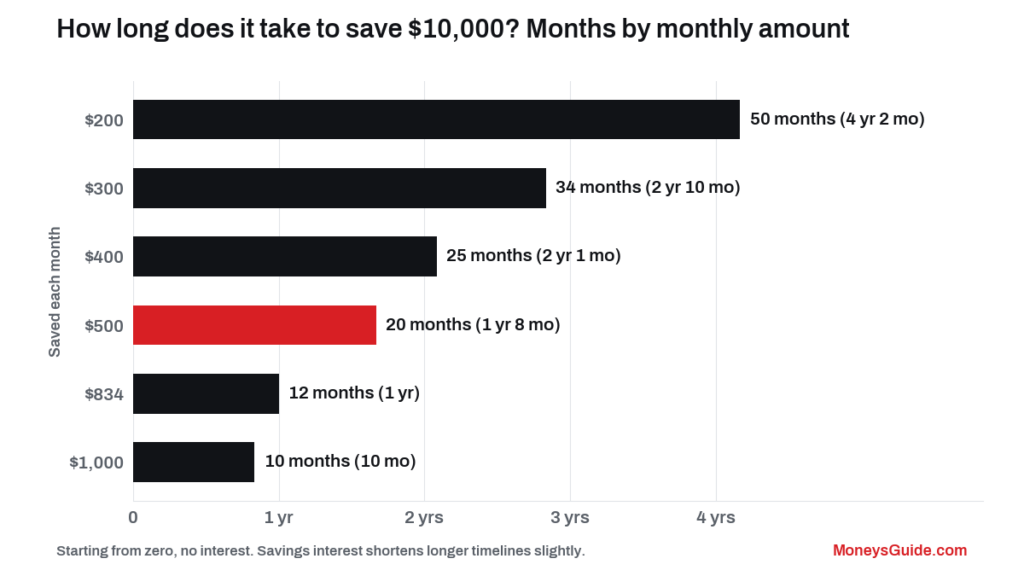
Interest makes the biggest difference on longer timelines. At $200 a month, a 4% savings rate gets you there about 3 months sooner than an account paying nothing. Run your own numbers in our savings goal calculator.
How much to save for a deadline
If you have a target date, here’s what you’d need to save from zero:
| Goal | Each month (0% interest) | Each month (4% interest) | Each week (0% interest) |
|---|---|---|---|
| 1 year | about $834 | about $818 | about $193 |
| 2 years | about $417 | about $401 | about $97 |
| 3 years | about $278 | about $262 | about $65 |
Amounts are rounded up so you reach the full $10,000. Breaking it into weekly or per-paycheck amounts can make a big goal feel more manageable.
What $500 a month means on different incomes
Saving $500 a month (to reach $10,000 in 20 months) takes a different share of your budget depending on your take-home pay:
| Monthly take-home pay | $500 as a share of pay |
|---|---|
| $3,000 | about 17% |
| $4,000 | 12.5% |
| $5,000 | 10% |
| $6,000 | about 8% |
The 50/30/20 rule suggests putting about 20% of take-home pay toward savings and extra debt payments, so $500 a month fits comfortably on most of these incomes.
What will you use the $10,000 for?
Your goal affects where the money should go:
- Emergency fund: keep it in an instant-access savings account. For many people, $10,000 covers about 3 months of essential costs. See how to build an emergency fund.
- Down payment or big purchase within a few years: a high-yield savings account or fixed-term deposit, where your money is safe. See how long it takes to save for a $50,000 down payment.
- Long-term investing (10+ years): once your emergency fund is in place, investing can grow your money faster, with more ups and downs. See how to start investing with $1,000.
10 ways to save $10,000 faster
- Automate it. Move a fixed amount to a separate savings account the day after payday.
- Use the 50/30/20 rule. It helps you find room for savings in your budget. See the 50/30/20 budget rule.
- Pay off high-interest debt first. Credit card interest works against your savings. See how much interest a $5,000 credit card balance costs.
- Save every pay rise. Put at least half of each raise into savings before you get used to spending it.
- Cut one big cost. Housing, transport and insurance usually offer the biggest savings.
- Cancel unused subscriptions. Small monthly charges add up over a year.
- Save windfalls. Put tax refunds, bonuses and gifts straight into your goal.
- Earn extra. Overtime, freelance work or selling things you don’t use can speed things up.
- Try a savings challenge. For example, saving a set amount every week and increasing it gradually.
- Track your progress. Seeing the balance grow is one of the best motivators. Our net worth calculator shows your whole financial picture in one number.
Simple ways to break down $10,000 in a year
Different people find different targets easier to stick to. All of these add up to about $10,000 in 12 months:
| Saving rhythm | Amount each time |
|---|---|
| Every day | about $27.40 |
| Every week | about $193 |
| Every two weeks (26 paychecks) | about $385 |
| Every month | about $834 |
If you’re paid every two weeks, matching your savings to each paycheck can make the habit automatic. And because a year has 26 biweekly paydays, saving the same amount each paycheck means two months a year get an extra deposit.
A realistic example
Say you can save $300 a month from your regular budget, and you also put a $1,500 tax refund and a $1,000 bonus into the fund during the year.
- From your budget: $300 × 12 = $3,600 in year one
- From windfalls: $2,500
- Total after year one: $6,100
At that pace, you’d reach $10,000 in about 25 months (2 years and 1 month), compared with 34 months from monthly savings alone. The windfalls save you about 9 months.
Where to keep your savings
- High-yield savings accounts pay more interest than standard accounts and keep your money easy to reach.
- Fixed-term deposits or certificates of deposit may pay a little more, but lock your money away for a set time. See what they’d earn with our CD calculator.
- Keep it separate from your everyday account, so you’re less tempted to spend it.
Avoid investing money you’ll need within the next few years. A market fall could set you back just when you need the cash. The Consumer Financial Protection Bureau’s guide to building an emergency fund has practical tips for getting started.
What $10,000 can grow into
Once you’ve saved $10,000, it can keep working for you. Left alone for 10 years:
- In a savings account paying 4% a year, it could grow to about $14,802.
- Invested at an average of 7% a year, it could grow to about $19,672, but with ups and downs along the way, and no guarantee.
Keep money you might need soon in savings, and invest only what you can leave untouched for the long term. Our compound interest calculator shows how different rates and timeframes change the result.
Common mistakes
- Saving whatever is left at the end of the month, which is often nothing
- Keeping savings in your current account, where it’s easy to spend
- Giving up after a setback. If you have to use some of your savings, just restart
- Saving while carrying high-interest debt, which can cost more than your savings earn
- Setting no deadline. A target date turns a wish into a plan
Now you know how long it takes to save $10,000 at different monthly amounts, and how to get there faster.
Frequently asked questions
How long does it take to save $10,000 at $500 a month?
20 months, or 1 year and 8 months. Interest at 4% barely changes this, because the timeline is short.
How much should I save a month to have $10,000 in a year?
About $834 a month, or $193 a week. With 4% interest, slightly less, about $818 a month.
Is $10,000 a good amount of savings?
Yes. It’s enough for a solid emergency fund for many people, covering about three months of essential costs on $3,300 a month.
Should I save $10,000 or pay off debt first?
Keep a small starter emergency fund, then pay off high-interest debt like credit cards. Once that’s done, build your savings to $10,000 and beyond.
Does a high-yield savings account help me save $10,000 faster?
A little. At 4% interest, saving $200 a month reaches $10,000 about three months sooner than an account paying nothing. The bigger difference comes from how much you save each month.
How can I save $10,000 on a low income?
Start smaller and stay consistent. Even $100 a month reaches $10,000 in a little over 8 years, and every pay rise, tax refund or bonus you add shortens that time. Clear any high-interest debt first, so interest isn’t working against you.
Where is the best place to keep $10,000?
For an emergency fund or short-term goal, a high-yield savings account. For long-term goals, consider investing once your emergency fund is in place.
This article is for education only and is not financial advice. Examples assume monthly deposits and a constant interest rate. Interest rates and account terms vary.