
How Long Does It Take to Save $100,000? (Timelines by Monthly Amount)
$100,000 is one of the biggest milestones in personal finance. Many investors say the first $100,000 is the hardest, because after that, growth starts doing a lot of the work for you. So how long does it take to save $100,000? This guide shows real timelines at different monthly amounts, how much you’d need to save for a 5 or 10-year goal, and why reaching this milestone early makes such a big difference.
Quick summary
- Saving $1,000 a month, you’d reach $100,000 in about 8 years 4 months with no growth, 7 years 3 months at 4%, or 6 years 8 months at 7%.
- At $2,000 a month, it takes about 4 years, or a little less with growth.
- To reach $100,000 in 5 years, you’d need to save about $1,508 a month at 4%.
- $100,000 left invested at 7% for 35 years could grow to over $1 million.
How long does it take to save $100,000?
Here’s how many months it takes to reach $100,000 from zero, at three rates of growth:
| Saved each month | No growth (0%) | Savings account (4%) | Invested (7% average) |
|---|---|---|---|
| $500 | 200 months (16 yrs 8 mo) | about 154 months (12 yrs 10 mo) | about 133 months (11 yrs 1 mo) |
| $1,000 | 100 months (8 yrs 4 mo) | about 87 months (7 yrs 3 mo) | about 80 months (6 yrs 8 mo) |
| $1,500 | about 67 months (5 yrs 7 mo) | about 61 months (5 yrs 1 mo) | about 57 months (4 yrs 9 mo) |
| $2,000 | 50 months (4 yrs 2 mo) | about 47 months (3 yrs 11 mo) | about 45 months (3 yrs 9 mo) |
| $3,000 | about 34 months (2 yrs 10 mo) | about 32 months (2 yrs 8 mo) | about 31 months (2 yrs 7 mo) |
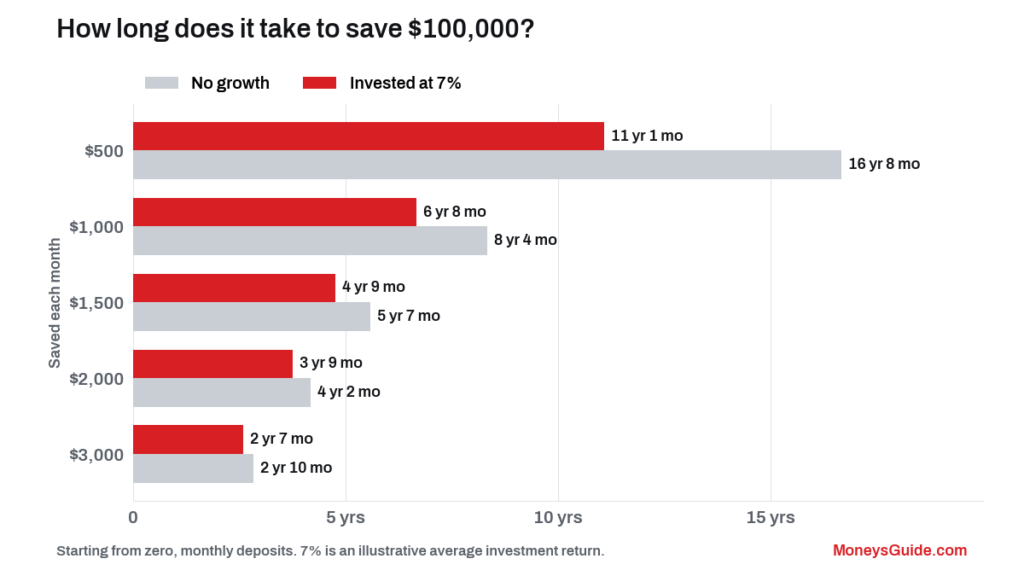
Two things stand out:
- How much you save matters most. Doubling from $1,000 to $2,000 a month roughly halves the time.
- Growth matters more on longer timelines. At $500 a month, a 7% average return saves you more than five years compared with no growth.
Run your own numbers in our savings goal calculator.
How much to save for a deadline
If you’d like to hit $100,000 by a certain date, here’s the monthly amount from zero:
| Goal | No growth | At 4% | At 7% |
|---|---|---|---|
| 5 years | about $1,667 a month | about $1,508 a month | about $1,397 a month |
| 10 years | about $833 a month | about $679 a month | about $578 a month |
Over 10 years, investing at an average 7% instead of keeping cash with no growth cuts the monthly amount needed by about $255.
Why the first $100,000 matters so much
Once you have $100,000, its growth starts to rival your own contributions. At 7%, $100,000 grows by about $7,000 a year on its own, and that amount keeps rising as the balance grows.
Time does the heavy lifting from there. Left invested at an average 7%, without adding another dollar:
- After 25 years, $100,000 could grow to about $542,700.
- After 35 years, it could grow to about $1,067,700.
That’s why reaching $100,000 earlier in life is so powerful: every extra year gives it more time to compound. Our guide to how long it takes to double your money at 7 percent explains the maths.
Savings or investments: where should your $100,000 go?
It depends on when you’ll need the money:
- Within the next few years (a home, a car, an emergency fund): a high-yield savings account or fixed-term deposit keeps it safe. Our CD calculator shows what a fixed-term deposit could earn. Market falls just before you need the money could set you back.
- 10 or more years away (retirement, long-term wealth): diversified, low-cost investments have historically grown faster than savings over long periods, with ups and downs along the way.
Many people do both: savings for short-term goals and an emergency fund, investments for the long term. If you’re starting out, see how to start investing with $1,000.
Milestones on the way to $100,000
Big goals feel more manageable broken into steps:
- $1,000: a starter emergency fund for small surprises. Track your overall progress with our net worth calculator.
- $10,000: a solid cushion for many people. See how long it takes to save $10,000.
- 3–6 months of expenses: a full emergency fund. See how to build an emergency fund.
- $50,000: halfway, and often enough for a home down payment. See how long it takes to save for a $50,000 down payment.
- $100,000: the milestone where growth starts to accelerate.
8 ways to reach $100,000 faster
- Automate it. Move a fixed amount on payday, before you can spend it.
- Raise your savings rate with every pay rise. Save at least half of each raise.
- Take any employer retirement match. It’s an instant boost to your savings.
- Use tax-advantaged accounts, so more of your growth stays invested.
- Clear high-interest debt first. Card interest can cancel out your savings growth. See how long it takes to pay off $20,000 in credit card debt.
- Cut one big fixed cost. Housing and transport usually offer the biggest savings.
- Put windfalls straight in. Bonuses, tax refunds and gifts can shave months off your timeline.
- Keep fees low. A 1% yearly fee can noticeably slow your progress over many years.
A simple budget helps you find the money. Our budget planner shows how much a 50/30/20 split would free up on your income.
How your savings rate changes the timeline
The share of your take-home pay you save matters more than any investment choice. On $5,000 of monthly take-home pay:
| Savings rate | Monthly saving | Time to $100,000 at 7% |
|---|---|---|
| 10% | $500 | about 11 years 1 month |
| 20% | $1,000 | about 6 years 8 months |
| 30% | $1,500 | about 4 years 9 months |
| 40% | $2,000 | about 3 years 9 months |
Moving from 10% to 20% cuts more than four years off the timeline. Raising your savings rate is usually the fastest way to reach any goal.
Saving $100,000 as a couple
Two incomes can shorten the timeline dramatically. At an average 7% return:
| Combined monthly saving | Time to $100,000 |
|---|---|
| $1,500 (for example, $750 each) | about 4 years 9 months |
| $2,500 (for example, $1,250 each) | about 3 years 1 month |
| $3,000 (for example, $1,500 each) | about 2 years 7 months |
A popular approach for couples is to live mainly on one income and save most of the other. Even partly following that idea can cut years off your goal.
Check the maths yourself
Every figure in this guide uses standard compound growth. You can test your own numbers with our savings goal calculator, or get a second opinion from the SEC’s compound interest calculator at investor.gov.
Common mistakes
- Waiting until you earn more to start saving
- Keeping long-term savings in a low-interest account for years
- Investing money you’ll need soon, and risking a market fall at the wrong time
- Ignoring fees, which compound against you
- Giving up after a setback. Progress, not perfection, gets you there
Now you know how long it takes to save $100,000, and that the two biggest levers are how much you save and how long you give it to grow.
Frequently asked questions
How long does it take to save $100,000 at $1,000 a month?
About 8 years 4 months with no growth, 7 years 3 months at 4% interest, or 6 years 8 months at an average 7% investment return.
How much do I need to save each month to have $100,000 in 5 years?
About $1,667 a month with no growth, $1,508 at 4%, or $1,397 at 7%.
Is $100,000 a lot of savings?
It’s a significant milestone. For most people it’s enough for a strong emergency fund plus a meaningful start on long-term investing.
Why is the first $100,000 the hardest?
Because at first, almost all the growth comes from your own contributions. Once the balance is large, investment growth adds thousands of dollars a year on its own.
How much interest does $100,000 earn?
In a savings account paying 4%, about $4,000 a year. Invested at an average 7%, about $7,000 a year, though investment returns vary and can be negative in some years.
Should I save or invest to reach $100,000?
Save money you’ll need within a few years, and invest money for goals 10 or more years away. Many people use both.
This article is for education only and is not financial or investment advice. Examples assume monthly deposits and constant growth rates. Investment returns are not guaranteed and can be negative.