
$100,000 a Year Is How Much an Hour? (Is Six Figures Rich?)
Earning $100,000 a year is a milestone many people aim for. It sounds like it should mean financial freedom, yet plenty of six-figure earners still live paycheck to paycheck. The difference usually comes down to what happens after the money arrives. So, $100,000 a year is how much an hour? At a standard 40-hour week, it’s $48.08. This guide breaks six figures down by pay period, asks whether $100,000 really makes you rich, and shows how to turn it into lasting wealth.
Quick summary
- $100,000 a year is $48.08 an hour at 40 hours a week for 52 weeks.
- That’s about $8,333 a month, $3,846 every two weeks and $1,923 a week, before tax.
- At 50 hours a week, your real hourly rate is about $38.46.
- Investing 15% of $100,000, about $1,250 a month, could grow to around $651,000 in 20 years at an average 7%.
$100,000 a year is how much an hour?
Hourly rate = yearly salary ÷ (hours per week × weeks per year)
$100,000 ÷ 2,080 = $48.08 an hour
$100,000 by pay period
| Pay period | Before tax |
|---|---|
| Hourly (40 hours a week) | $48.08 |
| Daily (5 days a week) | $384.62 |
| Weekly | $1,923.08 |
| Every two weeks | $3,846.15 |
| Twice a month | $4,166.67 |
| Monthly | $8,333.33 |
| Yearly | $100,000.00 |
Your real hourly rate
Many six-figure roles involve long hours:
| Typical hours per week | Effective hourly rate |
|---|---|
| 37.5 | about $51.28 |
| 40 | $48.08 |
| 45 | about $42.74 |
| 50 | about $38.46 |
A $100,000 job with 50-hour weeks pays the same per hour as an $80,000 job with 40-hour weeks. See $80,000 a year is how much an hour. Convert any salary with our free salary converter.
How $100,000 compares with nearby salaries
| Yearly salary | Hourly rate (40 hours) | Monthly pay |
|---|---|---|
| $80,000 | $38.46 | about $6,667 |
| $90,000 | $43.27 | $7,500 |
| $100,000 | $48.08 | about $8,333 |
| $110,000 | $52.88 | about $9,167 |
| $120,000 | $57.69 | $10,000 |
Take-home pay on $100,000
At this income, tax usually takes a larger share, and the amount depends heavily on where you live.
An example only: if about 27% went to tax and deductions, $100,000 would leave about $73,000 a year, or roughly $6,083 a month. That’s a big difference from the $8,333 gross figure, and it’s why budgeting with take-home pay matters so much.
Is $100,000 a year rich?
It depends on three things:
- Where you live. In lower-cost areas, $100,000 can feel very comfortable. In the most expensive cities, housing alone can take a large share.
- Who it supports. For a single person, it’s a high income. As the only income for a family of four, it’s comfortable but not lavish.
- What you keep. Wealth is what you save and invest, not what you earn. A $100,000 earner who saves nothing is building less wealth than a $60,000 earner who saves 20%.
The six-figure trap: lifestyle creep
The biggest risk at this level is that spending rises to match the income: a bigger home, newer cars, more expensive holidays and habits. None of these is wrong on its own, but together they can leave a high earner with little to show after years of good pay.
Three simple defences:
- Set a savings rate first, such as 20% to 25%, and live on the rest.
- Save at least half of every raise before your lifestyle adjusts.
- Keep fixed costs moderate. A 28% housing guideline allows up to about $2,333 a month on $100,000, a home of roughly $375,000 with 20% down at 6.5% and example taxes and insurance. Staying below the limit frees money to invest.
Turning $100,000 into wealth
At an average 7% a year:
| Invest each month | After 20 years | After 30 years |
|---|---|---|
| 15% of gross (about $1,250) | about $651,000 | about $1,525,000 |
| 25% of gross (about $2,083) | about $1,085,000 | – |
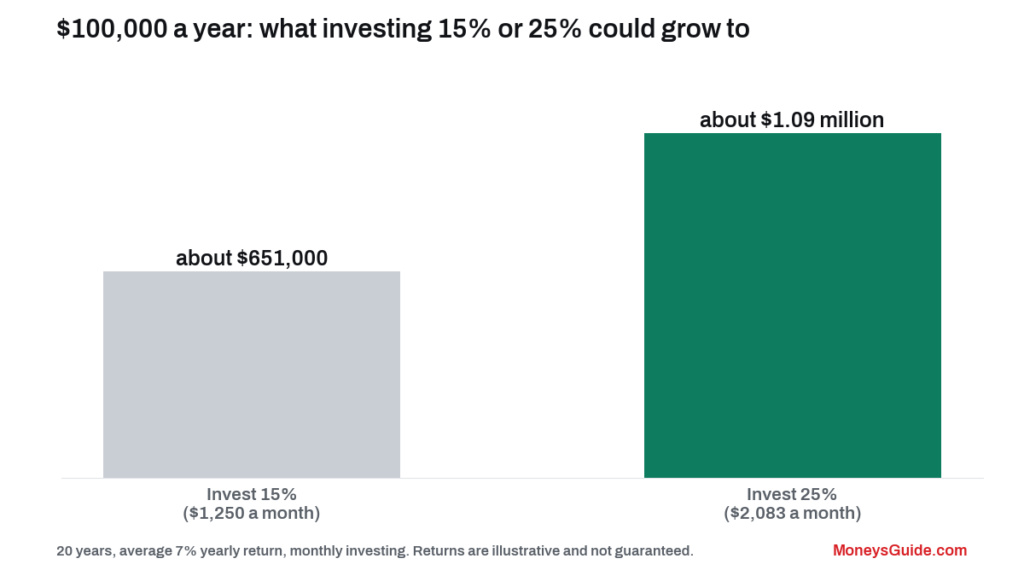
Returns aren’t guaranteed and markets go up and down, but these figures show how a six-figure income, invested consistently, can become real financial independence. Check your own path with our retirement calculator and see how long it takes to save a million dollars.
A priority order
- Emergency fund of 3 to 6 months of essential costs. Use our emergency fund calculator.
- Clear high-interest debt.
- Take the full employer retirement match.
- Use tax-advantaged accounts where available.
- Invest in diversified, low-cost funds, and keep fees low. The Securities and Exchange Commission’s investor site explains how fees affect returns.
A sample monthly budget on $100,000
Using the example take-home pay of about $6,083 a month:
| Category | Example monthly amount |
|---|---|
| Housing and utilities | $2,100 |
| Food | $650 |
| Transport | $550 |
| Insurance and health costs | $300 |
| Personal spending and fun | $1,100 |
| Emergency fund and goals | $383 |
| Investing (on top of any workplace plan) | $1,000 |
| Total | $6,083 |
Combined with workplace retirement contributions taken before your pay arrives, a plan like this can reach the 15% to 20% savings rate that builds real wealth. Our budget planner helps you build your own version.
$100,000 as a couple
If $100,000 is your combined household income, for example $55,000 and $45,000, the picture is different. Two earners often have more costs, but also more flexibility: one income can cover essentials while the other goes largely to savings or a home deposit. See $50,000 a year is how much an hour for budgeting on each income separately.
Track your progress with net worth
At this income, the best measure of progress isn’t your salary but your net worth: what you own minus what you owe. Check it once or twice a year with our net worth calculator. A rising net worth means your income is turning into wealth.
Protecting a six-figure income
At this level, your income is your biggest financial asset, so it’s worth protecting:
- Income protection or disability cover can replace part of your pay if illness or injury stops you working.
- Life insurance matters if others depend on your income.
- A will and up-to-date beneficiaries make sure your money goes where you intend.
Compare quotes, and check what your employer already provides before buying extra cover.
Common mistakes
- Budgeting on gross pay, when tax takes a big share at this level
- Letting spending rise with every raise
- Buying the biggest home or car the bank will finance
- Keeping long-term savings in cash
- Ignoring fees on a growing investment portfolio
So, $100,000 a year is how much an hour? $48.08 at a standard 40-hour week, or about $8,333 a month. Whether it makes you rich depends less on the number and more on what you keep and invest.
Frequently asked questions
How much is $100,000 a year per month?
About $8,333.33 a month before tax.
How much is $100,000 a year biweekly?
About $3,846.15 before tax, across 26 paychecks.
How much is $100,000 a year after tax?
It depends heavily on where you live and your deductions. As an example, if about 27% went to tax and deductions, you’d take home about $73,000 a year, or $6,083 a month.
What hourly rate is $100,000 a year?
$48.08 an hour at 40 hours a week for 52 weeks. At 37.5 hours a week, about $51.28.
Why do some people on $100,000 still feel broke?
Usually because their fixed costs rose with their income: a large mortgage or rent, car loans and other regular commitments. Keeping those costs moderate is the key to feeling the benefit of a high salary.
Is $100,000 a year enough to retire early?
It can help, but early retirement depends on how much you save, not just what you earn. Saving 25% or more of a six-figure income consistently for 15 to 20 years is what makes early retirement realistic for many people.
What is $100,000 a year at 45 hours a week?
About $42.74 an hour, if the extra hours aren’t paid as overtime.
How much house can I afford on $100,000?
Using a 28% guideline with example taxes and insurance, roughly $375,000 with 20% down at 6.5%. Your rate, debts and local costs will change this.
How much should I invest on $100,000 a year?
Many people aim for 15% to 25% of gross pay once they have an emergency fund and no high-interest debt, about $1,250 to $2,083 a month.
Is $50 an hour $100,000 a year?
Close. $50 an hour at 40 hours a week is $104,000 a year, slightly more than $100,000.
This article is for education only and is not financial, tax or investment advice. Figures are gross pay unless stated. Take-home, housing and investment examples are illustrative.