
$40,000 a Year Is How Much an Hour? (Living Well on $40k)
$40,000 a year can feel like a lot or very little, depending on where you live and what you spend. With a clear plan, though, it’s enough to cover the basics, build savings and avoid debt. So, $40,000 a year is how much an hour? At a standard 40-hour week, it’s $19.23. This guide breaks $40,000 down by pay period, then shows a realistic budget and practical ways to live well on this income.
Quick summary
- $40,000 a year is $19.23 an hour at 40 hours a week for 52 weeks.
- That’s about $3,333 a month, $1,538 every two weeks and $769 a week, before tax.
- A common 30% rent guideline suggests up to about $1,000 a month on this income.
- Saving $200 a month builds a $5,400 emergency fund in a little over two years.
$40,000 a year is how much an hour?
Hourly rate = yearly salary ÷ (hours per week × weeks per year)
$40,000 ÷ 2,080 = $19.23 an hour
$40,000 by pay period
| Pay period | Before tax |
|---|---|
| Hourly (40 hours a week) | $19.23 |
| Daily (5 days a week) | $153.85 |
| Weekly | $769.23 |
| Every two weeks | $1,538.46 |
| Twice a month | $1,666.67 |
| Monthly | $3,333.33 |
| Yearly | $40,000.00 |
Your real hourly rate
| Typical hours per week | Effective hourly rate |
|---|---|
| 37.5 | about $20.51 |
| 40 | $19.23 |
| 45 | about $17.09 |
| 50 | about $15.38 |
Convert any salary or rate with our free salary converter. For the hourly view, see $20 an hour is how much a year.
How $40,000 compares with nearby salaries
| Yearly salary | Hourly rate (40 hours) | Monthly pay |
|---|---|---|
| $30,000 | $14.42 | $2,500 |
| $35,000 | $16.83 | about $2,917 |
| $40,000 | $19.23 | about $3,333 |
| $45,000 | $21.63 | $3,750 |
| $50,000 | $24.04 | about $4,167 |
Take-home pay on $40,000
These figures are gross pay. Take-home pay depends on the tax rules where you live and your deductions.
An example only: if about 18% went to tax and deductions, $40,000 would leave about $32,800 a year, or roughly $2,733 a month. We’ll use that in the budget below.
A realistic budget on $40,000
Using the example take-home pay of about $2,733 a month and the 50/30/20 rule:
| Bucket | Share | Monthly |
|---|---|---|
| Needs (housing, food, transport, bills) | 50% | about $1,367 |
| Wants | 30% | about $820 |
| Savings and extra debt payments | 20% | about $547 |
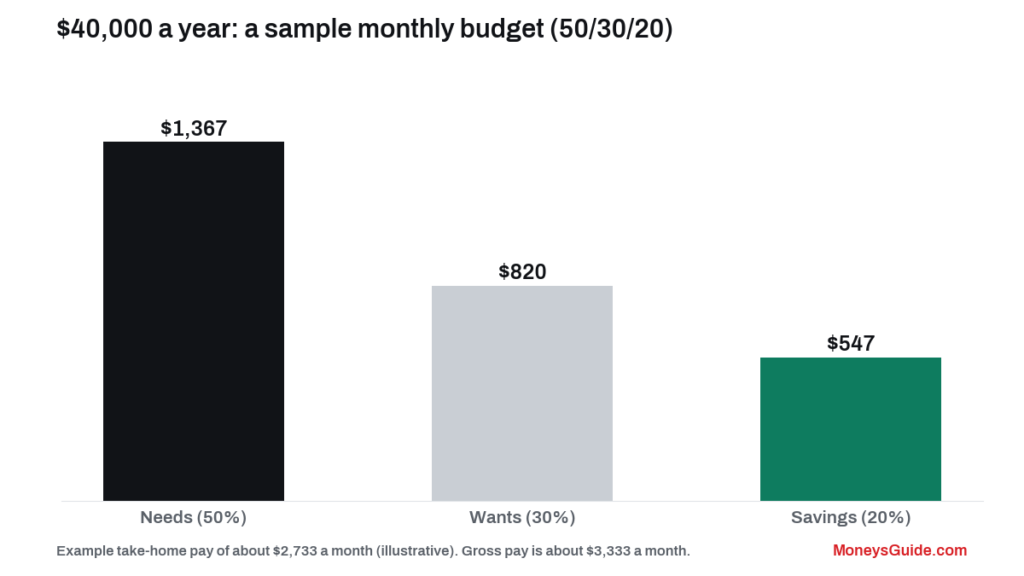
In practice, needs often take more than 50% on this income, mostly because of rent. A 60/30/10 or 60/20/20 split is a realistic alternative, as long as something goes to savings every month. Our budget planner shows the split for your own pay.
Housing on $40,000
The 30% guideline gives about $1,000 a month for rent. Depending on your area, that may cover a modest place on your own, or work better shared. To keep housing affordable:
- Share with a roommate or family to split rent and bills.
- Look slightly further out if the commute stays reasonable and affordable.
- Count the extras: utilities, internet and insurance can add $150 to $300 a month.
Seven ways to live well on $40,000
- Pay yourself first. Move savings out on payday, before you spend.
- Keep fixed costs low. Housing, transport and phone plans are where the biggest savings usually are.
- Choose an older, reliable car, or skip the car if you can. A large car loan can take 15% to 20% of your take-home pay.
- Plan meals and shop with a list. Food is one of the easiest costs to control.
- Review subscriptions every few months, and cancel what you don’t use.
- Use cash or debit for everyday spending, so card balances don’t build up.
- Set aside money for irregular costs, like car repairs and gifts, so they don’t end up on a credit card.
Building savings on $40,000
Start with an emergency fund
Aim for three months of essential costs. If your essentials are about $1,800 a month, that’s $5,400. Saving $200 a month in an account paying 4% gets you there in about 26 months. Our emergency fund calculator works out your own target and timeline. The Consumer Financial Protection Bureau also has a practical guide to building an emergency fund.
Avoid high-interest debt
On $40,000, credit card interest can quickly eat into your budget. A $3,000 balance at 22% costs about $55 a month in interest alone. See how to pay off $6,000 in credit card debt for a step-by-step plan.
Then save for the future
Once you have a cushion, take any employer retirement match, then invest a fixed amount every month, even $50 to $100. See how much $500 a month can grow for what regular saving can do over time.
Earning extra on the side
If your budget is tight, a little extra income can make a big difference, especially for clearing debt or building savings. Common options include:
- Overtime or extra shifts at your current job, if paid hourly
- Freelance work using skills you already have, such as writing, design or bookkeeping
- Weekend or seasonal work
- Selling things you no longer use
Even $300 a month of extra income adds up to $3,600 a year, enough to build a starter emergency fund or clear a small card balance. Put side income straight towards a specific goal, so it doesn’t quietly disappear into everyday spending.
How to grow beyond $40,000
| Change | Extra a year |
|---|---|
| $1-an-hour raise | about $2,080 |
| Moving to $45,000 | $5,000 |
| 5 hours of overtime a week at 1.5× (if paid hourly) | about $7,500 |
Building in-demand skills, earning certifications and comparing pay with other employers are often the fastest routes to a higher salary. See $45,000 a year is how much an hour for judging your next job offer.
Review your budget every month. Compare what you planned with what you spent, and adjust. Small corrections are much easier than recovering from a big overspend.
Is $40,000 a good salary?
For a single person in an area with moderate living costs, $40,000 can cover the basics and allow some saving, especially with shared housing. In expensive cities, or as the only income for a family, it’s tight. Your housing cost is usually what decides how comfortable it feels.
If your pay hasn’t changed for a while, check whether it has kept pace with prices using our salary vs inflation calculator.
Common mistakes
- Budgeting with gross pay, instead of what actually reaches your account
- Taking on a big car loan relative to your income
- Skipping savings because the amount feels too small
- Using credit cards to cover regular monthly shortfalls
- Not asking for a raise once you’ve built experience
So, $40,000 a year is how much an hour? $19.23 at a standard 40-hour week, or about $3,333 a month. With low fixed costs and savings set aside first, it can support a stable, stress-free financial life.
Frequently asked questions
How much is $40,000 a year per month?
About $3,333.33 a month before tax.
How much is $40,000 a year biweekly?
About $1,538.46 before tax, across 26 paychecks.
How much is $40,000 a year weekly?
About $769.23 a week before tax.
How much rent can I afford on $40,000 a year?
Using the 30% guideline, about $1,000 a month. Many people aim lower to save more.
Is $40,000 a year enough for one person?
In many areas, yes, especially with shared housing and a modest car. It becomes tight in high-cost cities or with large debts.
How much should I save on $40,000 a year?
Start with whatever you can manage consistently, even 5% of take-home pay. Aim to build up towards 10% to 20% as debts are paid off or your pay rises.
How much is $40,000 a year per day?
About $153.85 per working day before tax, based on 260 working days a year.
Can a couple live on $40,000 a year?
Many couples do, especially with low housing costs. Careful budgeting and avoiding high-interest debt make the biggest difference.
Can I afford a car on $40,000?
A common guideline keeps all car costs to about 10% to 15% of take-home pay, roughly $273 to $410 a month on the example figures. That usually points to a modest, reliable used car.
Is $19 an hour the same as $40,000 a year?
Close. $19 an hour at 40 hours a week is $39,520 a year. To reach $40,000, you’d need about $19.23 an hour.
This article is for education only and is not financial, tax or employment advice. Figures are gross pay unless stated. Take-home and budget examples are illustrative.