The 50/30/20 Budget Rule Explained
Budgeting doesn’t have to mean tracking every coffee. The 50/30/20 budget rule is one of the simplest ways to take control of your money: you split your take-home pay into just three buckets. It was popularised by Elizabeth Warren and Amelia Warren Tyagi in their book All Your Worth, and it’s still a favourite starting point because it’s easy to remember and easy to stick to.
Quick summary
- 50% of take-home pay for needs: rent, bills, food, transport, minimum debt payments.
- 30% for wants: eating out, entertainment, shopping, holidays.
- 20% for savings and extra debt payments.
- If your rent is high, adjust the split. The habit matters more than the exact numbers.
How the 50/30/20 budget rule works
Start with your take-home pay: what actually reaches your bank account after tax and deductions. Then divide it:
50% for needs
Costs you must pay to live and work:
- Rent or mortgage
- Utilities, internet and phone
- Groceries
- Transport to work
- Insurance
- Minimum payments on loans and cards
- Childcare or school fees
30% for wants
Things that make life enjoyable but aren’t essential:
- Eating out and takeaways
- Streaming and subscriptions
- Shopping and hobbies
- Holidays and travel
- Upgrades, like a bigger phone plan
20% for savings and debt
Money that builds your future:
- Your emergency fund
- Saving for goals, like a house deposit
- Investing for the long term
- Paying off debt faster than the minimum
A real example
Say your take-home pay is $5,000 a month:
| Bucket | Share | Amount |
|---|---|---|
| Needs | 50% | $2,500 |
| Wants | 30% | $1,500 |
| Savings & debt | 20% | $1,000 |
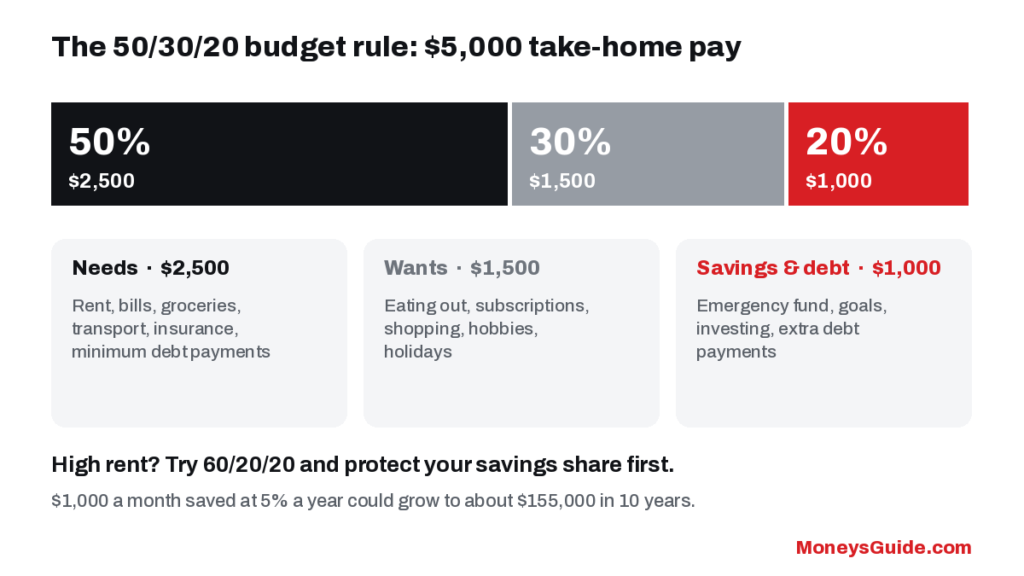
That $1,000 a month adds up. Saved steadily at 5% a year, it would grow to about $155,000 in 10 years. Use our compound interest calculator to try your own numbers.
How to set up your 50/30/20 budget
- Find your take-home pay. Use your average monthly amount if it varies.
- List your spending from the last two or three months of bank statements.
- Sort each item into needs, wants or savings.
- Compare with 50/30/20. Where are you over? Where is there room?
- Automate your 20%. Set up a transfer to savings the day after payday.
- Review monthly and adjust as your life changes.
If you prefer to start on paper, the Federal Trade Commission’s consumer site has a simple guide to making a budget, with a free worksheet.
What if your rent is too high for 50%?
In expensive cities, housing alone can take half your income. That doesn’t mean budgeting won’t work. Adjust the split instead:
- 60/20/20: more room for needs, while still saving 20%
- 70/20/10: a temporary plan while you cut costs or grow your income
Try to protect your savings share first and trim wants instead. Then work on bringing needs down over time, for example with a cheaper flat at renewal or sharing transport costs.
Needs vs wants: the grey areas
Some costs fall in between. A simple test: would life keep working without it?
- A basic phone plan is a need. The newest phone on a premium plan is partly a want.
- Groceries are a need. Premium brands and delivery fees lean towards wants.
- A car for work may be a need. A more expensive model than you need is partly a want.
Be honest when sorting. The rule only works if “needs” really are needs.
Common 50/30/20 budget rule mistakes
- Using gross salary instead of take-home pay. Always budget with what you actually receive.
- Treating savings as “whatever’s left”. Pay yourself first by automating your 20%.
- Ignoring irregular bills. Divide annual costs, like insurance, by 12 and include them monthly.
- Giving up after one bad month. Adjust and try again. Consistency matters more than perfection.
Where to put your 20%
A good order for most people:
- A starter emergency fund of about one month’s essentials
- High-interest debt, like credit cards
- A full emergency fund of 3–6 months. See our guide on how to build an emergency fund.
- Goals and long-term investing
Our savings goal calculator shows how much to set aside each month for any target.
Frequently asked questions
Is the 50/30/20 budget rule based on gross or net income?
Net income, meaning your take-home pay after tax and deductions.
Do debt payments count as needs or savings?
Minimum payments count as needs. Anything extra you pay to clear debt faster counts towards your 20%.
Is 20% enough to save?
It’s a solid starting point. If you have big goals or started saving late, you may want to save more by trimming wants.
Does the 50/30/20 rule work on a low income?
The exact split may not fit, but the idea still helps. Start by covering needs, save something every month, even a small amount, and build up as your income grows.
This article is for education only and is not financial advice. Figures are examples. Returns on savings and investments are not guaranteed.