How Compound Interest Works (With Real Examples)
Compound interest is the reason a modest monthly saving can grow into a large sum over time. It sounds technical, but the idea is simple: you earn interest not just on the money you put in, but also on the interest you have already earned. Over long periods, that “interest on interest” can end up larger than everything you deposited.
This guide explains how compound interest works, shows real numbers, and covers the few things that make the biggest difference to how much your money grows.
How compound interest works: simple vs compound interest
The easiest way to understand compounding is to compare it with simple interest.
Simple interest is paid only on your original deposit. If you put $10,000 into an account paying 7% simple interest, you earn $700 every year, no matter how long you wait. After 30 years you would have $31,000: your $10,000 plus 30 years of $700.
Compound interest is paid on your deposit plus any interest already added to your balance. In the first year you earn about $700 on $10,000. In the second year you earn interest on roughly $10,700, so the amount grows a little. Each year the base gets bigger, so the interest gets bigger too.
Leave that same $10,000 to compound monthly at 7% for 30 years and it grows to about $81,165. That is more than two and a half times the simple-interest result, with no extra money added.
The compound interest formula
For a single deposit, the standard formula is:
A = P × (1 + r/n)^(n × t)
- A is the amount you end up with
- P is the starting amount (the principal)
- r is the annual interest rate as a decimal (7% = 0.07)
- n is how many times interest is added per year (12 for monthly)
- t is the number of years
You don’t need to work this out by hand. Our compound interest calculator does it instantly, including regular monthly deposits, and shows a year-by-year breakdown.
You can also check the maths with the U.S. SEC’s compound interest calculator at investor.gov.
Real examples: what $10,000 becomes
Here is $10,000 left alone at 7% a year, compounded monthly, with nothing added:
- After 10 years: about $20,097
- After 20 years: about $40,387
- After 30 years: about $81,165
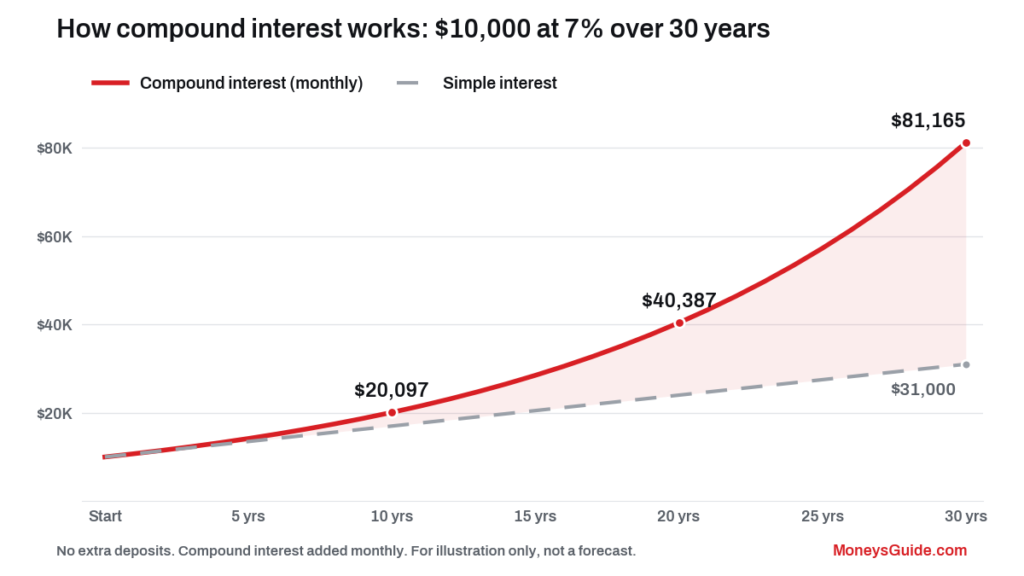
Notice the pattern. The balance roughly doubles every 10 years. In the first decade the money grows by about $10,000. In the third decade it grows by more than $40,000. Same rate, same starting amount: the only difference is that the balance compounding in the later years is much larger.
Time matters more than you think
Compounding rewards patience more than anything else. Take two people who each save $200 a month and earn 7% a year:
- Person A starts at 25 and saves until 65, which is 40 years. They deposit $96,000 in total and end up with about $524,963.
- Person B starts at 35 and saves until 65, which is 30 years. They deposit $72,000 and end up with about $243,994.
Person A put in only $24,000 more, yet finished with more than twice as much. Those first ten years gave their early deposits the longest time to compound. This is why the most common advice about saving and investing is simply to start as early as you can, even with small amounts.
Does compounding frequency matter?
Interest can be added yearly, quarterly, monthly or even daily. More frequent compounding does produce slightly more money, because interest starts earning interest sooner. But the difference is usually small.
For example, $10,000 plus $200 a month at 7% for 10 years grows to about $53,882 with yearly compounding, $54,714 with monthly compounding and $54,791 with daily compounding. Daily compounding beats yearly by less than $1,000 over a decade.
When you compare accounts, focus on the rate first. Many banks show an annual equivalent rate or annual percentage yield, which already includes the effect of compounding and makes comparisons easier.
The rule of 72: a quick shortcut
Want a rough idea of how fast your money will double? Divide 72 by the annual rate.
- At 6%, money doubles in about 12 years (72 ÷ 6)
- At 7%, about 10.3 years
- At 9%, about 8 years
It’s an approximation, but it’s surprisingly close for typical rates and a useful way to sense-check any growth figure you see.
What helps compounding, and what hurts it
What helps:
- Starting early. Every extra year gives earlier money more time to grow.
- Adding regularly. Monthly deposits each start their own compounding journey.
- Reinvesting returns. Leaving interest and dividends in the account keeps them compounding.
- A better rate. Even 1% more a year adds up significantly over decades.
What hurts:
- Fees. A 1% annual fee on an investment returning 7% leaves you with 6%, and that gap compounds against you year after year.
- Withdrawing early. Taking money out resets the clock on that portion.
- Inflation. Rising prices reduce what your future balance can buy. To see growth in today’s money, subtract the inflation rate from your return.
- Taxes. Depending on where you live, tax on interest or gains can reduce your effective return.
Compound interest works against you too
The same maths that grows savings also grows debt. Credit cards and many loans charge interest on unpaid interest. If you only pay the minimum on a credit card, the balance can take years to clear and cost far more than the original purchase.
That’s why paying off high-interest debt is often one of the best “returns” available. Clearing a card that charges 25% a year is like earning a guaranteed 25% on that money. You can see how interest builds on a loan with our loan and EMI calculator.
Putting it to work
- Pick a realistic rate. Use your savings account rate, or a cautious long-term estimate for investments. Investment returns are never guaranteed and some years are negative.
- Decide what you can add each month, even if it’s small.
- Run the numbers in our compound interest calculator and try a few different timelines.
- Automate it. A standing transfer on payday removes the temptation to skip a month.
If you are saving toward a specific target, such as a deposit or an emergency fund, our savings goal calculator works backwards to show how much you need to put aside each month.
Frequently asked questions
Is compound interest the same as compound returns?
They work the same way. “Compound interest” usually describes savings accounts and deposits. “Compound returns” describes investments, where growth comes from price changes and reinvested dividends rather than a fixed interest rate, so the rate varies from year to year.
How often is interest compounded on savings accounts?
It depends on the account. Monthly and daily compounding are both common. Check the account terms or the annual equivalent rate, which already factors compounding in.
Can compound interest make me rich?
On its own, it won’t turn a small amount into a fortune quickly. But steady saving, a reasonable return and a long time horizon can build substantial wealth. The biggest factor is time.
This article is for education only and is not financial advice. Examples use a fixed 7% rate for illustration. Real savings rates and investment returns vary and are not guaranteed.