$50,000 a Year Is How Much an Hour? (A First-Salary Money Plan)
For many people, $50,000 is their first proper full-time salary, and it’s often the moment money starts to feel manageable for the first time. But it’s also when habits form that can last for decades. So, $50,000 a year is how much an hour? At a standard 40-hour week, it’s $24.04. This guide breaks $50,000 down by pay period, then sets out a simple money plan for your first salary: a budget, an emergency fund, dealing with debt and starting to invest.
Quick summary
- $50,000 a year is $24.04 an hour at 40 hours a week for 52 weeks.
- That’s about $4,167 a month, $1,923 every two weeks and $962 a week, before tax.
- On an example take-home pay of about $3,333 a month, a 50/30/20 budget sets aside about $667 a month for savings and extra debt payments.
- Saving $300 a month builds a $6,000 emergency fund in about 20 months.
$50,000 a year is how much an hour?
Hourly rate = yearly salary ÷ (hours per week × weeks per year)
$50,000 ÷ 2,080 = $24.04 an hour
$50,000 by pay period
| Pay period | Before tax |
|---|---|
| Hourly (40 hours a week) | $24.04 |
| Daily (5 days a week) | $192.31 |
| Weekly | $961.54 |
| Every two weeks | $1,923.08 |
| Twice a month | $2,083.33 |
| Monthly | $4,166.67 |
| Yearly | $50,000.00 |
Your real hourly rate
| Typical hours per week | Effective hourly rate |
|---|---|
| 40 | $24.04 |
| 45 | about $21.37 |
| 50 | about $19.23 |
Convert any salary with our free salary converter. For the hourly view, see $25 an hour is how much a year.
How $50,000 compares with nearby salaries
| Yearly salary | Hourly rate (40 hours) | Monthly pay |
|---|---|---|
| $40,000 | $19.23 | about $3,333 |
| $45,000 | $21.63 | $3,750 |
| $50,000 | $24.04 | about $4,167 |
| $55,000 | $26.44 | about $4,583 |
| $60,000 | $28.85 | $5,000 |
Take-home pay on $50,000
These figures are gross pay. What reaches your account depends on your local tax rules and deductions.
An example only: if about 20% went to tax and deductions, $50,000 would leave about $40,000 a year, or roughly $3,333 a month. We’ll use that in the plan below. Check your first payslip for your real figure.
Your first-salary money plan
Step 1: Set up a simple budget
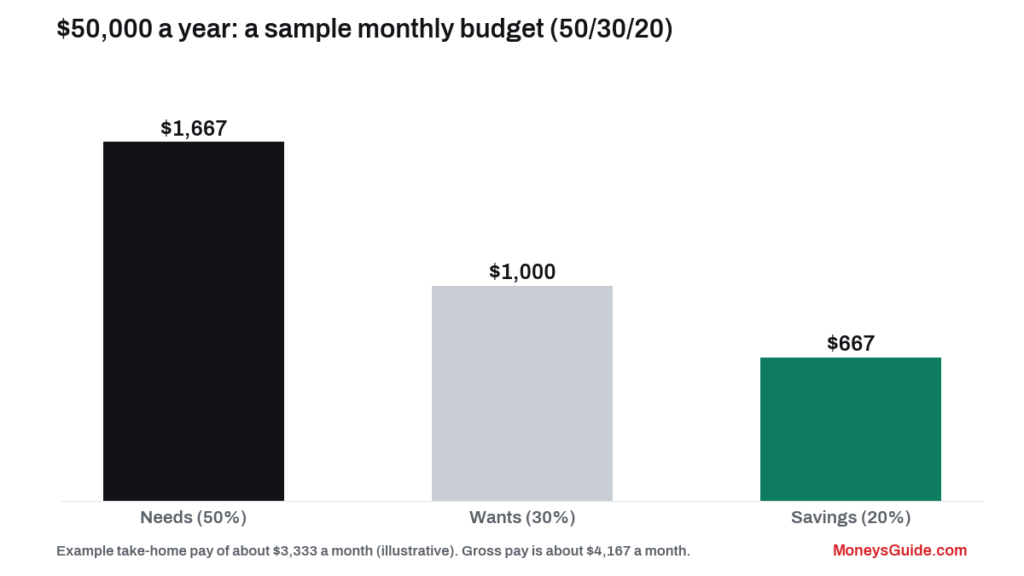
On about $3,333 a month, the 50/30/20 rule gives:
| Bucket | Share | Monthly |
|---|---|---|
| Needs (housing, food, transport, bills) | 50% | about $1,667 |
| Wants (eating out, hobbies, subscriptions) | 30% | about $1,000 |
| Savings and extra debt payments | 20% | about $667 |
If rent pushes needs above 50%, try 60/20/20, which keeps savings at 20% by trimming wants. Our budget planner shows the split for your own pay, and the Federal Trade Commission’s consumer site has a simple guide to making a budget.
Step 2: Keep rent in check
A common guideline is to keep rent to about 30% of gross pay, which on $50,000 is about $1,250 a month. Many people on a first salary aim lower, sharing housing for a year or two to build savings faster.
Step 3: Build an emergency fund
Start with $1,000, then build to three months of essential costs. If your essentials are about $2,000 a month, that’s $6,000. Saving $300 a month in an account paying 4% gets you there in about 20 months.
Use our emergency fund calculator to set your target.
Step 4: Deal with high-interest debt
If you have credit card debt, it should come next. A $5,000 card balance at 22% costs about $92 a month in interest. Paying $300 a month clears it in about 21 months. See interest on a $5,000 credit card for the full breakdown.
If you have several debts, our debt payoff calculator compares the snowball and avalanche methods.
Step 5: Start investing, even a little
Once you have a starter emergency fund and no high-interest debt:
- Take any employer retirement match first. It’s an instant boost.
- Invest a fixed amount every month, even $100 to $200.
Starting early matters more than starting big. See how to start investing with $1,000 and how much $500 a month can grow.
Why starting early matters on $50,000
Small amounts invested in your twenties can grow into large sums. At an average 7% a year over 40 years:
- $150 a month could grow to about $394,000.
- $300 a month could grow to about $787,000.
Returns aren’t guaranteed and markets go up and down, but time is the biggest advantage a first salary gives you. See how long it takes to save a million dollars for how starting age changes the monthly amount needed.
What to do with your first raise
Your first raise is the best chance to lock in good habits:
- Increase your automatic saving by at least half the raise.
- Top up your emergency fund towards three to six months of costs.
- Raise retirement contributions if your employer matches more.
- Then enjoy the rest. A plan you can stick to beats a perfect plan you abandon.
Habits that pay off for decades
- Automate everything: savings, investments and bill payments on payday.
- Save half of every raise before your spending adjusts.
- Keep your car modest. A big car loan on a first salary can take years to recover from. See the $20,000 car loan guide.
- Check your pay against inflation each year with our salary vs inflation calculator.
- Track your net worth once or twice a year with our net worth calculator.
Understanding your first payslip
Your first payslip can look confusing. It usually shows:
- Gross pay: your pay before anything is taken out
- Tax: income tax, and in many places other payroll taxes or social contributions
- Deductions: retirement contributions, health cover or other benefits you’ve chosen
- Net pay: what actually reaches your bank account
Check it carefully each month, especially the first few, to make sure your tax code or deductions are correct. Mistakes are easier to fix early.
Is $50,000 a good salary?
For a single person in many areas, $50,000 covers the essentials with room to save, especially with shared housing. In high-cost cities, or as the only income for a family, it’s much tighter. Your housing cost is usually the deciding factor.
For comparison, see $60,000 a year and $65,000 a year.
Common mistakes on a first salary
- Spending the whole raise from a previous lower-paid job
- Taking on a big car loan or expensive lease straight away
- Skipping the emergency fund, so surprises go on credit cards
- Leaving free retirement matching unclaimed
- Budgeting with gross pay, instead of take-home pay
So, $50,000 a year is how much an hour? $24.04 at a standard 40-hour week, or about $4,167 a month. With a simple plan, it can be the foundation of strong money habits for life.
Frequently asked questions
How much is $50,000 a year per month?
About $4,166.67 a month before tax.
How much is $50,000 a year biweekly?
About $1,923.08 before tax, across 26 paychecks.
How much is $50,000 a year weekly?
About $961.54 a week before tax.
How much is $50,000 a year after tax?
It depends on where you live and your deductions. As an example, if about 20% went to tax and deductions, you’d take home about $40,000 a year, or $3,333 a month.
How much car can I afford on $50,000 a year?
A common guideline keeps all car costs, including the loan, insurance and fuel, to about 10% to 15% of take-home pay, roughly $333 to $500 a month on the example figures. That usually points to a modest, reliable used car.
Should I pay off debt or save on $50,000?
Build a starter emergency fund of about $1,000 first, then focus on high-interest debt, then grow your savings and investing.
Is $24 an hour the same as $50,000 a year?
Close. $24 an hour at 40 hours a week is $49,920 a year.
How much should I save on a $50,000 salary?
Many people aim for 10% to 20% of take-home pay once they have a starter emergency fund, about $333 to $667 a month on the example figures.
How much rent can I afford on $50,000 a year?
Using a 30% guideline, about $1,250 a month. Many people aim lower to save more.
This article is for education only and is not financial, tax or employment advice. Figures are gross pay unless stated. Take-home and budget examples are illustrative.