
$80,000 a Year Is How Much an Hour? (And How Much House It Buys)
$80,000 is the salary at which many people start seriously thinking about buying a home. It’s a strong income, but house prices, mortgage rates and the down payment all decide whether owning is realistic. So, $80,000 a year is how much an hour? At a standard 40-hour week, it’s $38.46. This guide breaks $80,000 down by pay period, then shows how much house it can support, how long saving a down payment might take, and how to make home buying on $80,000 work.
Quick summary
- $80,000 a year is $38.46 an hour at 40 hours a week for 52 weeks.
- That’s about $6,667 a month, $3,077 every two weeks and $1,538 a week, before tax.
- A common 28% housing guideline allows about $1,867 a month for total housing costs.
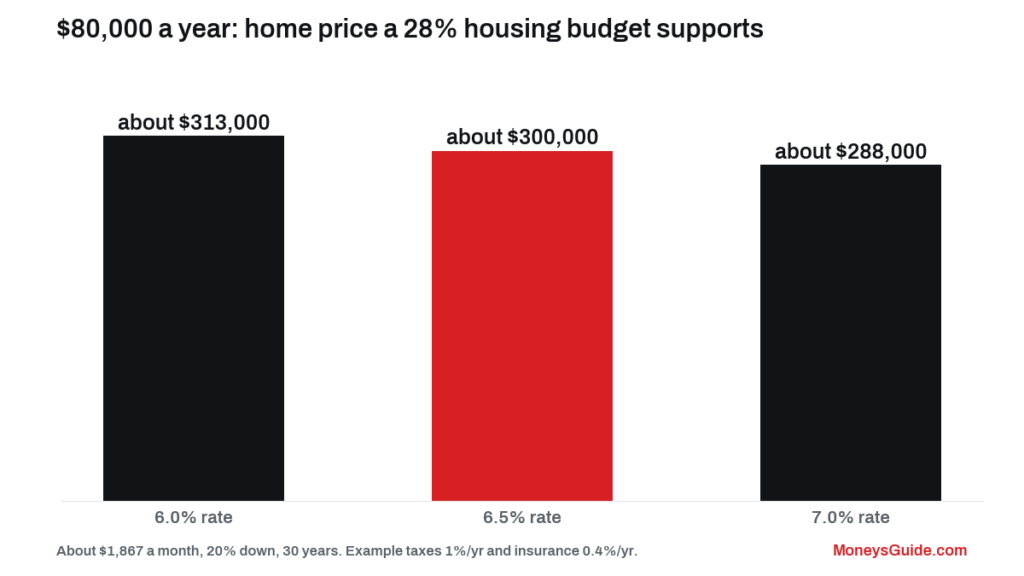
- With 20% down at 6.5%, that supports a home of roughly $300,000, including example taxes and insurance.
$80,000 a year is how much an hour?
Hourly rate = yearly salary ÷ (hours per week × weeks per year)
$80,000 ÷ 2,080 = $38.46 an hour
$80,000 by pay period
| Pay period | Before tax |
|---|---|
| Hourly (40 hours a week) | $38.46 |
| Daily (5 days a week) | $307.69 |
| Weekly | $1,538.46 |
| Every two weeks | $3,076.92 |
| Twice a month | $3,333.33 |
| Monthly | $6,666.67 |
| Yearly | $80,000.00 |
Your real hourly rate
| Typical hours per week | Effective hourly rate |
|---|---|
| 37.5 | about $41.03 |
| 40 | $38.46 |
| 45 | about $34.19 |
| 50 | about $30.77 |
Convert any salary with our free salary converter.
How $80,000 compares with nearby salaries
| Yearly salary | Hourly rate (40 hours) | Monthly pay |
|---|---|---|
| $70,000 | $33.65 | about $5,833 |
| $75,000 | $36.06 | $6,250 |
| $80,000 | $38.46 | about $6,667 |
| $85,000 | $40.87 | about $7,083 |
| $90,000 | $43.27 | $7,500 |
Take-home pay on $80,000
These are gross figures. Take-home pay depends on the tax rules where you live and your deductions.
An example only: if about 24% went to tax and deductions, $80,000 would leave about $60,800 a year, or roughly $5,067 a month.
How much house can you afford on $80,000?
Many lenders use a 28% guideline: total housing costs of no more than 28% of gross monthly income. On $6,667 a month, that’s about $1,867.
Using example property tax of 1% and insurance of 0.4% of the home’s value each year, plus mortgage insurance below 20% down, here’s the approximate home price that budget supports on a 30-year loan:
| Mortgage rate | 20% down | 10% down | 5% down |
|---|---|---|---|
| 6.0% | about $313,000 | about $266,000 | about $254,000 |
| 6.5% | about $300,000 | about $256,000 | about $244,000 |
| 7.0% | about $288,000 | about $245,000 | about $234,000 |
Taxes and insurance vary widely by location, so your own figures may be higher or lower. Lenders also look at your other debts, such as car loans and credit cards, which can reduce what you’re approved for. Test your own numbers in our mortgage calculator, and see mortgage on a $300k house for a full breakdown of a home at this price.
How long does it take to save a down payment?
On a home of about $300,000, you’d need cash for the down payment and closing costs, often a few percent of the price. Using an example of 3% for closing costs, and saving in an account paying 4%:
| Down payment | Cash needed (with example closing costs) | At $1,000 a month | At $1,500 a month |
|---|---|---|---|
| 20% | about $69,000 | about 5 years 3 months | about 3 years 7 months |
| 10% (on a $256,000 home) | about $33,000 | about 2 years 8 months | – |
A smaller down payment gets you into a home sooner, but means mortgage insurance and a higher monthly payment. See how long it takes to save for a $50,000 down payment, and use our savings goal calculator to plan your own timeline.
A sample monthly budget with a mortgage
Using the example take-home pay of about $5,067 a month, with a home at the guideline limit:
| Category | Example monthly amount |
|---|---|
| Mortgage, property tax and insurance | $1,867 |
| Utilities and maintenance fund | $350 |
| Food | $550 |
| Transport | $450 |
| Personal spending and fun | $800 |
| Savings and investing | $1,050 |
| Total | $5,067 |
That leaves room to keep saving after you buy, which matters: new homeowners often face unexpected repairs in the first year or two. If your target home pushes housing costs much higher than this, consider a lower price or a larger down payment.
Renting vs buying on $80,000
Buying isn’t automatically better than renting. Owning builds equity and protects you from rent increases, but it comes with upfront costs, maintenance and less flexibility. Renting can make more sense if:
- you may move within a few years, since buying and selling costs can outweigh the equity built in a short time
- local rents are much lower than the full cost of owning a similar home
- you’d need to use all your savings for the down payment
A common rule of thumb is to buy only if you expect to stay at least five years.
Making home buying work on $80,000
- Clear high-interest debt first. Lower debts can raise what lenders approve and lower your rate.
- Check your credit report well before applying, and fix any errors.
- Keep an emergency fund separate from your down payment. Use our emergency fund calculator.
- Compare at least three lenders on rate and fees. A half-point lower rate adds over $12,000 to your budget at this income.
- Don’t buy at the very top of your budget. Leave room for maintenance, often around 1% of the home’s value a year, and for rate changes.
The Consumer Financial Protection Bureau’s Your Home Loan Toolkit walks through the home-buying process and includes worksheets for budgeting.
Plan for the first year of ownership, too. Budget for moving costs, basic furniture and early repairs, and keep at least a few months of expenses in savings after closing.
Is $80,000 a good salary?
For most single people and many families, yes. $80,000 usually covers a comfortable lifestyle, regular saving and, in many areas, a realistic path to owning a home. In very expensive cities, housing costs can still make it feel tight.
If your pay hasn’t risen for a while, check it against rising prices with our salary vs inflation calculator.
Common mistakes
- Using your maximum approval as your budget
- Forgetting taxes, insurance and maintenance when estimating housing costs
- Using your emergency fund as your down payment
- Comparing lenders on rate alone, without looking at fees
- Taking on a big car loan just before applying for a mortgage
So, $80,000 a year is how much an hour? $38.46 at a standard 40-hour week, or about $6,667 a month. With a clear savings plan and a sensible budget, it’s a solid foundation for buying a home you can comfortably afford.
Frequently asked questions
How much is $80,000 a year per month?
About $6,666.67 a month before tax and deductions.
How much is $80,000 a year biweekly?
About $3,076.92 before tax, across 26 paychecks.
How much house can I afford on $80,000 a year?
Using a 28% guideline with example taxes and insurance, roughly $300,000 with 20% down at 6.5%. Your rate, debts and local costs will change this.
How much is $80,000 a year after tax?
It depends on where you live and your deductions. As an example, if about 24% went to tax and deductions, you’d take home about $60,800 a year, or $5,067 a month.
How much should I save for a house on $80,000?
For a home of about $300,000, roughly $69,000 for 20% down plus example closing costs, or about $33,000 for 10% down on a home of around $256,000.
Can I buy a house on $80,000 with no savings?
It’s very difficult. Even low-deposit loans need some money down plus closing costs, and lenders like to see savings left over after you buy. Building savings first makes buying safer and often gets you a better rate.
What else do lenders look at besides salary?
Your credit history, your other monthly debts, how stable your income is and how much you have saved. Paying down debts before you apply can raise what you’re approved for.
Is $38 an hour the same as $80,000 a year?
Close. $38 an hour at 40 hours a week is $79,040 a year. To reach $80,000, you’d need about $38.46 an hour.
This article is for education only and is not financial, tax or mortgage advice. Figures are gross pay unless stated. Housing, tax and insurance examples are illustrative and vary by location.