Are Biweekly Mortgage Payments Worth It? (With Real Numbers)
Switching to biweekly mortgage payments is one of the most popular “pay off your mortgage early” tips. The idea is simple: pay half your monthly payment every two weeks instead of the full amount once a month. But are biweekly mortgage payments worth it, and is there a catch?
This guide runs the real numbers on a $300,000 mortgage, explains exactly where the savings come from, and shows a simpler way to get almost the same result without paying anyone a fee.
Quick summary
- Biweekly payments work because you make 26 half-payments a year, which equals 13 full payments instead of 12.
- On a $300,000 loan at 6.5% over 30 years, that could save about $88,000 in interest and clear the loan about 6 years early.
- You can get almost the same result by adding 1/12 of your payment to each monthly payment.
- Avoid third-party biweekly programs that charge setup or per-payment fees.
How biweekly mortgage payments work
There are 52 weeks in a year. If you pay every two weeks, you make 26 payments. Each one is half your normal monthly payment, so over a year you pay the equivalent of 13 monthly payments, one more than usual.
That extra payment goes straight toward your loan balance (the principal). Because interest is charged on the balance you still owe, reducing it faster means paying less interest for the rest of the loan.
There’s no magic in the “every two weeks” part. The savings come almost entirely from that 13th payment.
Are biweekly mortgage payments worth it? A real example
Let’s look at a typical loan:
- Loan amount: $300,000
- Interest rate: 6.5% fixed
- Term: 30 years
- Monthly payment (principal and interest): about $1,896.20
- Total interest over 30 years: about $382,633
Here’s what changes with biweekly payments, or with the simple “extra 1/12” method:
| Monthly payments | Biweekly payments | Monthly + 1/12 extra | |
|---|---|---|---|
| Payment | $1,896.20 a month | $948.10 every two weeks | $2,054.22 a month |
| Paid off in | 30 years | about 24 years 2 months | about 24 years 2 months |
| Total interest | about $382,633 | about $294,512 | about $295,377 |
| Interest saved | — | about $88,122 | about $87,256 |
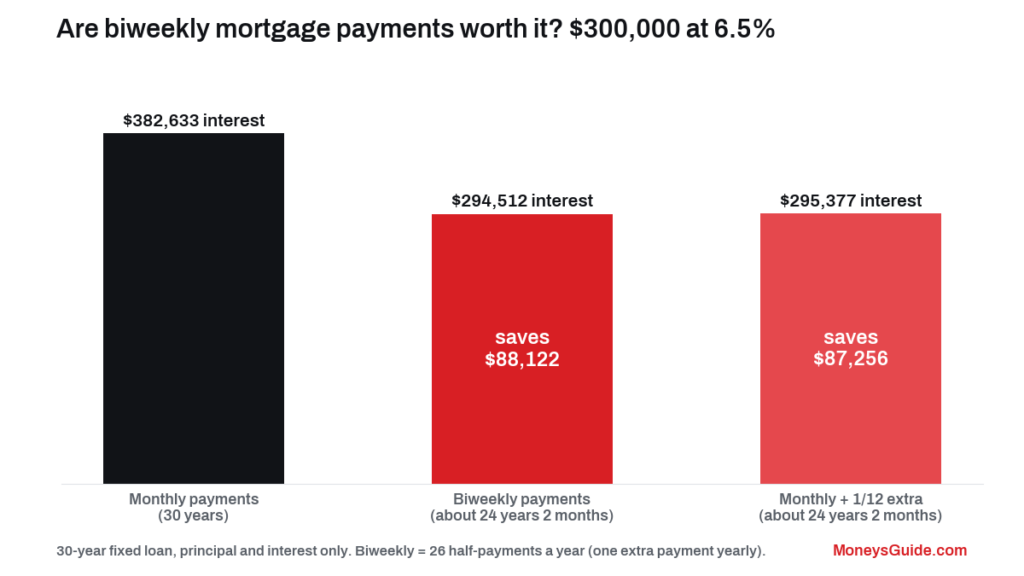
The biweekly plan saves slightly more because each half-payment reduces the balance a little sooner. But the difference between true biweekly payments and simply adding 1/12 extra each month is under $1,000 over the life of the loan.
You can test your own loan in our mortgage calculator.
Why the savings are so large
Mortgages are amortized: in the early years, most of each payment goes to interest. Extra payments made early reduce the balance that every future month’s interest is charged on, so the savings snowball. Our guide to how mortgage amortization works shows this year by year. The Consumer Financial Protection Bureau also explains how paying down a mortgage works.
The catch: fees and how payments are applied
Watch out for paid biweekly programs
Some companies offer to “set up” biweekly payments for you, often for a setup fee plus a small fee on every payment. For example, a $400 setup fee and $2.50 per payment would add up to almost $1,900 over 23 years. That’s money you could have put toward the loan yourself.
Some lenders hold half-payments
If your lender holds each half-payment until a full payment has arrived, you get no interest benefit from paying early in the month. The savings only come from the 13th payment, and you could achieve that yourself.
Make sure extra money goes to principal
Extra payments should reduce your principal, not be treated as an early payment of next month’s bill. Check your statements or ask your lender how extra payments are applied.
The simpler alternative: add 1/12 to each payment
You can get almost all the benefit, free and on your own schedule:
- Divide your monthly payment by 12. On our example: $1,896.20 ÷ 12 ≈ $158.
- Add that amount to each monthly payment, so you pay about $2,054.
- Mark the extra as “apply to principal” if your lender asks.
Other easy options:
- One extra full payment each year, for example from a tax refund or bonus
- Round up your payment to the nearest $100
- Recast or refinance to a shorter term if your budget allows
How much would you save on your loan size?
The effect scales with your loan. Here’s the same strategy (one extra payment a year, via biweekly payments or 1/12 extra each month) on 30-year loans at 6.5%:
| Loan amount | Monthly payment | Extra each month (1/12) | Paid off in | Interest saved |
|---|---|---|---|---|
| $200,000 | about $1,264 | about $105 | about 24 years 2 months | about $58,171 |
| $300,000 | about $1,896 | about $158 | about 24 years 2 months | about $87,256 |
| $400,000 | about $2,528 | about $211 | about 24 years 2 months | about $116,342 |
| $500,000 | about $3,160 | about $263 | about 24 years 2 months | about $145,427 |
At the same interest rate, the time saved is the same for every loan size, because the extra payment is always the same share of your normal payment. The dollar savings grow with the size of the loan.
How to set up biweekly payments: step by step
- Call your lender or check its website. Ask whether it accepts biweekly payments directly, and whether there’s a fee.
- Ask how payments are applied. You want each half-payment credited when it arrives, and any extra applied to principal.
- Check for prepayment penalties. Most standard mortgages allow extra payments, but confirm before you start.
- Line it up with your paydays. Biweekly payments are easiest if you’re paid every two weeks.
- Track your balance. After a few months, check your statements to confirm the principal is falling faster than scheduled.
If your lender doesn’t offer free biweekly payments, use the 1/12 method described above instead. It’s simpler and gives almost the same result.
Does it still make sense at lower rates?
Yes, but the savings are smaller. On the same $300,000 loan at 4%, the monthly payment is about $1,432. Adding 1/12 extra each month saves about $33,400 in interest and finishes the loan about 4 years early.
The higher your rate, the more valuable extra payments become.
When biweekly payments may not be the best choice
Paying off a mortgage early is a guaranteed saving, but it isn’t always the top priority. Consider other options first if:
- You don’t have an emergency fund. Money paid into your mortgage is hard to get back out. See how to build an emergency fund.
- You have high-interest debt. Paying off a 22% credit card beats prepaying a 6.5% mortgage. See how long it takes to pay off $10,000 in credit card debt.
- You’re not saving for retirement, especially if you’re missing out on an employer match.
- Your mortgage rate is very low. Investing the extra money may grow more over time, although with risk. Our guide on how much $500 a month can grow shows long-term investing returns.
Biweekly payments vs other ways to save on your mortgage
| Strategy | Effort | Cost | Typical effect |
|---|---|---|---|
| Biweekly payments (through your lender) | Low | Usually free | About one extra payment a year |
| Paid third-party biweekly program | Low | Setup and per-payment fees | Same as above, minus fees |
| Add 1/12 to each payment | Low | Free | Same as biweekly |
| One extra payment a year | Medium | Free | Same as biweekly |
| Refinance to a shorter term | Higher | Closing costs | Large interest savings, higher payment |
So, are biweekly mortgage payments worth it? Yes, if they’re free and your lender applies each payment promptly. If not, adding a little extra each month gets you nearly the same result.
Frequently asked questions
How much do biweekly mortgage payments save?
On a $300,000, 30-year loan at 6.5%, about $88,000 in interest, and the loan is paid off around 6 years early. Savings depend on your loan size, rate and term.
Do biweekly payments shorten a 30-year mortgage?
Yes. Making the equivalent of one extra monthly payment each year typically shortens a 30-year loan by about 4 to 6 years, depending on the interest rate.
Is it better to pay biweekly or make one extra payment a year?
They have almost the same effect. Biweekly can feel easier if you’re paid every two weeks. One extra annual payment suits people who receive a yearly bonus or tax refund.
Can I set up biweekly payments myself?
Often, yes. Ask your lender whether it accepts biweekly payments and applies them immediately. If not, adding 1/12 extra to each monthly payment works just as well.
Are there downsides to biweekly mortgage payments?
The main ones are fees from third-party programs, lenders holding half-payments, and tying up cash you might need for emergencies or higher-interest debt.
This article is for education only and is not financial or mortgage advice. Examples assume a fixed rate, principal and interest only, and extra payments applied to principal. Check your loan terms with your lender.