Mortgage on a $400k House: Payment and Income Needed by Rate
A $400,000 home is a common price in many areas, and the first question most buyers ask is: can I afford it? The answer depends on your income, your other debts, your down payment and, increasingly, the interest rate. So what does a mortgage on a $400k house cost, and what income do you need? This guide shows monthly payments at different rates, the income lenders typically look for, and practical ways to make the numbers work.
Quick summary
- With 20% down ($80,000) at 6.5% over 30 years, the mortgage on a $400k house is about $2,023 a month for principal and interest, or about $2,489 with example taxes and insurance.
- Under the common 28% guideline, that needs an income of about $107,000 a year.
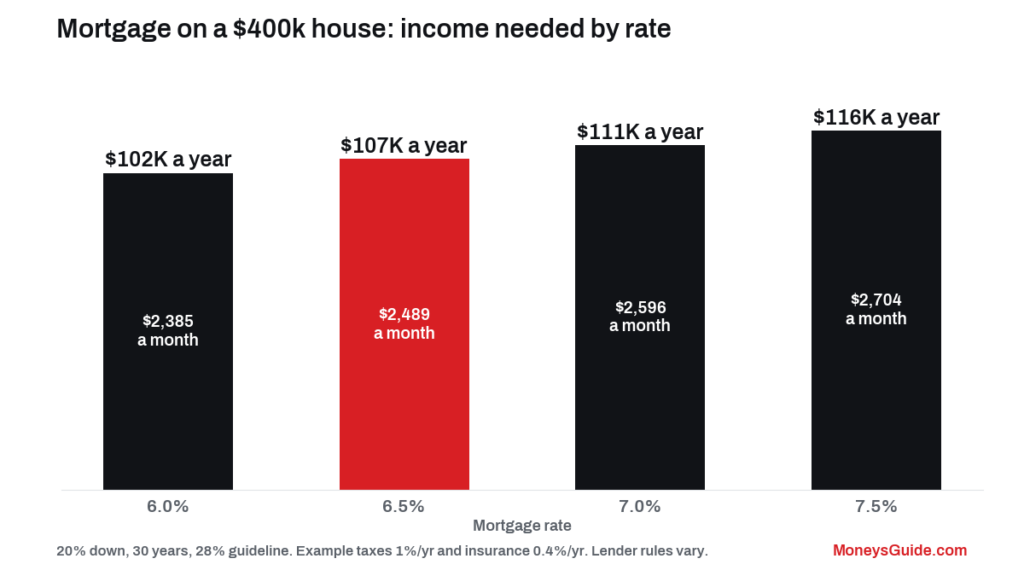
- At 6%, the income needed falls to about $102,000. At 7.5%, it rises to about $116,000.
- With 10% down, the payment rises to about $2,922, needing about $125,000 of income.
Mortgage on a $400k house: monthly payment by rate
With 20% down, you’d borrow $320,000. Here’s the payment at different rates over 30 years. Taxes and insurance vary widely by location; these use example rates of 1% a year for property tax ($333 a month) and 0.4% a year for insurance ($133 a month).
| Rate | Principal & interest | Total with example taxes and insurance |
|---|---|---|
| 6.0% | about $1,919 | about $2,385 |
| 6.5% | about $2,023 | about $2,489 |
| 7.0% | about $2,129 | about $2,596 |
| 7.5% | about $2,237 | about $2,704 |
Each half-point adds roughly $105 a month. Over 30 years, the difference between 6% and 7.5% is about $114,000 in extra interest.
Try your own figures in our mortgage calculator.
What income do you need for a $400k house?
Lenders commonly use two guidelines:
- The 28% rule: total housing costs should be no more than 28% of your gross monthly income.
- The 36% rule: all your monthly debt payments, including housing, should be no more than 36% of your gross monthly income.
Here’s the yearly income each guideline suggests with 20% down. The 36% column assumes you also have $500 a month of other debt, such as a car loan.
| Rate | Housing payment | Income needed (28% rule) | Income needed (36% rule, with $500 other debt) |
|---|---|---|---|
| 6.0% | about $2,385 | about $102,000 | about $96,000 |
| 6.5% | about $2,489 | about $107,000 | about $100,000 |
| 7.0% | about $2,596 | about $111,000 | about $103,000 |
| 7.5% | about $2,704 | about $116,000 | about $107,000 |
Lenders generally use the stricter of the two, so with $500 of other debt the 28% rule is the limiting factor here. With more debt, the 36% rule becomes the one that holds you back. Some lenders allow higher ratios, and rules vary by lender and location, so treat these as guidelines.
What if you put less than 20% down?
With 10% down ($40,000), you’d borrow $360,000 at 6.5%:
- Principal and interest: about $2,275
- Example taxes and insurance: about $467
- Example mortgage insurance (0.6% of the loan a year): about $180
- Total: about $2,922 a month
Under the 28% guideline, that needs about $125,000 a year, roughly $18,000 more than with 20% down. A smaller down payment gets you into the home sooner, but raises the income you need. See how long it takes to save for a $50,000 down payment.
What about 5% down?
With 5% down ($20,000), you’d borrow $380,000 at 6.5%:
- Principal and interest: about $2,402
- Example taxes and insurance: about $467
- Example mortgage insurance: about $190
- Total: about $3,059 a month
Under the 28% guideline, that needs an income of about $131,000, around $24,000 more than with 20% down. The upfront cash is much lower, though: about $32,000, including example closing costs of 3%, compared with about $92,000 for 20% down.
So the trade-off is clear. A smaller down payment makes it easier to buy sooner, but you’ll need a higher income to qualify and you’ll pay more each month.
The total cost over 30 years
On a $320,000 loan at 6.5%, total interest over 30 years is about $408,000, more than the loan itself. That’s why rate, term and extra payments matter so much:
- A 15-year loan cuts the interest dramatically, at a higher monthly payment. See 15 vs 30 year mortgage.
- Extra payments shorten the loan and save interest. See whether biweekly mortgage payments are worth it.
- A lower rate saves thousands. See how much a 0.25% rate cut saves.
The Consumer Financial Protection Bureau explains how paying down a mortgage works, including why early payments are mostly interest.
How to afford a $400k house on a lower income
If the income figures look out of reach, you have several levers:
- Pay down other debts first. Clearing a $500-a-month car loan can raise what lenders will approve.
- Increase your down payment. Borrowing less lowers both the payment and the income needed.
- Shop hard for the rate. Moving from 7% to 6.5% lowers the income needed by about $4,500 a year in this example.
- Buy with a partner or co-borrower, so two incomes count.
- Look at areas with lower property taxes, which can make a real difference to the monthly payment.
- Consider a slightly lower price. Every $25,000 less, at 6.5% with 20% down, lowers principal and interest by about $126 a month.
Being approved isn’t the same as being comfortable
Lenders tell you the maximum you can borrow, not what fits your life. Before committing, check that you can still:
- Save regularly for retirement and emergencies
- Handle repairs and maintenance, often around 1% of the home’s value a year
- Cope with a rate rise, if your rate isn’t fixed for the whole term
- Keep a healthy emergency fund. See how to build an emergency fund.
A budget framework like the 50/30/20 rule helps you see whether the payment leaves enough room for everything else. For the full affordability walkthrough, see how much house can I afford.
Common mistakes
- Using the maximum approval as your budget
- Ignoring taxes, insurance and mortgage insurance when estimating the payment
- Forgetting your other debts, which can sharply reduce what you can borrow
- Not comparing lenders, when a small rate difference changes the income needed
- Leaving no cash for closing costs and emergencies
Knowing the real mortgage on a $400k house, and the income behind it, helps you set a budget you can live with, not just one you can get approved for.
Frequently asked questions
How much is the mortgage on a $400k house per month?
With 20% down at 6.5% over 30 years, about $2,023 for principal and interest, or about $2,489 including example taxes and insurance.
What salary do I need for a $400k house?
Using the 28% guideline with 20% down, roughly $102,000 to $116,000 a year at rates between 6% and 7.5%. With 10% down, about $125,000 at 6.5%.
How much do I need to put down on a $400k house?
Some loans accept 3% to 5% ($12,000 to $20,000). Putting 20% down ($80,000) usually avoids mortgage insurance and lowers the payment.
Can I afford a $400k house on $80,000 a year?
It would be tight under the 28% guideline at current example rates, unless you put down a large deposit, have no other debts, or buy with a co-borrower. Some lenders may approve more, but check the payment fits your budget.
How much cash do I need to buy a $400k house?
With 20% down, about $80,000 for the down payment plus closing costs, often a few percent of the price. At 3%, that’s about $12,000, so roughly $92,000 in total. With 5% down, about $32,000.
Is a $400k house affordable on two incomes?
Often, yes. Lenders usually combine both incomes, which can make the 28% and 36% guidelines much easier to meet, as long as both borrowers’ debts are also taken into account.
Do lenders use gross or take-home pay?
Most affordability guidelines, including the 28% and 36% rules, use gross income, before tax. Your own budget should also check the payment against your take-home pay.
How much interest will I pay on a $400k house?
On a $320,000 loan at 6.5% over 30 years, about $408,000 in total interest.
This article is for education only and is not financial or mortgage advice. Taxes, insurance and mortgage insurance are examples and vary widely by location, lender and borrower. Lender income rules also vary. Check current rates and terms with lenders.