$15,000 Car Loan Payment: Monthly Cost by Rate and Term
A $15,000 car loan is a common amount for a reliable used car, or a smaller new one. It’s a manageable loan, but the rate and term you choose can still change the total cost by several thousand dollars. So what is the $15,000 car loan payment each month? This guide gives exact figures by rate and term, shows the interest you’d pay, and explains why a shorter loan often makes the most sense at this price.
Quick summary
- At 7% over 60 months, the $15,000 car loan payment is about $297 a month, with about $2,821 of interest.
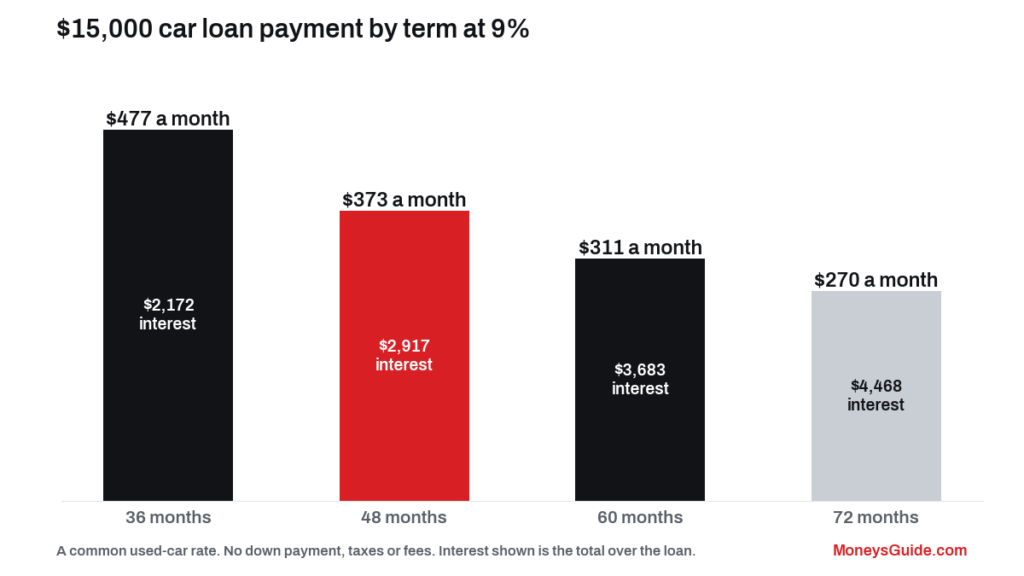
- At 9%, a common used-car rate, it’s about $311 a month, with about $3,683 of interest.
- Over 48 months at 9%, the payment rises to about $373, but you save about $770 in interest.
- At 12% over 72 months, interest passes $6,000, more than 40% of the loan.
$15,000 car loan payment by rate and term
Monthly payment on a $15,000 loan:
| Interest rate | 36 months | 48 months | 60 months | 72 months |
|---|---|---|---|---|
| 5% | about $450 | about $345 | about $283 | about $242 |
| 7% | about $463 | about $359 | about $297 | about $256 |
| 9% | about $477 | about $373 | about $311 | about $270 |
| 12% | about $498 | about $395 | about $334 | about $293 |
Total interest over the loan:
| Interest rate | 36 months | 48 months | 60 months | 72 months |
|---|---|---|---|---|
| 5% | about $1,184 | about $1,581 | about $1,984 | about $2,393 |
| 7% | about $1,674 | about $2,241 | about $2,821 | about $3,413 |
| 9% | about $2,172 | about $2,917 | about $3,683 | about $4,468 |
| 12% | about $2,936 | about $3,960 | about $5,020 | about $6,114 |
Run your own figures, including any down payment, trade-in, tax and fees, in our car loan calculator.
Why the rate matters more on used cars
Used car loans often come with higher rates than new car loans, because lenders see older cars as riskier. On a $15,000 loan over 60 months, going from 5% to 12% adds about $51 a month and over $3,000 in interest.
That’s a big share of a modest loan. To keep your rate down:
- Check your credit report and fix any errors before you apply
- Get pre-approved by a bank or credit union, so you can compare it with dealer finance
- Compare the APR, not just the monthly payment
- Choose a shorter term, which lenders often price lower
The case for a shorter loan
On a used car, a shorter loan is often the smartest choice:
- You pay less interest. At 9%, 48 months instead of 72 saves about $1,550.
- You build equity faster, so you’re less likely to owe more than the car is worth.
- You’re less likely to be paying for repairs and the loan at the same time. Older cars tend to need more maintenance, and you don’t want to be making loan payments on a car that’s off the road.
A common rule of thumb is to avoid a loan term that’s longer than you realistically expect the car to stay reliable and affordable to run. For a car that’s already several years old, that often points to 36 to 48 months.
What a down payment does
Putting money down shrinks the loan and the interest. At 9% over 48 months:
| Down payment | Amount borrowed | Monthly payment | Total interest |
|---|---|---|---|
| $0 | $15,000 | about $373 | about $2,917 |
| $1,500 (10%) | $13,500 | about $336 | about $2,625 |
| $3,000 (20%) | $12,000 | about $299 | about $2,334 |
Even $1,500 down lowers the payment by about $37 a month, and 20% down saves almost $600 in interest over the loan. See is $1,000 down on a car enough for how much to put down at different prices.
Can you afford a $15,000 car?
A common guideline is to keep all car costs, including the loan, insurance, fuel and maintenance, to a modest share of your take-home pay, often around 10% to 20%. At about $311 a month for the loan, plus running costs, a $15,000 car can fit many budgets comfortably. Our budget planner shows how a car payment fits alongside your other costs.
How the payment is calculated
Car loans use the standard amortization formula:
Payment = P × r × (1 + r)^n ÷ ((1 + r)^n − 1)
where P is the amount borrowed, r the monthly rate (APR ÷ 12) and n the number of payments. At 7% over 60 months, that gives $297.02. Each payment covers that month’s interest first, and the rest reduces your balance. Our guide on how loan payments are calculated explains this step by step, and the Consumer Financial Protection Bureau explains how auto loan amortization works.
Refinancing a $15,000 car loan
If you took a high rate, refinancing later can save money. Example: a $15,000 loan at 12% over 60 months costs about $334 a month. After a year, you’d owe about $12,671. Refinancing that balance to 8% over the remaining 48 months:
- New payment: about $309, around $24 a month less
- Interest saved: about $1,168 over the rest of the loan
Refinancing makes the most sense when your credit has improved or rates have fallen. Check for fees, and avoid stretching the term, which can cancel out the savings.
Tips for buying a used car with a loan
- Get an independent mechanical inspection before you buy. A repair bill soon after purchase can undo any savings.
- Check the vehicle history for accidents, flood damage or unpaid finance.
- Budget for maintenance from day one: tyres, brakes and servicing.
- Avoid stretching to 72 months on an older car. See 60 vs 72 month car loan.
- Pay extra when you can. Even $25 a month shortens the loan. See how to pay off your car loan faster.
- Watch for add-ons such as extended warranties rolled into the loan, and check whether they’re worth the cost.
Common mistakes
- Choosing the longest term to get the lowest payment
- Ignoring the rate, which can add thousands to a modest loan
- Skipping an inspection on a used car
- Forgetting taxes and fees, which may be added to the loan
- Borrowing your whole budget and leaving nothing for repairs
Knowing the real $15,000 car loan payment, and exactly how the rate and term change it, helps you pick a loan that’s easy to pay off, and a car that’s still running when you’ve finished. For other amounts, see interest on a $20,000 car loan and the $30,000 car loan payment.
Frequently asked questions
What is the monthly payment on a $15,000 car loan?
About $297 a month at 7% over 60 months, or about $311 at 9%. Over 48 months at 7%, about $359.
How much interest will I pay on a $15,000 car loan?
About $2,821 at 7% over 60 months, or $3,683 at 9%. Over 72 months at 12%, about $6,114.
Is 60 months too long for a $15,000 used car loan?
It depends on the car’s age and condition. For an older car, 36 to 48 months is often safer, because you’ll finish paying before major repairs are likely.
How much should I put down on a $15,000 car?
Around 10% to 20%, or $1,500 to $3,000, is common. More down means a lower payment and less interest.
Is it better to buy a $15,000 car with cash or a loan?
If paying cash would leave you without an emergency fund, a loan may be safer. If you can pay cash and still keep healthy savings, you avoid interest entirely. A middle path is a large down payment with a short loan.
How much does a $15,000 car loan cost in total?
At 7% over 60 months, you’d repay about $17,821 in total, of which about $2,821 is interest. Over 36 months, the total falls to about $16,674.
Can I pay off a $15,000 car loan early?
Usually, yes. Check your contract for prepayment penalties, and make sure extra payments go to principal. Paying even $50 extra a month can take several months off the loan.
What credit score do I need for a $15,000 car loan?
Lenders set their own requirements, and you may be approved with a range of scores. A higher score usually means a lower rate, which can save hundreds or thousands of dollars on the loan.
This article is for education only and is not financial advice. Figures assume fixed rates and no taxes or fees. Your rate and terms will depend on your lender and credit history.