How Much Will $500 a Month Grow in 10, 20 and 30 Years?
Investing $500 a month is a realistic goal for many people, and over time it can grow into a serious amount of money. But how much will $500 a month grow, exactly? The honest answer depends on three things: how long you invest, what return you earn, and what costs you pay along the way.
This guide shows how much $500 a month will grow over 10, 20 and 30 years at different rates of return, with clear tables, a chart and the real-world factors that change the result.
Quick summary
- $500 a month for 30 years is $180,000 of your own money.
- At 7% a year, it could grow to about $610,000.
- At 4%, about $347,000. At 10%, about $1.13 million.
- Time matters most: starting 10 years later at 7% leaves you with about $350,000 less.
How much will $500 a month grow? The numbers
Here’s what $500 invested every month could grow to, assuming monthly compounding and the same return every year:
| Years | You invest | At 4% a year | At 7% a year | At 10% a year |
|---|---|---|---|---|
| 10 | $60,000 | about $73,625 | about $86,542 | about $102,422 |
| 20 | $120,000 | about $183,387 | about $260,463 | about $379,684 |
| 30 | $180,000 | about $347,025 | about $609,985 | about $1,130,244 |
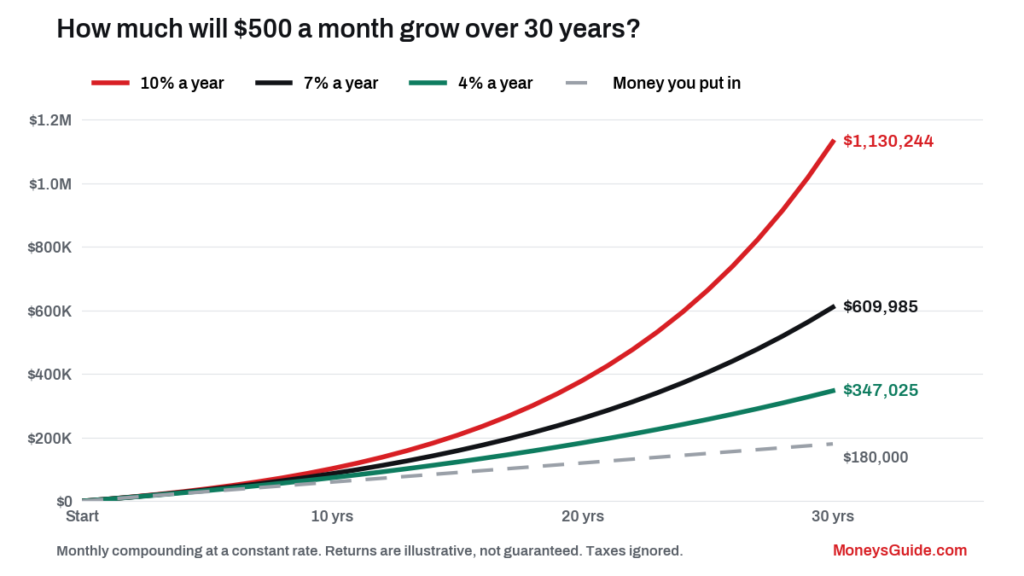
Notice how the gap widens over time. After 10 years, the difference between 4% and 10% is under $30,000. After 30 years, it’s nearly $800,000. That’s compound growth: your returns start earning returns of their own. Our guide on how compound interest works explains this in detail.
Which rate of return is realistic?
No one can promise a return, but these ranges are commonly used for planning:
- Around 4%: closer to what cautious, lower-risk investments or high-yield savings might earn over long periods, or a stock portfolio’s return after inflation.
- Around 7%: a common long-term planning assumption for a diversified stock-heavy portfolio, after typical costs but before inflation.
- Around 10%: close to the long-run historical average of broad stock markets before inflation and fees. Real portfolios often earn less after costs.
Markets don’t rise in a straight line. Some years return 20% or more, and some fall sharply. These figures are averages for planning, not predictions.
Time matters more than anything
The cost of waiting 10 years
At 7%, investing $500 a month for 30 years grows to about $609,985. Wait 10 years and invest for only 20 years, and you’d have about $260,463.
Starting a decade later costs about $349,522, even though you’d only have invested $60,000 less.
Why the last 10 years do the heavy lifting
In the 7% example, the balance grows by about $86,500 in the first 10 years, but by about $349,500 in the final 10 years. The money you invest early has the longest time to compound.
Milestones: when does $500 a month reach $100,000?
At 7% a year, here’s roughly when $500 a month passes each milestone:
| Milestone | Time to reach it | Your contributions by then |
|---|---|---|
| $100,000 | about 11 years | about $66,500 |
| $250,000 | about 19 years 7 months | about $117,500 |
| $500,000 | about 27 years 7 months | about $165,500 |
The first $100,000 is the slowest. After that, growth accelerates: the jump from $250,000 to $500,000 takes only about eight years, because the balance itself is doing much of the work.
What if returns are uneven?
Real markets don’t deliver a smooth 7% every year. Some years might return 25% and others might fall 15%. When you invest the same amount every month, those swings work partly in your favour: in down years, your $500 buys more shares at lower prices, which can boost long-term results when markets recover. See how this works with real prices in our dollar cost averaging calculator. This approach is called dollar-cost averaging. We compare it with investing all at once in our guide to dollar-cost averaging vs lump sum.
The bigger risk is the order of returns near the end. A large fall just before you need the money hurts much more than one at the start. That’s why many people gradually move toward lower-risk investments as their goal gets closer.
How taxes affect the result
The figures in this guide ignore taxes. In an ordinary taxable account, you may owe tax on dividends, interest or gains, which reduces your effective return. Inside a tax-advantaged retirement or savings account, your money can often grow tax-free or tax-deferred, so more of it keeps compounding. Using those accounts first is one of the easiest ways to get closer to the higher numbers above.
What if you invest more, or less?
At 7% a year for 30 years:
| Monthly amount | You invest | Could grow to |
|---|---|---|
| $250 | $90,000 | about $304,993 |
| $500 | $180,000 | about $609,985 |
| $1,000 | $360,000 | about $1,219,971 |
If $500 feels like too much right now, start with what you can and raise it over time, for example with every pay rise. Our savings goal calculator works backwards from a target, so you can see exactly what you need to invest each month.
How fees change the result
Fees come straight off your return, every year. Imagine the investments return 7%, but you pay 1% a year in fund and platform fees, so your return falls to 6%:
| Years | At 7% (low fees) | At 6% (1% fees) | Lost to fees |
|---|---|---|---|
| 10 | about $86,542 | about $81,940 | about $4,602 |
| 20 | about $260,463 | about $231,020 | about $29,443 |
| 30 | about $609,985 | about $502,258 | about $107,727 |
A 1% fee sounds small, but over 30 years it costs over $100,000 in this example. The Securities and Exchange Commission’s investor site has a clear guide to understanding investment fees. Low-cost index funds and ETFs are a popular way to keep fees down.
What about inflation?
Prices rise over time, so $610,000 in 30 years won’t buy what $610,000 buys today. A simple way to think in today’s money is to subtract expected inflation from your return.
If investments return 7% and inflation averages 3%, your real return is roughly 4%. In today’s money, $500 a month for 30 years would be worth about $347,000. That’s still a large sum, but a more honest planning number.
Where to invest $500 a month
The right place depends on your goals, but common choices include:
- Tax-advantaged retirement accounts, especially workplace plans with employer matching, which is effectively free money
- Tax-free savings or investment accounts, where available
- Low-cost, diversified index funds or ETFs inside those accounts
- A high-yield savings account for money you’ll need within a few years
New to investing? Our guide on how to start investing with $1,000 covers the first steps.
How to make $500 a month happen
- Automate it. Set up an automatic transfer the day after payday.
- Build your emergency fund first, so you won’t need to sell investments in a crisis. See how to build an emergency fund.
- Clear high-interest debt before investing heavily. A 22% credit card costs far more than investing is likely to earn. See how long it takes to pay off $10,000 in credit card debt.
- Increase your amount with each pay rise.
- Ignore short-term market noise. Staying invested through ups and downs matters more than timing.
Check the maths yourself
You can try any amount, rate and time period in our compound interest calculator. For a second opinion, the SEC’s compound interest calculator at investor.gov uses the same principles.
So, how much will $500 a month grow for you? It depends most on three things you control: starting early, keeping fees low and staying consistent.
Frequently asked questions
How much will $500 a month be worth in 30 years?
At 7% a year, about $610,000 from $180,000 of contributions. At 4%, about $347,000. At 10%, about $1.13 million. Real results vary with market returns, fees and taxes.
How much will $500 a month be worth in 10 years?
About $73,600 at 4%, $86,500 at 7% or $102,400 at 10%, from $60,000 of contributions.
Can I become a millionaire investing $500 a month?
It’s possible over a long period with strong returns. At 10% a year, $500 a month passes $1 million in about 29 years. At 7%, it would take about 36 years. Higher contributions or an earlier start shorten the timeline.
Is it better to invest $500 a month or $6,000 once a year?
Investing monthly spreads your purchases across different prices and builds a steady habit. Investing a lump sum earlier gives the money more time in the market. The difference is usually small. Consistency matters most.
Should I invest $500 a month or pay off debt?
Pay off high-interest debt like credit cards first. For low-interest debt, many people do both: pay the normal amount and invest the rest.
This article is for education only and is not financial or investment advice. Returns are illustrative, assume monthly compounding at a constant rate and ignore taxes. Investments can fall as well as rise.