15 vs 30 Year Mortgage: Total Interest on $300,000 Compared
Choosing your mortgage term is one of the biggest money decisions you’ll make. A 30-year mortgage keeps monthly payments lower. A 15-year mortgage costs more each month but can save a fortune in interest. This guide compares a 15 vs 30 year mortgage on a $300,000 loan with real numbers, explains the trade-offs, and shows a flexible middle path many borrowers overlook.
Quick summary
- On $300,000, a 30-year loan at 6.5% costs about $1,896 a month and $382,633 in interest.
- A 15-year loan at 5.75% costs about $2,491 a month but only $148,421 in interest, saving about $234,000.
- 15-year loans usually come with lower rates, which adds to the savings.
- A 30-year loan with extra payments can give you much of the saving with more flexibility.
15 vs 30 year mortgage: the numbers on $300,000
Lenders usually offer lower rates on 15-year loans, because they’re repaid faster and carry less risk. For this example, we’ll assume 6.5% for 30 years and 5.75% for 15 years:
| 30-year at 6.5% | 15-year at 5.75% | Difference | |
|---|---|---|---|
| Monthly payment | about $1,896 | about $2,491 | 15-year costs about $595 more a month |
| Total interest | about $382,633 | about $148,421 | 15-year saves about $234,212 |
| Total repaid | about $682,633 | about $448,421 | |
| Mortgage-free after | 30 years | 15 years | 15 years sooner |
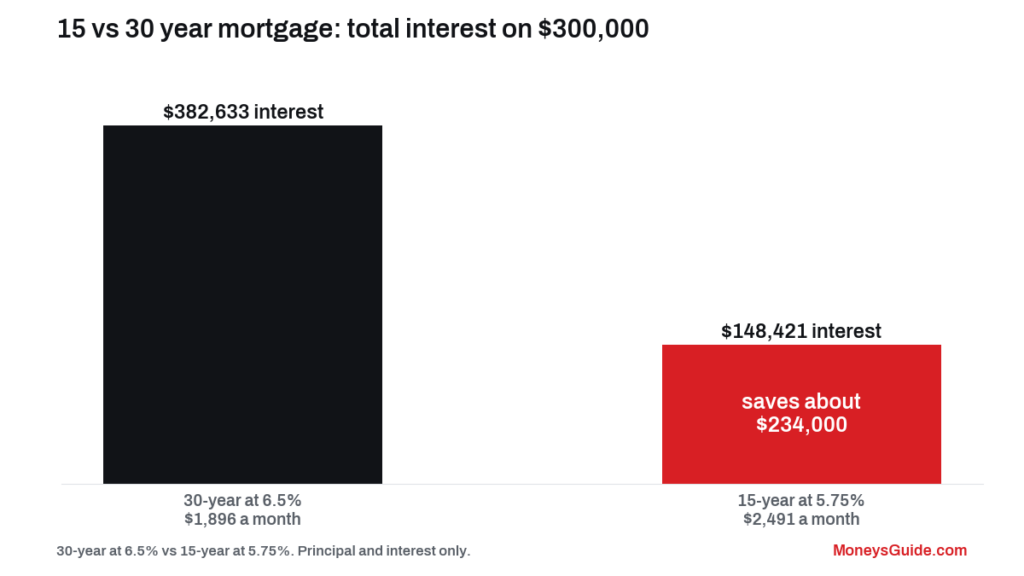
Even at the same rate, the shorter term saves a lot. A 15-year loan at 6.5% would cost about $2,613 a month and about $170,398 in interest, still around $212,000 less than the 30-year loan.
Try your own rates and loan size in our mortgage calculator.
Why the 15-year loan saves so much
Two things work together:
- You borrow for half as long, so interest is charged for 15 years instead of 30.
- The balance falls much faster. With a 30-year loan, early payments are mostly interest. Our guide to mortgage amortization shows how slowly a 30-year balance falls in the first decade.
The Consumer Financial Protection Bureau explains how paying down a mortgage works, including why more of each payment goes to principal over time.
How fast you build equity
Equity is the share of your home you own outright. Here’s how much you’d still owe on $300,000 after 5 and 10 years:
| After | 30-year at 6.5% | 15-year at 5.75% |
|---|---|---|
| 5 years | about $280,833 owed | about $226,952 owed |
| 10 years | about $254,328 owed | about $129,638 owed |
After 10 years, the 15-year borrower owes about $125,000 less. That extra equity matters if you sell, move or need to borrow against your home later.
Can you afford the 15-year payment?
A common guideline is to keep housing costs to about 28% of gross monthly income. Using principal and interest alone:
- The 30-year payment of about $1,896 fits that guideline on an income of about $6,772 a month.
- The 15-year payment of about $2,491 needs about $8,897 a month.
Taxes, insurance and other housing costs come on top, so your real budget needs to stretch further. If the 15-year payment would leave no room for savings, the 30-year loan with optional extra payments is often the safer choice.
Pros and cons of a 15-year mortgage
Pros
- Far less interest overall
- Usually a lower interest rate
- Mortgage-free in half the time
- Builds equity in your home much faster
Cons
- A much higher monthly payment
- Less flexibility if your income drops
- Less money left for saving, investing or emergencies
- May reduce how much house you can afford
Pros and cons of a 30-year mortgage
Pros
- Lower, more affordable monthly payment
- More flexibility in your monthly budget
- Frees up cash for investing, retirement saving or an emergency fund
- You can still pay extra when you choose to
Cons
- Much more interest overall
- Usually a higher rate
- Slower equity growth
- Mortgage payments may continue into later life
The flexible middle path: a 30-year loan paid like a 15-year
If your lender allows extra payments without penalties, you can take the 30-year loan but pay more each month when you can.
Example: take the 30-year loan at 6.5%, but pay the 15-year amount of about $2,491 a month:
- You’d be mortgage-free in about 16 years and 4 months
- Total interest would be about $187,167, around $195,000 less than the standard 30-year schedule
You’d pay more interest than a true 15-year loan, because the rate is higher, but you keep the safety net: in a tough month, you can drop back to the lower $1,896 payment. Smaller extras help too. See whether biweekly mortgage payments are worth it.
Should you invest the difference instead?
Some people choose the 30-year loan and invest the $595 monthly difference. Whether that wins depends on what your investments earn. To compare fairly, imagine you spend the same amount each month on both paths for 30 years:
- Path A, 15-year loan: pay $2,491 a month for 15 years, then invest that $2,491 a month for the next 15 years.
- Path B, 30-year loan: pay $1,896 a month for 30 years, and invest the $595 difference every month for 30 years.
After 30 years:
| Investment return | Path A (15-year loan) | Path B (30-year + invest) |
|---|---|---|
| 7% a year | about $789,626 | about $725,915 |
| 9% a year | about $942,696 | about $1,089,340 |
At 7%, the 15-year path comes out ahead. At 9%, investing the difference wins, but only if you actually invest every month for 30 years, never touch the money, and the market delivers. Investment returns are never guaranteed, while the interest you save on a mortgage is certain.
Which mortgage term is right for you?
A 15-year mortgage may suit you if:
- The higher payment fits comfortably within your budget
- You already have an emergency fund and are saving for retirement
- You value being debt-free and paying less interest
- Your income is stable
A 30-year mortgage may suit you if:
- You need the lower payment to buy the home you want
- Your income varies, or you want flexibility
- You’d rather invest or save the difference, and you’ll stick with it
- You want room in your budget for other goals
Not sure what you can afford? Start with how much house you can afford, and see how payments change with rates in our guide to a 1% rate increase on a $300,000 mortgage.
What if rates fall after you borrow?
If rates drop after you take a fixed-rate loan, you may be able to refinance, either to a lower rate on the same term or to a shorter term. Refinancing usually involves closing costs, so check how long it would take for the monthly savings to cover those costs.
A 30-year loan gives you the option to refinance into a 15-year loan later, once your income has grown. A 15-year loan already locks in the faster payoff. Either way, keep an eye on rates and review your mortgage every year or two.
Common mistakes
- Choosing 15 years with no emergency fund. A high payment with no buffer is risky.
- Taking 30 years and never paying extra when you easily could.
- Comparing payments without comparing rates. The rate gap is a big part of the saving.
- Forgetting taxes, insurance and fees, which come on top of principal and interest.
Weighing a 15 vs 30 year mortgage comes down to one question: is a lower monthly payment worth the extra interest to you?
Frequently asked questions
How much do you save with a 15-year mortgage vs a 30-year?
On $300,000, a 15-year loan at 5.75% saves about $234,000 in interest compared with a 30-year loan at 6.5%. Your savings depend on your rates and loan size.
How much higher is a 15-year mortgage payment?
In our example, about $595 more a month: roughly $2,491 instead of $1,896.
Is it smarter to get a 30-year mortgage and pay it off early?
It can be, if you’re disciplined. You get flexibility to pay less in a tough month, but you’ll usually pay a slightly higher rate than on a true 15-year loan.
Why are 15-year mortgage rates lower?
Lenders take less risk on shorter loans, because the money is repaid faster, so they often offer lower rates.
Can I switch from a 30-year to a 15-year mortgage later?
Usually by refinancing, which involves closing costs. Making extra payments on your existing loan can achieve a similar effect without refinancing.
This article is for education only and is not financial or mortgage advice. Figures show principal and interest only and use example rates. Investment returns are not guaranteed. Check current rates and terms with lenders.