How Much Does a 1% Rate Increase on a $300,000 Mortgage Cost?
Mortgage rates can change a lot in a short time, and even a small move makes a big difference to your monthly budget. So what does a 1% rate increase on a $300,000 mortgage actually cost? This guide answers that with exact figures, shows payments at a range of rates, and explains how to protect yourself whether you’re buying, renewing or on an adjustable rate.
Quick summary
- On a $300,000, 30-year mortgage, going from 6% to 7% raises the payment by about $197 a month, or $2,367 a year.
- Over the full 30 years, that 1% adds about $71,000 in interest.
- A rough rule: each 1% adds about $66 a month per $100,000 borrowed at these rates.
- The same 1% rise cuts the loan you can afford on the same payment by about $30,000.
What a 1% rate increase on a $300,000 mortgage costs
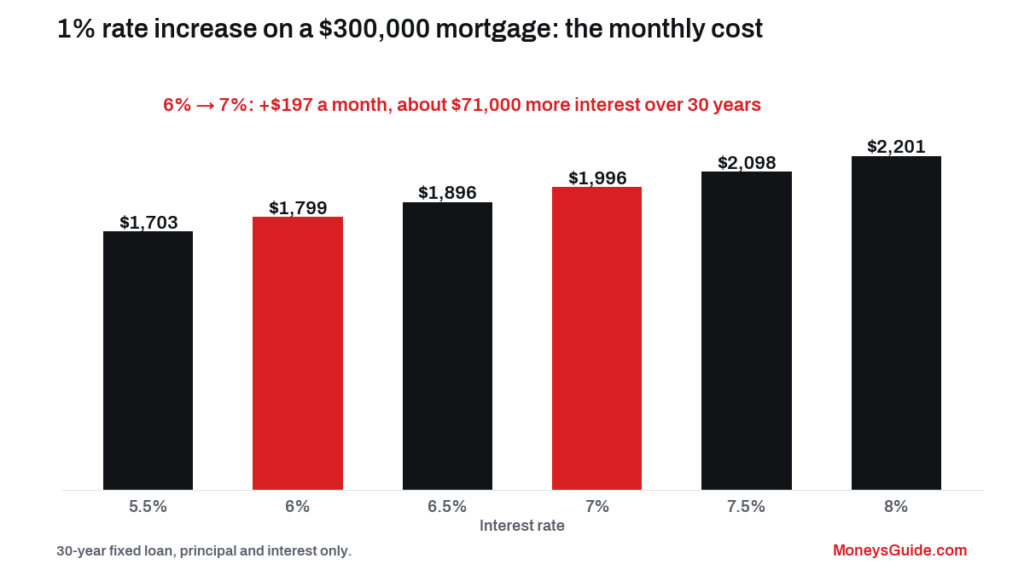
Here’s the monthly payment (principal and interest only) on a $300,000 loan over 30 years at different rates:
| Interest rate | Monthly payment | Total interest over 30 years |
|---|---|---|
| 5.5% | about $1,703 | about $313,212 |
| 6.0% | about $1,799 | about $347,515 |
| 6.5% | about $1,896 | about $382,633 |
| 7.0% | about $1,996 | about $418,527 |
| 7.5% | about $2,098 | about $455,152 |
| 8.0% | about $2,201 | about $492,466 |
From 6% to 7%: the exact cost
- Monthly payment: about $1,799 rises to about $1,996, an increase of $197.26 a month
- Each year: about $2,367 more
- Over 30 years: about $71,012 more in interest
That’s the price of a single percentage point. From 6% to 8%, two points, the payment rises by about $403 a month, and total interest grows by about $145,000.
You can check any combination of loan size, rate and term in our mortgage calculator.
A quick rule of thumb
At rates around 6–7%, each 1% change moves the monthly payment by roughly $66 per $100,000 borrowed on a 30-year loan. So a 1% rise costs about:
- $200,000 loan: about $130 more a month
- $300,000 loan: about $197 more a month
- $400,000 loan: about $263 more a month
It’s a handy way to judge headlines about rate moves without opening a calculator.
What a 1% rise costs at other loan sizes
The bigger the loan, the bigger the impact. Here’s what moving from 6% to 7% does on a 30-year mortgage:
| Loan amount | Payment at 6% | Payment at 7% | Extra each month | Extra interest over 30 years |
|---|---|---|---|---|
| $200,000 | about $1,199 | about $1,331 | about $132 | about $47,341 |
| $300,000 | about $1,799 | about $1,996 | about $197 | about $71,012 |
| $400,000 | about $2,398 | about $2,661 | about $263 | about $94,683 |
| $500,000 | about $2,998 | about $3,327 | about $329 | about $118,354 |
On a 15-year loan, the monthly jump from 6% to 7% on $300,000 is a little smaller, about $165, because you’re borrowing for less time. Total interest is much lower overall on a shorter term.
How a 1% rise changes what you can afford
Rate rises don’t just raise payments. They also shrink your buying power.
If your budget allows $1,799 a month for principal and interest, that buys a $300,000 loan at 6%. At 7%, the same payment only supports a loan of about $270,351, about $29,649 less.
So when rates rise, buyers often have to choose between a higher payment, a bigger down payment, or a cheaper home. Our guide on how much house you can afford walks through the full calculation.
If you have an adjustable rate or a rate that resets
With a fixed rate, your payment stays the same for the term, so later rate rises don’t affect you. With an adjustable rate, or a fixed period that ends and resets, a rise hits your payment when the rate changes.
Example: you took a $300,000, 30-year loan at 6%, fixed for 5 years. After 5 years, about $279,163 is left to repay over 25 years.
- If the rate resets to 7%, the payment rises to about $1,973, about $174 a month more.
- If it resets to 8%, the payment rises to about $2,155, about $356 a month more.
Check your loan documents for when your rate can change, how often, and whether there are caps on how much it can rise each time.
Why a 1% change has such a big effect
On a long mortgage, most early payments go to interest. Our guide to how mortgage amortization works shows this year by year. Because interest is charged on a large balance for many years, a higher rate increases the cost of almost every payment you make. The Consumer Financial Protection Bureau explains how paying down a mortgage works and why early payments are mostly interest.
How to protect yourself from rate rises
If you’re buying
- Get pre-approved and ask whether you can lock your rate while you house-hunt.
- Stress-test your budget. Make sure you could still afford the payment if rates were 1–2% higher.
- Put down more, if you can. A smaller loan means each 1% costs less.
- Compare lenders. Rate differences between lenders can be as big as a market move.
If your rate is about to reset
- Start shopping early, often several months before the reset.
- Ask your current lender what rate they’ll offer, then compare it with others.
- Consider fixing, if certainty matters more to you than a possibly lower variable rate.
If you already have a mortgage
- Build a buffer in savings for higher payments. See how to build an emergency fund.
- Overpay while rates are low, if your loan allows it, to reduce the balance before any reset.
- Look at biweekly or extra payments. Our guide to whether biweekly mortgage payments are worth it shows how much they save.
What if rates fall instead?
The same maths works in reverse. A 1% drop from 7% to 6% on $300,000 saves about $197 a month. If rates fall after you’ve taken a fixed-rate loan, refinancing may make sense, as long as the savings outweigh the closing costs. A common check is to divide the total refinancing costs by the monthly saving to see how many months it takes to break even.
Fixed or adjustable: which protects you better?
A fixed rate gives certainty: your principal and interest payment won’t change for the fixed period, whatever happens to rates. That makes budgeting easier, but fixed rates can be slightly higher at the start, and you may pay fees to switch early.
An adjustable rate may start lower, and your payment can fall if rates drop, but it can also rise. If a rise of $200 to $350 a month would strain your budget, the certainty of a fixed rate may be worth more than the initial saving. Whichever you choose, keep an emergency buffer for higher payments.
Common mistakes
- Only checking today’s payment. Always ask what happens if the rate rises.
- Ignoring taxes, insurance and fees. Your full payment is higher than principal and interest alone.
- Borrowing the maximum. It leaves no room for rate rises or surprises.
- Missing your reset date. Moving to a lender’s standard rate can be expensive.
Knowing what a 1% rate increase on a $300,000 mortgage costs helps you plan ahead, rather than being caught out.
Frequently asked questions
How much does a 1% rate increase add to a $300,000 mortgage payment?
At around 6–7%, about $197 a month on a 30-year loan, or roughly $2,367 a year. The exact amount depends on your starting rate and loan term.
How much more interest will I pay over the life of the loan?
From 6% to 7% on $300,000 over 30 years, about $71,000 more in total interest.
Does a rate increase affect a fixed-rate mortgage?
Not during the fixed period. Your payment only changes if your rate is adjustable or when a fixed period ends.
How much house can I afford if rates rise 1%?
On the same monthly payment, a 1% rise from 6% to 7% reduces the loan you can afford by about 10%, roughly $30,000 on a $300,000 loan.
Is it worth paying to lock my rate?
If rates are rising and you’re close to buying, a rate lock can protect you from a higher payment. Compare the cost of the lock with what a rate rise would cost you, using the figures above.
This article is for education only and is not financial or mortgage advice. Figures show principal and interest only, on a fixed-rate 30-year loan. Your actual rate, fees and payment will depend on your lender and circumstances.