60 vs 72 Month Car Loan: Total Interest on $30,000
When you finance a car, the dealer or lender will often show you two numbers side by side: a 60-month loan and a 72-month loan. The longer loan has a lower monthly payment, which can be tempting. But how much does that extra year really cost? This guide compares a 60 vs 72 month car loan on $30,000, with exact payments, total interest and the hidden risks of longer terms.
Quick summary
- On $30,000 at 7%, a 60-month loan costs about $594 a month and $5,642 in interest.
- A 72-month loan costs about $511 a month but $6,826 in interest, about $1,184 more.
- Longer loans often come with higher rates, which widens the gap further.
- After 3 years, you’d still owe about $3,300 more on the 72-month loan, which raises the risk of owing more than the car is worth.
60 vs 72 month car loan: the numbers
Here’s a $30,000 car loan at 7% APR, compared side by side:
| 60-month loan | 72-month loan | Difference | |
|---|---|---|---|
| Monthly payment | about $594 | about $511 | 72 months is about $83 less a month |
| Total interest | about $5,642 | about $6,826 | 72 months costs about $1,184 more |
| Total paid | about $35,642 | about $36,826 | |
| Owed after 3 years | about $13,268 | about $16,565 | about $3,297 more on 72 months |
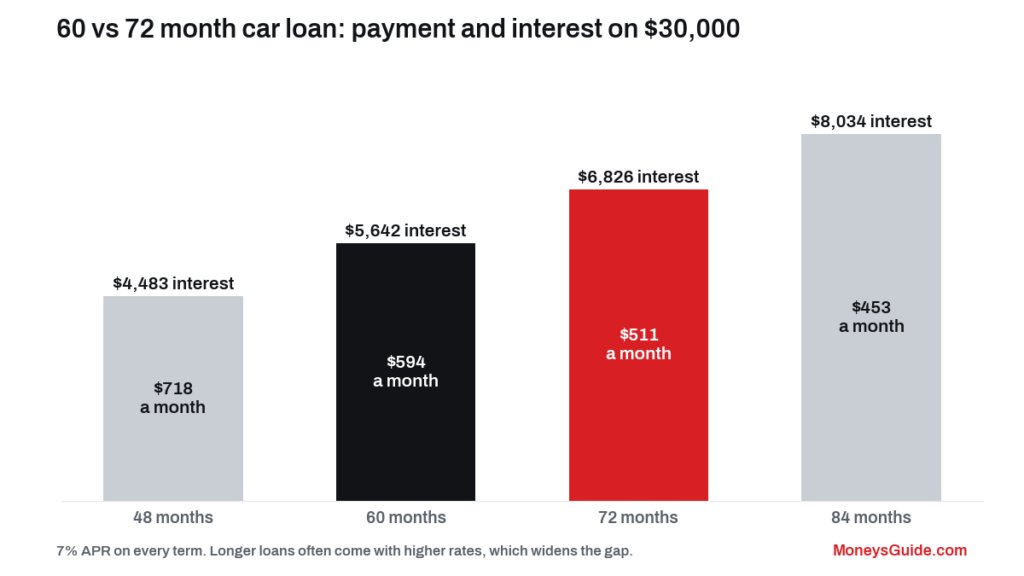
The 72-month loan feels cheaper every month, but you pay for that comfort with an extra year of payments and over $1,000 more in interest.
You can compare any loan amount, rate and term in our loan payment calculator.
Longer loans often have higher rates
Lenders usually see longer loans as riskier, so 72- and 84-month loans often come with higher interest rates. That makes the true gap bigger than the table above suggests.
If the 72-month loan were offered at 7.5% instead of 7%:
- Monthly payment: about $519
- Total interest: about $7,347, about $1,705 more than the 60-month loan at 7%
Always compare the APR for each term, not just the monthly payment.
How other terms compare
For a fuller picture, here’s the same $30,000 at 7% across four common terms:
| Term | Monthly payment | Total interest |
|---|---|---|
| 48 months | about $718 | about $4,483 |
| 60 months | about $594 | about $5,642 |
| 72 months | about $511 | about $6,826 |
| 84 months | about $453 | about $8,034 |
Going from 48 to 84 months cuts the payment by about $266, but nearly doubles the interest. At a higher rate on the longer term, for example 8% over 84 months, total interest reaches about $9,277.
How your interest rate changes the comparison
Your credit history, the lender and whether the car is new or used all affect your rate. The higher the rate, the more a longer term costs. Here’s the 60 vs 72 month comparison on $30,000 at three different rates:
| Rate | 60 months: payment / interest | 72 months: payment / interest | Extra interest on 72 months |
|---|---|---|---|
| 5% | about $566 / $3,968 | about $483 / $4,787 | about $819 |
| 9% | about $623 / $7,365 | about $541 / $8,935 | about $1,570 |
| 12% | about $667 / $10,040 | about $587 / $12,228 | about $2,188 |
At 12%, the extra year costs over $2,000. If your rate is on the higher side, improving your credit score or shopping around for a better rate can save more than the choice of term itself.
What a bigger down payment does
Putting $5,000 down, so you borrow $25,000 instead of $30,000 at 7%:
- 60 months: about $495 a month, about $4,702 in interest
- 72 months: about $426 a month, about $5,688 in interest
With $5,000 down, the 60-month payment ($495) is actually lower than the 72-month payment on the full $30,000 ($511), and it costs over $2,100 less in interest. A larger down payment is often a better way to lower your payment than a longer loan.
The hidden risk: negative equity
Cars lose value quickly, especially in the first few years. With a longer loan, your balance falls more slowly, so you’re more likely to owe more than the car is worth. This is called negative equity, or being “upside down” on the loan.
In our example, after three years you’d still owe about $16,565 on the 72-month loan, compared with $13,268 on the 60-month loan. If you need to sell or trade in the car, or if it’s written off in an accident, that gap can leave you paying off a car you no longer have.
Ways to reduce the risk:
- Make a bigger down payment
- Choose a shorter term
- Consider gap insurance if you have a long loan and a small down payment
- Avoid rolling old car debt into a new loan
When a 72-month loan might make sense
A longer term isn’t always wrong. It can be reasonable if:
- You get a very low or 0% promotional rate, so the extra time costs little or nothing
- You plan to keep the car for many years, well beyond the loan term
- You’ll make extra payments to finish early, but want the flexibility of a lower required payment
- The lower payment protects your budget and helps you keep an emergency fund
When the 60-month loan is better
- You can comfortably afford the higher payment
- The longer loan has a higher rate
- You tend to change cars every few years
- You want to be debt-free sooner and pay less overall
If the 60-month payment feels too high, that may be a sign the car is too expensive for your budget. A cheaper car, or a bigger down payment, often beats a longer loan.
A middle path: take the longer loan, pay it like a shorter one
If you want flexibility, you can take the 72-month loan but pay what the 60-month payment would be, about $594 instead of $511. As long as there’s no prepayment penalty, this clears the loan years early and cuts the interest, while leaving you free to drop back to the lower payment in a tight month.
Our guide on how to pay off your car loan faster shows exactly how much extra payments save.
Look at the total cost of owning the car
The loan is only part of what a car costs. Insurance, fuel, maintenance, registration and repairs all add up, and repairs tend to rise as a car gets older. With a 72-month loan, you may still be making payments when bigger repair bills start arriving.
Before choosing a term, add up the monthly payment plus your other car costs, and make sure the total fits comfortably alongside your savings goals. A simple budget such as the 50/30/20 rule can help you see how much room you really have.
How car loan interest works
Car loans are usually simple interest, amortized loans: each payment covers that month’s interest first, and the rest reduces the balance. Longer terms mean you pay interest on a higher balance for more months, which is why total interest rises. The Consumer Financial Protection Bureau explains how amortization affects your auto loan. For the formula behind your payment, see our guide on how loan payments are calculated.
Questions to ask before you sign
- What’s the APR for each term, not just the monthly payment?
- Is there a prepayment penalty?
- What’s the total cost of the loan, including fees?
- Is any optional product, like an extended warranty, built into the loan?
- Can I get pre-approved by a bank or credit union to compare offers?
Choosing between a 60 vs 72 month car loan comes down to one trade-off: a lower payment now, or less interest and less risk overall.
Frequently asked questions
Is a 72-month car loan a bad idea?
Not always, but it usually costs more in interest and increases the risk of owing more than the car is worth. It works best with a low rate and a car you plan to keep for a long time.
How much more interest is a 72-month loan than a 60-month loan?
On $30,000 at 7%, about $1,184 more. If the longer loan has a higher rate, such as 7.5%, the difference grows to about $1,705.
How much lower is the payment on a 72-month loan?
On $30,000 at 7%, about $83 a month lower: roughly $511 instead of $594.
Can I pay off a 72-month car loan early?
Usually, yes. Check your contract for prepayment penalties, and make sure extra payments go to principal.
What’s the best car loan length?
Many people aim for 60 months or less. The best term is the shortest one you can comfortably afford while keeping an emergency fund.
This article is for education only and is not financial advice. Examples assume a fixed APR and no fees. Your rate and terms will depend on your lender and credit history.