How Much Does a 0.25% Rate Cut Save on a Mortgage?
When a central bank cuts interest rates by a quarter of a point, the headlines are everywhere. But what does it actually mean for your mortgage? A 0.25% rate cut sounds tiny, and on its own it is fairly modest, but it adds up over a long loan, and several cuts together can make a real difference. This guide shows exactly how much a 0.25% rate cut saves, by loan size, and how to get the most out of it.
Quick summary
- A 0.25% rate cut from 6.5% to 6.25% saves about $49 a month on a $300,000, 30-year mortgage, or about $17,700 over the loan.
- On $500,000, it saves about $82 a month.
- Four quarter-point cuts (1% in total) would save about $193 a month on $300,000.
- If you keep paying your old amount after a cut, you could clear the loan about 2 years sooner and save about $48,000 in interest.
How much does a 0.25% rate cut save?
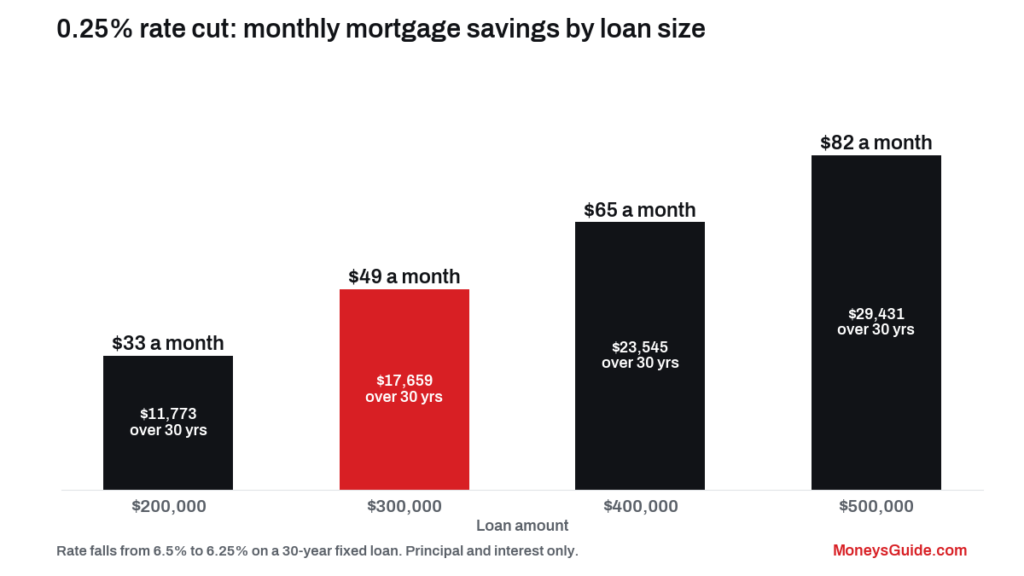
Here’s what a cut from 6.5% to 6.25% saves on a 30-year mortgage:
| Loan amount | Payment at 6.5% | Payment at 6.25% | Monthly saving | Saving over 30 years |
|---|---|---|---|---|
| $200,000 | about $1,264 | about $1,231 | about $33 | about $11,773 |
| $300,000 | about $1,896 | about $1,847 | about $49 | about $17,659 |
| $400,000 | about $2,528 | about $2,463 | about $65 | about $23,545 |
| $500,000 | about $3,160 | about $3,079 | about $82 | about $29,431 |
A useful rule of thumb: at rates around 6%, each 0.25% changes the payment by roughly $16 per $100,000 borrowed on a 30-year loan.
Check your own loan in our mortgage calculator.
What about a 15-year mortgage?
On shorter loans, a 0.25% cut saves a little less each month, because you’re borrowing for less time. On a $300,000, 15-year mortgage, a cut from 6% to 5.75% saves about $40 a month, or roughly $7,300 over the loan.
The monthly saving is smaller than on a 30-year loan, but the total interest you pay on a 15-year mortgage is already much lower. See our comparison of a 15 vs 30 year mortgage.
Rate cut vs extra payments
A 0.25% rate cut on $300,000 saves about $49 a month. You can get a similar effect without waiting for a cut: paying about $49 extra a month toward your principal from day one shortens the loan and cuts interest in a similar way.
So if your budget allows, extra payments are a reliable way to save money, whatever happens to rates. Our loan payment calculator shows how much any extra payment saves.
When several cuts add up
Central banks often move rates in a series of steps. Here’s the effect on a $300,000 loan starting at 6.5%:
| Rate cuts | New rate | Monthly saving | Saving over 30 years |
|---|---|---|---|
| One cut (0.25%) | 6.25% | about $49 | about $17,659 |
| Two cuts (0.50%) | 6.00% | about $98 | about $35,119 |
| Four cuts (1.00%) | 5.50% | about $193 | about $69,421 |
The reverse is also true: a 1% rise adds about $197 a month at these rates. Our guide to a 1% rate increase on a $300,000 mortgage shows the full picture.
Will a 0.25% rate cut lower your payment?
It depends on your type of mortgage:
Fixed-rate mortgage
Your rate and payment stay the same for the fixed period, so a cut doesn’t change your current payment. It may help when your fixed period ends, or if you refinance.
Variable or adjustable-rate mortgage
Your rate may fall when your lender’s rate falls, often within a month or two. Lenders don’t always pass on the full cut, so check what your lender actually announces.
Buying a home
New mortgage rates often move before and after central bank decisions, because lenders price in expected changes. A cut can lower the rate you’re offered, or improve how much you can borrow on the same payment.
The smartest way to use a rate cut
When your payment falls, you have two choices: enjoy the lower payment, or keep paying the old amount.
Example: on a $300,000 loan, the rate falls from 6.5% to 6.25%, but you keep paying the old $1,896 a month instead of the new $1,847:
- You’d pay the loan off in about 27 years 11 months instead of 30 years.
- Total interest would be about $334,168, instead of about $364,975 at the new rate with the new payment.
That’s roughly $30,800 less interest than taking the lower payment, and about $48,500 less than at the original 6.5% rate, just by keeping your payment the same.
If your lender allows extra payments without penalties, this is one of the easiest ways to pay off a mortgage faster. Our guide to whether biweekly mortgage payments are worth it shows another simple approach.
Is it worth refinancing for a 0.25% cut?
Usually not on its own. Refinancing involves closing costs, often several thousand dollars. A simple way to check is to work out your break-even point:
Break-even (months) = refinancing costs ÷ monthly saving
Example: $4,000 in costs ÷ $49 a month ≈ 82 months, almost 7 years. If you’d sell or move before then, refinancing for a small cut would cost you money.
Refinancing becomes more attractive when the total rate drop is larger, for example after several cuts, or when your current rate is well above what’s on offer.
What else a rate cut affects
- Savings accounts: rates often fall too, so your savings may earn a little less.
- Credit cards and personal loans: variable rates may edge down, but card rates stay high. See how much interest a $5,000 credit card balance costs.
- Affordability: lower rates can increase how much you can borrow. Our guide on how much house you can afford explains how lenders work it out.
Why a small cut still matters
On a long loan, interest is charged on a large balance for many years. Even a small rate change applies to almost every payment you make. That’s why a 0.25% cut can save thousands of dollars over 30 years, and several cuts can save tens of thousands. The Consumer Financial Protection Bureau explains how paying down a mortgage works, including why most early payments go to interest.
How to make the most of a rate cut: a checklist
- Check your mortgage type. Fixed, variable or adjustable? Only variable and adjustable rates usually change straight away.
- Check what your lender passes on. Lenders don’t always cut by the full amount, or at the same time.
- Decide what to do with the saving. Keep your old payment to clear the loan sooner, or use the extra cash to build your emergency fund. See how to build an emergency fund.
- Review your fixed-rate end date. If it’s coming up, start comparing offers a few months early.
- Run the break-even maths before refinancing.
Common mistakes
- Assuming a fixed-rate payment will fall after a central bank cut
- Refinancing for a tiny cut without checking the break-even point
- Spending all the savings when keeping your old payment could cut years off your loan
- Forgetting that cuts can reverse. Rates can rise again later
Understanding what a 0.25% rate cut means for your own loan helps you decide whether to pocket the saving or put it to work.
Frequently asked questions
How much does a 0.25% rate cut save on a $300,000 mortgage?
About $49 a month on a 30-year loan going from 6.5% to 6.25%, or roughly $17,700 over the full term.
How much does a 0.25% rate cut save on a $400,000 mortgage?
About $65 a month, or roughly $23,500 over 30 years, at rates around 6% to 6.5%.
Does a central bank rate cut lower my mortgage straight away?
Only if your mortgage rate is variable and your lender passes the cut on. Fixed-rate payments don’t change until the fixed period ends.
How much does a 0.25% rate cut save on a $200,000 mortgage?
About $33 a month on a 30-year loan, or roughly $11,800 over the full term.
Should I refinance after a 0.25% cut?
Usually only if the total rate drop is larger, or if the savings cover the refinancing costs well before you plan to move.
Is it better to take the lower payment or keep paying the same?
Keeping your old payment pays the loan off faster and saves more interest. Taking the lower payment gives you more monthly breathing room. Choose based on your budget and goals.
This article is for education only and is not financial or mortgage advice. Figures show principal and interest only on fixed-rate, 30-year loans. Your lender’s rates and terms may differ.