Is It Worth Paying Off a 4% Mortgage Early? (Real Numbers)
If you locked in a mortgage around 4%, you might be wondering whether to throw extra money at it or put that money somewhere else. Being mortgage-free sounds great, but with a relatively low rate, the maths isn’t as clear-cut as it seems. This guide looks at paying off a 4% mortgage early with real numbers: how much you’d save, how it compares with investing, and when early payoff still makes sense.
Quick summary
- On a $300,000, 30-year mortgage at 4%, the payment is about $1,432 and total interest is about $215,600.
- Paying $200 extra a month clears it about 6 years early and saves about $50,400 in interest.
- Investing that $200 a month at an average 7% instead could leave you with roughly $93,000 more after 30 years, but with market risk.
- Paying off a 4% mortgage early makes most sense if you value certainty, are close to retirement, or have no better low-risk use for the money.
What paying off a 4% mortgage early saves
Let’s start with a typical loan:
- Loan: $300,000
- Rate: 4% fixed
- Term: 30 years
- Monthly payment (principal and interest): about $1,432.25
- Total interest over 30 years: about $215,609
Here’s what extra payments would save:
| Extra payment | Paid off in | Interest saved |
|---|---|---|
| $100 a month | about 26 years 6 months | about $28,747 |
| $200 a month | about 23 years 10 months | about $50,412 |
| $500 a month | about 18 years 4 months | about $92,415 |
| $20,000 lump sum in year 5 | about 27 years 1 month | about $31,196 |
Those are real savings, and guaranteed ones. Every extra dollar you put toward a 4% mortgage earns an effective 4% return, with no market risk. You can test your own numbers in our mortgage calculator.
The other side: what that money could do instead
The question isn’t just “how much would I save?” It’s “what’s the best use of this money?” Here’s a direct comparison using an extra $200 a month for 30 years:
- Option A, prepay first: put $200 a month into the mortgage. It’s paid off after about 23 years 10 months. Then invest the full freed-up amount (about $1,632 a month) until year 30.
- Option B, invest instead: keep paying the normal mortgage, and invest $200 a month from day one.
Value of the investments after 30 years:
| Average investment return | Option A (prepay first) | Option B (invest instead) |
|---|---|---|
| 5% | about $141,137 | about $166,452 |
| 6% | about $145,727 | about $200,903 |
| 7% | about $150,509 | about $243,994 |
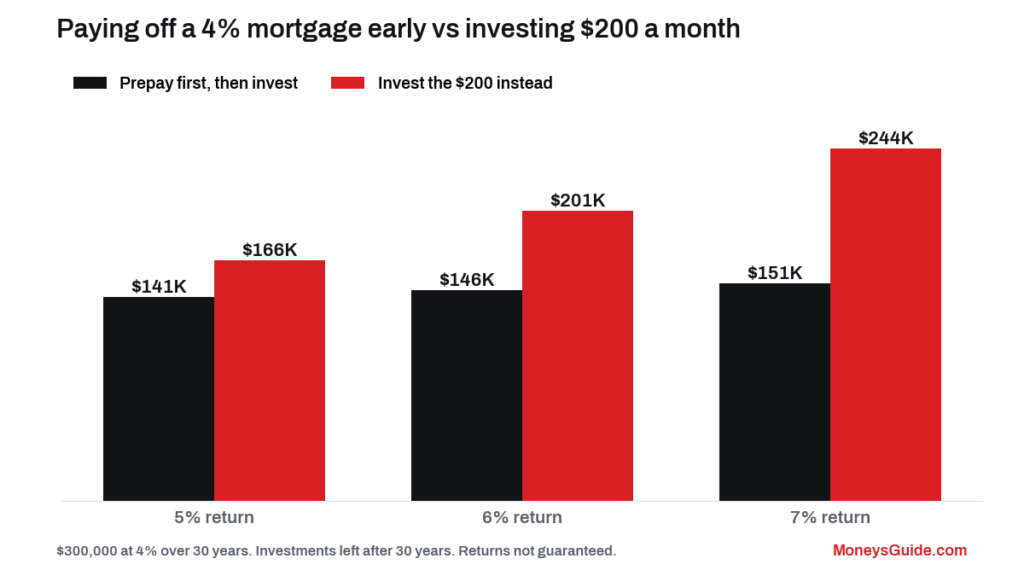
In both options the mortgage is fully paid after 30 years, so the difference is the investments left over. When investments earn more than 4%, investing comes out ahead, and the gap widens the higher the return. If investments only matched the mortgage rate, the two options would end up roughly equal.
The catch: investment returns aren’t guaranteed
The table assumes steady average returns. Real markets don’t work that way:
- Some years fall sharply, and a bad decade can drag down long-term results.
- Returns before tax are higher than returns after tax in an ordinary account.
- Fees reduce what you actually keep.
Paying down a 4% mortgage gives you a certain 4% return. Investing gives you a possibly higher, but uncertain one. For many people, the right answer depends as much on their comfort with risk as on the maths. Our guide to how much $500 a month can grow shows how investment returns build over time.
Compare: a 6.5% mortgage changes the picture
The higher your rate, the stronger the case for paying early. On the same $300,000 loan at 6.5%, $200 extra a month saves about $103,448 in interest, roughly double the saving on a 4% loan. At that rate, a guaranteed 6.5% return is much harder for investments to beat reliably after tax and fees.
So a useful rule of thumb:
- Mortgage rate well below expected long-term returns (around 4% or less): investing often has the edge, if you’re comfortable with risk.
- Mortgage rate close to or above expected returns (around 6% or more): paying it down is often the better deal.
See how a rate change affects your payment in our guide to a 1% rate increase on a $300,000 mortgage.
When paying off a 4% mortgage early makes sense
Even with a low rate, early payoff can be the right choice when:
- You’re close to retirement. Being mortgage-free can sharply reduce the income you need in retirement.
- You value peace of mind. A paid-off home means lower risk if your income falls.
- Your other bases are covered: a full emergency fund, no high-interest debt, and solid retirement saving.
- You’d otherwise keep the money in cash earning less than 4%. In that case, the mortgage is the better place for it.
- You tend to spend extra cash. Prepaying the mortgage locks the money away from impulse spending.
When it probably doesn’t
- You don’t have an emergency fund. Money paid into a mortgage is hard to get back out. See how to build an emergency fund.
- You have higher-interest debt. Paying off a 22% credit card is far more valuable. See how long it takes to pay off $10,000 in credit card debt.
- You’re missing an employer retirement match. That match is often worth far more than 4%.
- You have a long time horizon and are comfortable with investment ups and downs.
A middle path
You don’t have to choose all or nothing. Many homeowners split the difference:
- Build a full emergency fund first.
- Clear any high-interest debt.
- Contribute enough for any employer match in a workplace retirement plan.
- Split extra money: for example, half to investments and half to the mortgage.
This gives you some guaranteed savings and some growth potential, and a bit of both kinds of security. If you’d like to see the effect of small regular extras, our guide to whether biweekly mortgage payments are worth it shows the numbers.
Things to check before you prepay
- Prepayment penalties or limits. Some mortgages restrict how much you can overpay each year.
- Where the extra goes. Make sure extra payments reduce your principal, not just next month’s payment.
- Your fixed-rate period. If your rate resets soon, paying down the balance before then can reduce the impact of a higher future rate.
- Liquidity. Once money is in your home, you usually need to sell or borrow to get it back.
The Consumer Financial Protection Bureau explains how paying down a mortgage works, including why extra payments early in the loan save the most interest.
Common mistakes
- Prepaying while carrying credit card debt at much higher rates
- Draining your emergency fund to make extra payments
- Ignoring an employer match in favour of the mortgage
- Assuming investments will always return 7% without considering risk
- Not checking overpayment limits, and paying a penalty by mistake
Paying off a 4% mortgage early is a guaranteed, low-risk return, but not always the highest one. The best choice is the one that fits your goals, your timeline and how much risk lets you sleep at night.
Frequently asked questions
Is it smart to pay off a 4% mortgage early?
It can be, especially if you’re near retirement, value certainty, or would otherwise keep the money in cash. If you have a long horizon and are comfortable with risk, investing has historically tended to earn more than 4% over long periods.
How much do I save by paying $200 extra on a 4% mortgage?
On a $300,000, 30-year loan, about $50,400 in interest, and the loan is paid off about 6 years early.
Should I invest or pay off my 4% mortgage?
If expected long-term investment returns are clearly above 4% after tax and fees, and you can handle the ups and downs, investing often comes out ahead. If you want a guaranteed return, prepaying is the safer choice.
Does paying off my mortgage early hurt my credit?
Usually not in any meaningful way. Closing an installment loan can cause a small, temporary change, but having less debt is generally good for your finances.
What if my mortgage rate is 6% or higher?
The case for paying it off early becomes much stronger, because a guaranteed 6% or more is hard to beat reliably with investments after tax and fees.
This article is for education only and is not financial or mortgage advice. Examples show principal and interest only, assume fixed rates, and use illustrative investment returns that are not guaranteed. Taxes and fees are ignored.