Is $1,000 Down on a Car Enough? (By Car Price)
If you’ve saved $1,000 for a car, you might be wondering whether that’s a big enough down payment, or whether you should wait and save more. The answer depends mostly on the price of the car. Putting $1,000 down on a car can be perfectly sensible for a cheaper used car, but on a newer, more expensive one it leaves you borrowing nearly the full price. This guide shows the real numbers at different car prices and explains when $1,000 is enough.
Quick summary
- $1,000 down on a car is 10% of a $10,000 car, but only 3.3% of a $30,000 car.
- On a $30,000 car at 7% over 60 months, $1,000 down means a payment of about $574. A 20% down payment ($6,000) cuts it to about $475.
- A small down payment raises the risk of owing more than the car is worth.
- Common guidance is around 10% down for a used car and 20% for a new car.
Is $1,000 down on a car enough?
Whether it’s enough depends on what share of the price it covers:
| Car price | $1,000 as a share of the price | Verdict |
|---|---|---|
| $8,000 | 12.5% | A solid down payment |
| $10,000 | 10% | Meets the common used-car guideline |
| $20,000 | 5% | Below typical guidance |
| $30,000 | 3.3% | Thin, with a higher risk of negative equity |
| $40,000 | 2.5% | Very thin |
For an older, lower-priced used car, $1,000 down can be completely reasonable. For a new or nearly new car, it usually means borrowing almost the full price.
What $1,000 down means for your payment
At 60 months, comparing $1,000 down with a 20% down payment:
| Car price and rate | Payment with $1,000 down | Payment with 20% down | Extra interest with $1,000 down |
|---|---|---|---|
| $10,000 at 9% | about $187 | about $166 ($2,000 down) | about $246 |
| $20,000 at 7% | about $376 | about $317 ($4,000 down) | about $564 |
| $30,000 at 7% | about $574 | about $475 ($6,000 down) | about $940 |
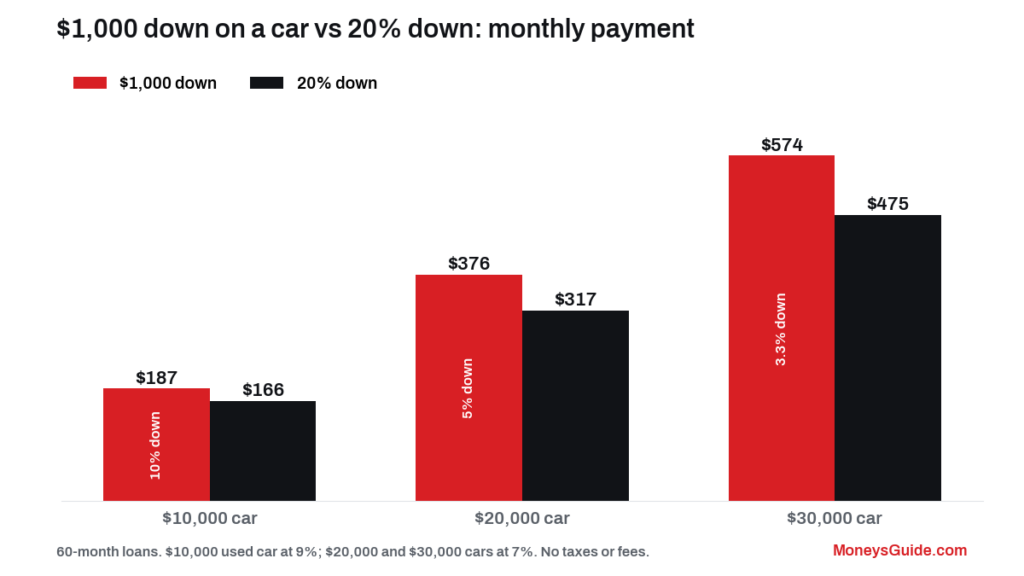
The higher the price, the more a small down payment costs you, both every month and in total interest. The used-car example uses a slightly higher rate, because used car loans often carry higher rates than new car loans.
Try your own numbers in our car loan calculator, which includes your down payment, trade-in, taxes and fees.
The bigger risk: negative equity
Cars usually lose value fastest in their first few years. With a small down payment, your loan balance can fall more slowly than the car’s value, leaving you owing more than the car is worth. That’s called negative equity.
Example: you buy a $30,000 car with $1,000 down at 7% over 60 months. After one year, you’d still owe about $23,980. If the car were then worth about 80% of its price, around $24,000, you’d have almost no equity at all. Any faster drop in value would leave you underwater. These values are illustrative, so check what your own car is worth.
On a $10,000 used car with $1,000 down at 9%, you’d owe about $7,508 after a year. If the car were worth around $8,500, you’d have roughly $1,000 of equity, a much safer position.
Negative equity becomes a real problem if you need to sell, trade in, or the car is written off. See trading in a car with negative equity for what that can cost.
$1,000 down vs nothing down
Is putting $1,000 down better than putting nothing down? Yes, but on an expensive car, the difference is small. On a $30,000 car at 7% over 60 months:
| Down payment | Monthly payment | Total interest |
|---|---|---|
| $0 | about $594 | about $5,642 |
| $1,000 | about $574 | about $5,454 |
| $6,000 (20%) | about $475 | about $4,514 |
The first $1,000 saves about $20 a month and $188 in interest. A full 20% saves about $119 a month and over $1,100 in interest. So if you can wait a few months to save more, the payoff is real.
When $1,000 down is enough
- The car is lower-priced, so $1,000 is around 10% or more of the price.
- You can get a reasonable interest rate, not a high subprime rate.
- You choose a shorter loan term, such as 36 to 48 months, so you build equity faster.
- You’ll keep the car for many years, well past the loan term.
- You have gap insurance, or the loan is small enough that the risk is low.
When to save more first
- You’re buying a new or expensive car where $1,000 is under 5% of the price.
- The only way the payment fits is a 72 or 84-month term. See 60 vs 72 month car loan.
- You’d be rolling negative equity from your current car into the new loan.
- The interest rate you’re offered is high, so every extra dollar borrowed costs more.
- Spending the $1,000 would wipe out your emergency savings.
How to build a bigger down payment
- Keep your current car a little longer while you save.
- Set a monthly saving target. Saving $300 a month for a year turns $1,000 into $4,600.
- Use your trade-in. If your current car has positive equity, it adds to your down payment.
- Sell your current car privately, which often brings more than a trade-in offer.
- Put windfalls toward it, such as tax refunds or bonuses.
Our savings goal calculator shows exactly how long it takes to reach your target.
Other ways to keep the cost down
- Choose a cheaper car. Lowering the price does more than any other step.
- Get pre-approved by a bank or credit union, so you can compare rates with dealer finance.
- Pick the shortest term you can comfortably afford.
- Avoid financing extras like extended warranties unless you’ve checked their real cost.
- Pay extra each month when you can. See how to pay off your car loan faster.
The Consumer Financial Protection Bureau explains how car loans and amortization work, including why early payments are mostly interest.
Don’t forget the other upfront costs
Your down payment isn’t the only cash you’ll need. Depending on where you buy, there may be taxes, registration and dealer fees, plus the first insurance payment. If these are added to the loan, they reduce the effect of your down payment. Ask for the total amount financed before signing.
Common mistakes
- Judging the down payment in dollars, not as a share of the price
- Using your whole emergency fund for the down payment
- Stretching the loan term to make a small down payment work
- Forgetting taxes and fees, which can be added to the loan
- Skipping gap insurance when you owe nearly the full price
So, is $1,000 down on a car enough? On a cheaper used car, often yes. On a $30,000 car, it’s usually too thin, and saving a little more first can save you hundreds of dollars and a lot of risk.
Frequently asked questions
Can I buy a car with $1,000 down?
Yes. Many lenders accept $1,000 down, especially for used cars. Whether it’s a good idea depends on the car’s price, your interest rate and the loan term.
How much does $1,000 down lower my car payment?
On a 60-month loan at 7%, each $1,000 down lowers the payment by about $20 a month and saves about $188 in interest.
What is a good down payment on a $20,000 car?
About $2,000 (10%) for a used car, or $4,000 (20%) for a new one. On a 60-month loan at 7%, $4,000 down cuts the payment by about $59 a month compared with $1,000 down.
Is it better to put more money down or keep it in savings?
Keep a basic emergency fund first. After that, a larger down payment usually saves money, especially if your loan rate is higher than what your savings earn.
Do I need a down payment if I have a trade-in?
Your trade-in can act as your down payment, as long as it’s worth more than you owe on it. If you owe more than it’s worth, it adds to your new loan instead.
Is $1,000 down on a $30,000 car bad?
It’s on the low side, at 3.3% of the price. It isn’t automatically bad, but it means a higher payment, more interest and a greater chance of owing more than the car is worth early on.
This article is for education only and is not financial advice. Figures assume fixed rates and no taxes or fees. Car values in examples are illustrative. Your rate and terms will depend on your lender and credit history.