Trading In a Car With Negative Equity: What It Really Costs
You want a new car, but you still owe more on your current one than it’s worth. That gap is called negative equity, and it’s more common than many people think, especially with long car loans. Dealers often say they’ll “pay off your trade no matter what you owe”, but that rarely means the debt disappears. This guide explains what trading in a car with negative equity really costs, with real numbers, and the smarter options to consider first.
Quick summary
- Negative equity means you owe more on your car loan than the car is worth.
- When you trade in, the shortfall is usually added to your new loan, so you pay interest on old debt.
- Rolling $4,000 into a $30,000 loan at 7% over 60 months adds about $79 a month and $752 in interest.
- Better options often include waiting, paying down the gap, or selling privately for a higher price.
What is negative equity on a car?
Your car’s equity is what it’s worth minus what you still owe:
Equity = car’s value − loan balance
If you owe $18,000 and the car is worth $14,000, your equity is −$4,000. You’re “upside down” or “underwater” on the loan.
Negative equity happens because cars lose value fastest in the first few years, while long loans pay down the balance slowly. Small down payments, long terms and rolling over old debt all make it more likely.
How trading in a car with negative equity works
When you trade in a car with negative equity, the dealer pays off your old loan. But the shortfall doesn’t vanish. Usually it’s:
- added to your new loan, so you borrow more than the new car’s price, or
- paid upfront by you, in cash, before the deal goes through
The Federal Trade Commission warns that ads promising to pay off your trade “no matter what you owe” can be misleading, because the negative equity is often rolled into the new loan. Its guide to auto trade-ins and negative equity explains how to check what the dealer is really doing.
What it really costs: a worked example
You owe $18,000 on a car worth $14,000, so you have $4,000 of negative equity. You’re buying a car for $30,000, financed at 7%.
| Without negative equity | With $4,000 rolled in | |
|---|---|---|
| Amount financed | $30,000 | $34,000 |
| Payment over 60 months | about $594 | about $673 |
| Total interest over 60 months | about $5,642 | about $6,394 |
| Payment over 72 months | about $511 | about $580 |
| Total interest over 72 months | about $6,826 | about $7,736 |
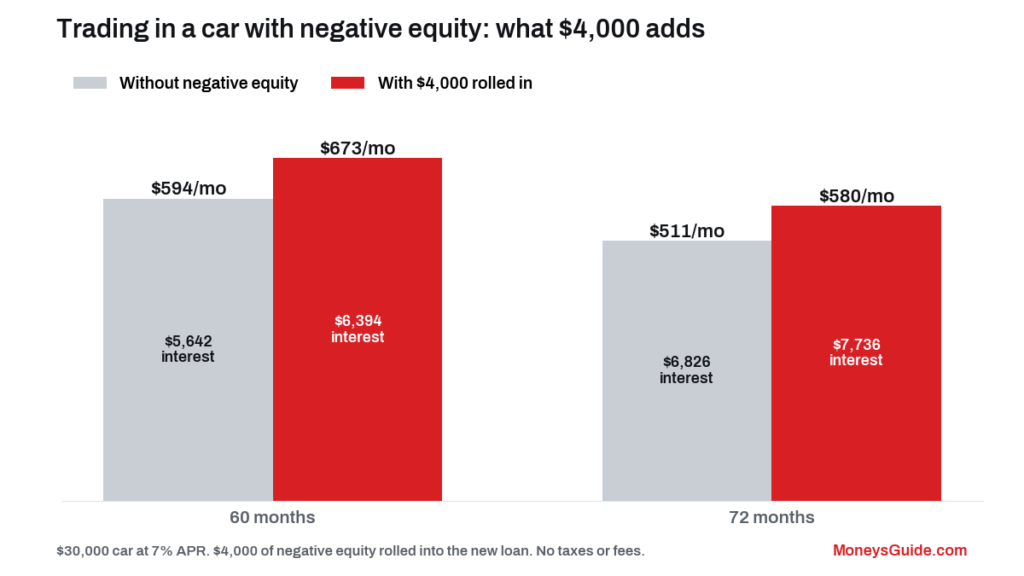
Over 60 months, that $4,000 of old debt costs about $4,752 in total once interest is included. And there’s a bigger risk: you start the new loan already owing more than the new car is worth, so the cycle can repeat next time you trade in.
Check your own numbers with our car loan calculator. It includes your trade-in value and the amount still owed, and shows how negative equity changes your payment.
How to find out if you have negative equity
- Get your loan payoff amount from your lender. This is slightly different from the balance on your statement.
- Check what your car is worth. Use online valuation tools, and get real offers from dealers or car-buying services.
- Subtract the payoff from the value. A negative number is your negative equity.
Do this before you visit a dealer, so you know your numbers when you negotiate.
Five better options than rolling it over
1. Wait and keep paying
Every payment reduces your balance, while your car’s value falls more slowly after the first few years. Waiting even 12 months can shrink the gap a lot.
Example: the same $18,000 loan at 8% with three years left (about $564 a month) drops to about $12,470 after a year. If the car is then worth around $11,900, your negative equity has shrunk from $4,000 to under $600. The value used here is an estimate, so check your own car’s value.
2. Pay down the gap first
Put extra money toward your current loan, or save up and pay the negative equity in cash when you trade in. You avoid paying interest on old debt for another five years.
3. Sell privately
Private sales often bring more than a dealer’s trade-in offer. If you sold the car for $15,500 instead of trading it in for $14,000, your negative equity would fall from $4,000 to $2,500. That alone saves about $30 a month on a 60-month loan at 7%. You’ll need to pay off the loan to transfer ownership, so ask your lender how it works.
4. Choose a cheaper car
If you must replace your car now, choosing a less expensive one keeps the total loan, including the negative equity, more manageable.
5. Refinance your current loan
If the issue is a high payment rather than needing a new car, refinancing your existing loan to a lower rate can make it more affordable while you build equity.
If you do roll it into a new loan
Sometimes rolling over negative equity is unavoidable, for example if the car is unreliable or no longer fits your needs. If so:
- Choose the shortest term you can afford. The longer the loan, the longer you’ll stay underwater. Avoid stretching to 72 or 84 months just to lower the payment. See 60 vs 72 month car loan.
- Make a down payment to offset some of the negative equity.
- Ask the dealer to show the negative equity as a separate line in the contract, so you know exactly what you’re financing.
- Consider gap insurance, which can cover the difference between what you owe and what the car is worth if it’s written off.
- Pay extra each month to get back to positive equity sooner. See how to pay off your car loan faster.
Warning signs at the dealership
- “We’ll pay off your trade no matter what you owe.” Ask how the negative equity will be handled.
- A loan amount higher than the car’s price that isn’t explained
- A very long term offered to make the payment “fit”
- Pressure to sign quickly before you’ve checked the numbers
Don’t sign until you understand the total amount financed, the term, the rate and how your old loan is being treated.
Common mistakes
- Not knowing your payoff amount or your car’s value before negotiating
- Focusing only on the monthly payment, while the loan quietly grows
- Rolling negative equity again and again with each new car
- Choosing a long term that keeps you underwater for years
- Skipping gap insurance when you owe much more than the car is worth
Trading in a car with negative equity is possible, but it’s rarely free. Knowing the real cost gives you the power to wait, negotiate or choose a better option.
Frequently asked questions
Can you trade in a car with negative equity?
Yes. The dealer pays off your old loan, and the shortfall is usually added to your new loan or paid by you upfront.
How much does rolling over negative equity cost?
It depends on the amount, rate and term. Rolling $4,000 into a 60-month loan at 7% adds about $79 a month and about $752 in interest.
Does negative equity affect my credit score?
Not directly. But borrowing more increases your debt, and missed payments on a larger loan would hurt your score.
How can I get out of negative equity on my car?
Keep paying, make extra payments, sell privately for a higher price, or save up to pay the gap. Waiting a year or two often helps the most.
Can I trade in a leased car with negative equity?
Often, yes, but the same principle applies: if the lease buyout is more than the car is worth, the difference is usually added to your next deal. Ask the dealer to show it clearly in the paperwork.
Is it ever a good idea to roll negative equity into a new loan?
It can make sense if your current car is unreliable or unaffordable to repair, but keep the new loan short, make a down payment if you can, and understand the full cost before signing. For more on loan costs, see the $30,000 car loan payment.
This article is for education only and is not financial advice. Figures assume fixed rates and no taxes or fees. Car values are estimates; check your own car’s value and loan payoff amount.