$50,000 Car Loan Payment: Monthly Cost by Rate and Term
$50,000 buys a well-equipped new car, a pickup truck or an entry-level luxury model. At this price, the loan is a major monthly commitment, and the term and rate you choose can change the total cost by more than $10,000. So what is the $50,000 car loan payment each month? This guide gives exact figures, corrects some wrong numbers you’ll find online, and shows how to keep the cost under control.
Quick summary
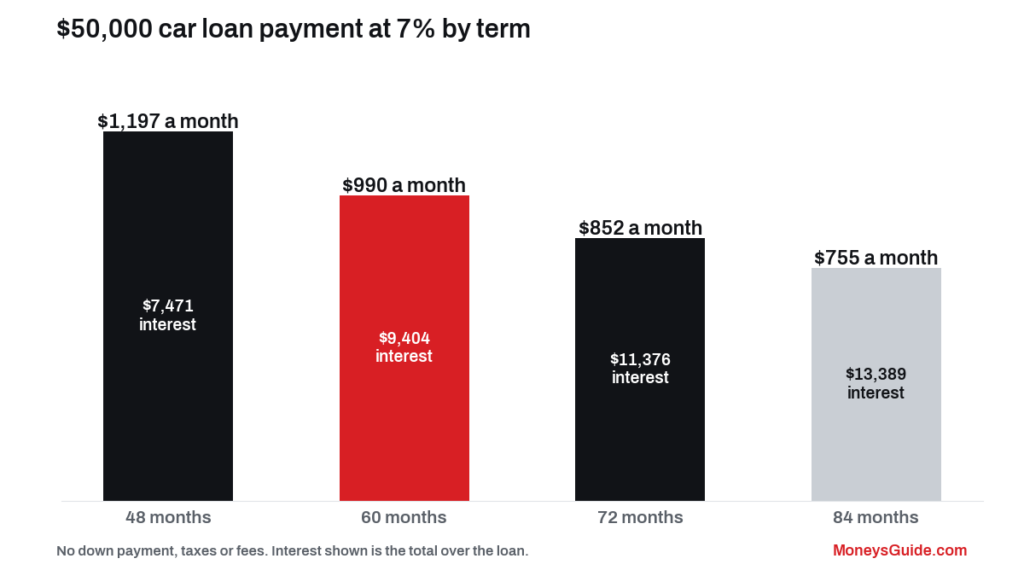
- At 7% over 60 months, the $50,000 car loan payment is about $990 a month, with about $9,404 in interest.
- Over 72 months at 7%, it’s about $852 a month, with about $11,376 in interest.
- At 12% over 84 months, interest reaches about $24,141, nearly half the loan.
- A 20% down payment ($10,000) brings the 60-month payment at 7% down to about $792.
$50,000 car loan payment by rate and term
Monthly payment on a $50,000 loan, with no down payment:
| Interest rate | 48 months | 60 months | 72 months | 84 months |
|---|---|---|---|---|
| 5% | about $1,151 | about $944 | about $805 | about $707 |
| 7% | about $1,197 | about $990 | about $852 | about $755 |
| 9% | about $1,244 | about $1,038 | about $901 | about $804 |
| 12% | about $1,317 | about $1,112 | about $978 | about $883 |
Total interest over the loan:
| Interest rate | 48 months | 60 months | 72 months | 84 months |
|---|---|---|---|---|
| 5% | about $5,270 | about $6,614 | about $7,978 | about $9,362 |
| 7% | about $7,471 | about $9,404 | about $11,376 | about $13,389 |
| 9% | about $9,724 | about $12,275 | about $14,892 | about $17,574 |
| 12% | about $13,201 | about $16,733 | about $20,381 | about $24,141 |
Include your down payment, trade-in, taxes and fees with our car loan calculator.
Watch out for wrong numbers online
Some websites divide the loan by the number of months, for example $50,000 ÷ 72 = $694, and call that the payment. That ignores interest completely. At 7% over 72 months, the real payment is about $852.
Car loans use the standard amortization formula:
Payment = P × r × (1 + r)^n ÷ ((1 + r)^n − 1)
where P is the amount borrowed, r the monthly rate (APR ÷ 12) and n the number of payments. Each payment covers that month’s interest first, and the rest reduces your balance. Our guide on how loan payments are calculated walks through it step by step.
How the term changes the cost
At 7%, going from 48 to 84 months lowers the payment by about $443 a month, but adds about $5,900 in interest and three more years of payments.
A $50,000 car also loses value over time, so a long loan increases the risk of owing more than the car is worth for several years. That’s a problem if you need to sell, trade in, or the car is written off. See trading in a car with negative equity.
What a down payment does
At 7% over 60 months:
| Down payment | Amount borrowed | Monthly payment | Total interest |
|---|---|---|---|
| $0 | $50,000 | about $990 | about $9,404 |
| $5,000 (10%) | $45,000 | about $891 | about $8,463 |
| $10,000 (20%) | $40,000 | about $792 | about $7,523 |
A 20% down payment cuts the payment by nearly $200 a month and saves about $1,900 in interest. It also protects you against early depreciation.
Paying extra on a $50,000 car loan
Extra payments go straight to the balance and cut interest. On a 60-month loan at 7%:
| Extra each month | Paid off in | Interest saved |
|---|---|---|
| $100 | about 54 months | about $1,046 |
| $250 | about 47 months | about $2,235 |
Make sure extra money goes to principal, and check your contract for prepayment penalties first. Even occasional lump sums, such as a tax refund, can take months off the loan.
Trucks, SUVs and luxury cars: what to check
At this price, you may be choosing between a pickup, a large SUV or a premium car. Before you commit:
- Compare total cost of ownership, including fuel, insurance, tyres and servicing, not just the payment.
- Check resale values. Some models hold their value much better than others, which affects your equity if you sell early.
- Consider certified pre-owned versions of the same model, which can cost thousands less.
- Think about how long you’ll keep it. The longer you keep the vehicle after the loan ends, the better value it becomes.
Can you afford a $50,000 car?
A common guideline is to keep all car costs, including the loan, insurance, fuel and maintenance, to around 10% to 20% of your take-home pay. At about $990 a month for the loan alone, plus insurance on a more expensive vehicle, total car costs can easily pass $1,300 a month.
A quick check: if total car costs of $1,300 a month were 15% of your take-home pay, you’d need about $8,700 a month after tax. If that feels like a stretch, a less expensive car, a larger down payment or a shorter loan on a cheaper model are all worth considering.
See how a car payment fits alongside your other costs with our budget planner.
Insurance and running costs are higher too
More expensive vehicles usually cost more to insure, and parts and servicing can cost more as well. If you’re financing, lenders typically require full coverage, and gap insurance may be worth considering if you put little down. Get insurance quotes before you buy, so the total monthly cost doesn’t surprise you.
How to pay less on a $50,000 car loan
- Choose the shortest term you can comfortably afford. 60 months instead of 72 at 7% saves about $1,970.
- Put 10% to 20% down, or more.
- Get pre-approved by a bank or credit union, so you can compare with dealer finance.
- Look out for promotional rates on new vehicles, and compare them with any cash discount offered instead.
- Negotiate the price first, then discuss financing.
- Pay extra when you can. See how to pay off your car loan faster.
The Consumer Financial Protection Bureau explains how auto loan amortization works, including why early payments are mostly interest.
Is a $50,000 car worth it?
There’s no single answer. A higher-priced vehicle can make sense if you need the space, towing capacity or reliability, and you’ll keep it for many years. But it’s worth comparing with a slightly older or lower-spec model. A $35,000 car at the same rate and term would cost about $297 less each month. See the $35,000 car loan payment and $40,000 car loan payment for comparison.
Common mistakes
- Choosing by monthly payment, instead of total cost
- Stretching to 84 months to afford a more expensive vehicle
- Ignoring insurance and running costs, which are higher on pricier cars
- Rolling negative equity from your old car into the new loan
- Financing extras without checking their real cost
Knowing the real $50,000 car loan payment, and how term, rate and down payment change it, helps you decide whether the car fits your budget, not just your wish list.
Frequently asked questions
What is the monthly payment on a $50,000 car loan?
About $990 a month at 7% over 60 months. At 5% it’s about $944, and at 12% about $1,112.
What is the payment on a $50,000 car loan over 72 months?
About $852 a month at 7%, or about $805 at 5%.
How much interest will I pay on a $50,000 car loan?
About $9,404 at 7% over 60 months, or $11,376 over 72 months.
How much should I put down on a $50,000 car?
Many people aim for 10% to 20%, or $5,000 to $10,000. With $10,000 down at 7% over 60 months, the payment falls to about $792.
How much income do I need for a $50,000 car?
Using a 10% to 20% guideline for all car costs, many people would need a take-home pay of several thousand dollars a month, often $7,000 or more, for a $50,000 car to fit comfortably.
Is it better to lease or finance a $50,000 car?
Leasing often lowers the monthly payment, but you don’t own the car at the end, and mileage limits may apply. Financing costs more each month but leaves you with the car once the loan is paid. If you keep cars for many years, financing is usually cheaper overall.
What is the payment on a $50,000 car loan over 84 months?
About $755 a month at 7%, but total interest rises to about $13,389. Long terms also increase the risk of owing more than the car is worth.
This article is for education only and is not financial advice. Figures assume fixed rates and no taxes or fees unless stated. Your rate and terms will depend on your lender and credit history.