How Are Loan Payments Calculated? (EMI Explained)
How are loan payments calculated? Whether it’s a car loan, personal loan or mortgage, your fixed monthly payment comes from one standard formula. Some countries call this payment an EMI (equated monthly instalment); most people simply call it their “monthly payment”. Understanding how it’s worked out helps you compare loans properly and avoid paying more interest than you need to.
Quick summary
- EMI is a fixed monthly payment that covers both interest and part of the loan.
- Early payments are mostly interest. Later payments are mostly loan repayment.
- A $50,000 loan at 8.5% over 5 years has an EMI of about $1,025.83 and costs about $11,550 in interest.
- A shorter term, a lower rate or extra payments all reduce your total cost.
How are loan payments calculated?
Your loan payment (EMI) is the equal amount you pay each month on an amortising loan. Each payment has two parts:
- Interest: the lender’s charge for that month, worked out on the balance you still owe
- Principal: the part that actually reduces your loan
The total stays the same every month, but the mix changes. As your balance falls, the interest part shrinks and the principal part grows.
The EMI formula
Lenders use the reducing-balance formula:
EMI = P × r × (1 + r)^n ÷ ((1 + r)^n − 1)
- P = the loan amount
- r = the monthly interest rate (annual rate ÷ 12 ÷ 100)
- n = the number of monthly payments
You don’t need to calculate it by hand. Our loan and EMI calculator does it instantly and shows the full repayment schedule.
A worked example
You borrow $50,000 at 8.5% a year for 5 years (60 payments).
- Monthly rate: 8.5 ÷ 12 ÷ 100 ≈ 0.0070833
- EMI: about $1,025.83
- Total repaid: about $61,550
- Total interest: about $11,550
In the first month, interest is $50,000 × 0.0070833 ≈ $354.17, so only $671.66 of your $1,025.83 payment reduces the loan.
By the last year, almost all of each payment goes to the loan itself.
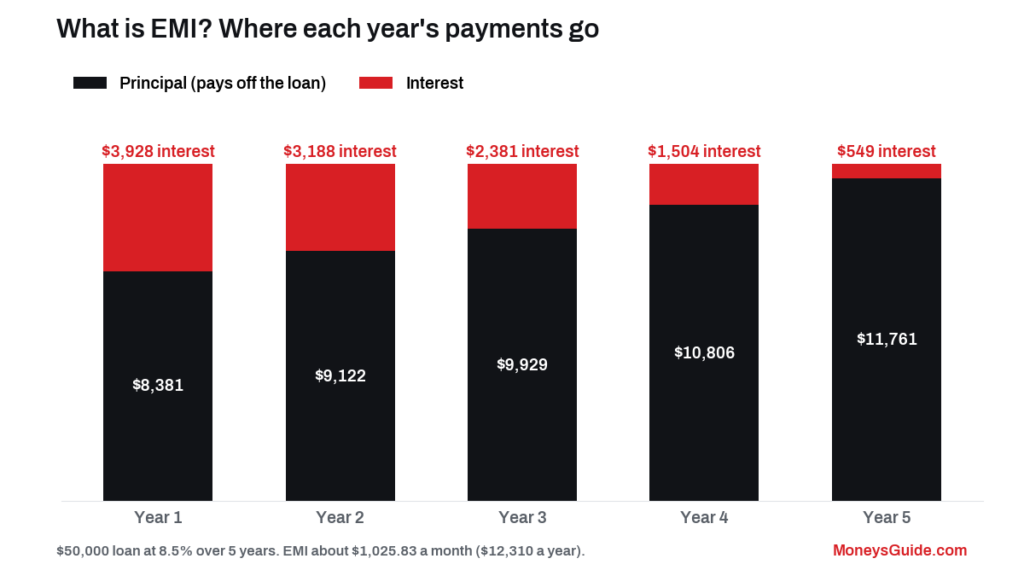
Year by year, the split looks like this:
| Year | Interest paid | Principal paid |
|---|---|---|
| 1 | about $3,928 | about $8,381 |
| 2 | about $3,188 | about $9,122 |
| 3 | about $2,381 | about $9,929 |
| 4 | about $1,504 | about $10,806 |
| 5 | about $549 | about $11,761 |
This pattern is called amortisation. The Consumer Financial Protection Bureau explains it simply: in an amortising loan, more of each early payment goes to interest, and the balance falls faster towards the end.
What changes your EMI?
Loan amount
A bigger loan means a bigger EMI. Borrowing only what you need is the simplest way to keep payments down.
Interest rate
On the same $50,000 over 5 years:
- At 7.5%: EMI about $1,001.90, total interest about $10,114
- At 8.5%: EMI about $1,025.83, total interest about $11,550
- At 9.5%: EMI about $1,050.09, total interest about $13,006
A 2% difference in rate costs almost $2,900 more over the loan.
Loan term
The term has the biggest effect:
- 3 years: EMI about $1,578.38, total interest about $6,822
- 5 years: EMI about $1,025.83, total interest about $11,550
- 7 years: EMI about $791.82, total interest about $16,513
A longer term makes each payment smaller but more than doubles the interest compared with 3 years.
Flat rate vs reducing rate: a costly difference
Some lenders quote a flat rate, where interest is charged on the original amount for the whole term, even as you repay it.
A $50,000 loan at an 8.5% flat rate over 5 years costs $21,250 in interest, with a monthly payment of $1,187.50. The same headline rate on a reducing basis costs about $11,550.
Same number, nearly double the interest. Always ask which method a lender uses, and compare the APR, which includes fees.
How to reduce the cost of your loan
- Choose the shortest term you can comfortably afford.
- Compare rates and APRs from several lenders.
- Make extra payments when you can. On the example loan, paying $200 extra a month clears it in 4 years and 1 month and saves about $2,332 in interest.
- Check for fees, including processing fees and early repayment charges.
- Avoid stretching the term just to fit a bigger loan into your budget.
Common EMI mistakes to avoid
- Looking only at the monthly payment. A lower EMI from a longer term often means far more interest.
- Confusing flat and reducing rates. Always confirm how interest is calculated.
- Ignoring fees. A low rate with high fees can cost more than a slightly higher rate with none.
- Borrowing at your limit. Leave room in your budget for rate changes and emergencies.
Knowing how loan payments are calculated helps you avoid all four.
Frequently asked questions
What is EMI in simple words?
EMI is the fixed amount you pay each month on a loan. It covers that month’s interest plus a part of the loan, so the debt is fully repaid by the end of the term.
Does EMI change during the loan?
On a fixed-rate loan, no. On a variable or floating-rate loan, the lender may change your EMI or your term when rates move.
Is it better to reduce EMI or tenure when prepaying?
Reducing the tenure usually saves more interest. Reducing the EMI gives you more monthly breathing room. Ask your lender which options they offer.
How much of my salary should go on EMIs?
A common guideline is to keep all debt payments, including housing, under about 36% of gross income. Lenders use their own affordability tests, which vary by lender and loan type. Staying well below any limit is safer.
This article is for education only and is not financial advice. Rates and examples are for illustration. Check the full terms, APR and fees with your lender before borrowing.