
$32 an Hour Is How Much a Year? (Cash vs Financing a Car)
At $32 an hour, a reliable car is well within reach. The bigger question is how to pay for it: take a loan now, or save and buy with cash. The difference can be thousands of dollars in interest, and it shapes your budget for years. So, $32 an hour is how much a year? At standard full-time hours, it’s $66,560 before tax. This guide breaks that down by pay period, then compares financing a car with saving for it in cash.
Quick summary
- $32 an hour at 40 hours a week for 52 weeks is $66,560 a year before tax.
- That’s about $5,547 a month, $2,560 every two weeks and $1,280 a week.
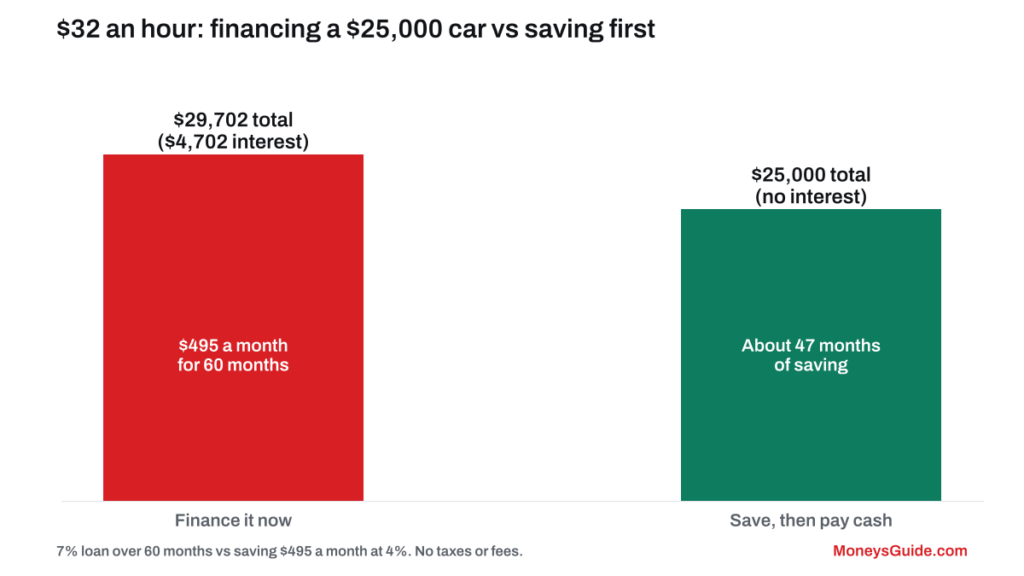
- Financing a $25,000 car at 7% over 60 months costs $495 a month and $4,702 in interest.
- Saving $495 a month at 4% instead would reach $25,000 in about 47 months, with no interest to pay.
$32 an hour is how much a year?
Yearly pay = hourly rate × hours per week × weeks per year
$32 × 40 × 52 = $66,560 a year, before tax and deductions.
| Pay period | Before tax |
|---|---|
| Hourly | $32.00 |
| Daily (8 hours) | $256.00 |
| Weekly | $1,280.00 |
| Every two weeks | $2,560.00 |
| Twice a month | $2,773.33 |
| Monthly | $5,546.67 |
| Yearly | $66,560.00 |
See every rate from $10 to $100 in our hourly to salary chart, or use our free salary converter.
Different schedules
| Schedule | Yearly pay |
|---|---|
| 20 hours a week | $33,280 |
| 30 hours a week | $49,920 |
| 40 hours a week | $66,560 |
| 40 hours + 5 hours overtime at 1.5× | $79,040 |
Take-home pay
These figures are gross pay. Take-home pay depends on the tax rules where you live and your deductions.
An example only: if about 23% went to tax and deductions, $66,560 would leave about $51,251 a year, or roughly $4,271 a month.
How much car can you afford on $32 an hour?
A common guideline keeps all car costs, including any loan, insurance, fuel and maintenance, to about 10% to 15% of take-home pay. On about $4,271, that’s roughly $427 to $641 a month. After $250 or so for insurance, fuel and maintenance, that leaves around $177 to $391 for a loan payment.
Cash vs financing: a worked example
Suppose you want a $25,000 car.
Option 1: Finance it now
At 7% over 60 months:
- Monthly payment: about $495
- Total interest: about $4,702
- Total paid: about $29,702
Option 2: Save first, then pay cash
Save the same $495 a month in a savings account paying 4%:
- Time to $25,000: about 47 months
- Interest paid: $0, and you earn a little interest instead
Saving $700 a month would get you there in about 34 months.
The catch
Saving takes time, and you still need transport while you save. That’s why many people combine the two:
- Keep your current car a little longer, or buy a cheaper car now.
- Save towards your next car every month.
- Buy with cash, or with a large down payment and a short loan.
Once you’ve done this once, keep “paying yourself” a car payment into savings, and you may never need a car loan again.
The true cost of owning a car
The purchase price is only part of the cost. On a $25,000 car, a typical year can also include:
| Cost | Example yearly amount |
|---|---|
| Insurance | $1,200 to $2,000 |
| Fuel | $1,200 to $2,400 |
| Maintenance and tyres | $600 to $1,200 |
| Registration, parking and tolls | $300 to $800 |
| Depreciation (value lost), early years | often several thousand dollars |
Depreciation doesn’t come out of your bank account each month, but it’s real: a new car can lose a large share of its value in the first few years. Buying a reliable car that’s a few years old lets someone else absorb that early drop.
When financing can make sense
Paying cash isn’t always possible or best. Financing can be reasonable if:
- you need a car now for work and don’t have enough saved
- you can get a low promotional rate, below what your savings earn
- you keep the loan short and make a solid down payment
The key is that the payment fits comfortably within the 10% to 15% guideline, and that you still have an emergency fund afterwards.
If you do finance
- Get pre-approved by a bank or credit union before visiting a dealer.
- Choose the shortest term you can comfortably afford. See 60 vs 72 month car loan.
- Put money down. See is $1,000 down on a car enough.
- Pay extra when you can. See how to pay off your car loan faster.
Compare real offers in our car loan calculator. The Consumer Financial Protection Bureau explains how auto loans work.
A sample monthly budget on $32 an hour
Using the example take-home pay of about $4,271:
| Category | Example monthly amount |
|---|---|
| Rent or mortgage and utilities | $1,550 |
| Food | $500 |
| Car costs (insurance, fuel, maintenance) | $250 |
| Car fund (saving to pay cash) | $495 |
| Phone and internet | $90 |
| Personal spending | $586 |
| Emergency fund | $200 |
| Saving and investing | $600 |
| Total | $4,271 |
Instead of a loan payment, the $495 car fund builds towards your next car. Our budget planner helps you build your own version.
How $32 an hour compares with nearby rates
| Hourly rate | Yearly pay | Monthly pay |
|---|---|---|
| $28 | $58,240 | about $4,853 |
| $30 | $62,400 | $5,200 |
| $32 | $66,560 | about $5,547 |
| $34 | $70,720 | about $5,893 |
| $35 | $72,800 | about $6,067 |
See $30 an hour and $34 an hour.
Is $32 an hour good pay?
For most single people in most areas, yes. At $66,560 a year, you can cover a comfortable lifestyle and still save. In expensive cities, or as the only income for a family, housing can make it tighter. Check whether your pay has kept up with prices using our salary vs inflation calculator.
Common mistakes
- Financing the most expensive car the lender approves
- Choosing a long loan term to lower the payment
- Forgetting insurance and running costs in the car budget
- Not saving for the next car once the current loan is paid off
- Using your emergency fund for a car purchase
So, $32 an hour is how much a year? $66,560 at full-time hours before tax, or about $5,547 a month. Save for your next car instead of borrowing for it, and you keep thousands of dollars that would otherwise go to interest.
Frequently asked questions
How much is $32 an hour a month?
About $5,547 a month before tax, at 40 hours a week for 52 weeks.
How much is $32 an hour every two weeks?
$2,560 before tax, at 40 hours a week.
How much is $32 an hour after tax?
It depends on where you live and your deductions. As an example, if about 23% went to tax and deductions, you’d take home about $51,251 a year, or $4,271 a month.
Is it better to pay cash for a car?
If you can do so without emptying your emergency fund, paying cash avoids interest entirely. Otherwise, a large down payment with a short loan is a good middle ground.
How much is $32 an hour a week?
$1,280 a week before tax, at 40 hours.
Should I buy a new or used car on $32 an hour?
A reliable used car that’s a few years old usually offers the best value, because the steepest drop in value has already happened.
Is $32 an hour the same as $66,000 a year?
Close. At 40 hours a week for 52 weeks, it’s exactly $66,560.
Should I pay off my car loan early?
If your loan rate is high and you have an emergency fund, extra payments save interest. Check for prepayment penalties first, and make sure extra money goes to principal.
How long does it take to save for a car on $32 an hour?
Saving $495 a month at 4%, about 47 months for $25,000. Saving $700 a month, about 34 months.
How much car can I afford on $32 an hour?
Using a 10% to 15% guideline for all car costs, about $427 to $641 a month on the example take-home pay, including insurance and fuel.
How much is $32 an hour with overtime?
With 5 hours of overtime a week at time-and-a-half, about $79,040 a year before tax.
This article is for education only and is not financial, tax or employment advice. Figures are gross pay unless stated. Car loan and take-home examples are illustrative.